


Men to the rescue: A modest proposal for women’s political relief

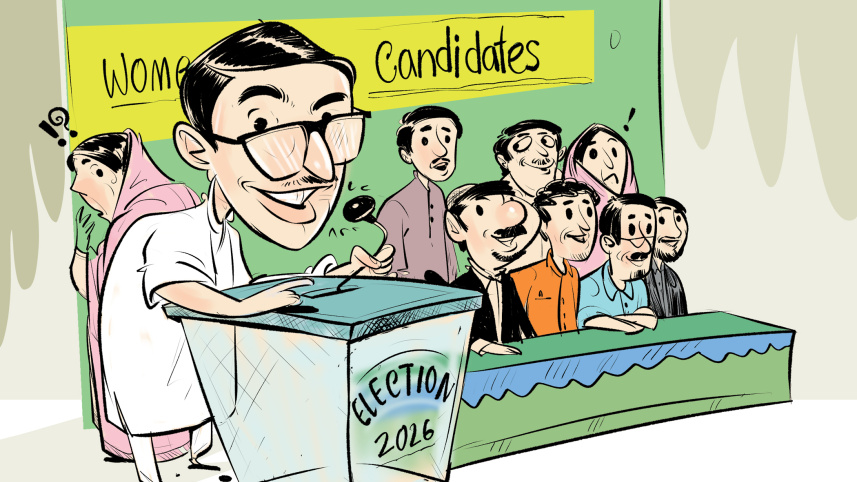
In a generous act of national service, men across the political spectrum have stepped forward to rescue women from the exhausting burden of political participation. Panels have been formed. Microphones secured. At last, women’s rights are being discussed safely, sensibly, and above all, without women.
This is a relief to everyone involved.

Women, after all, are busy. They have revolutions to survive, harassment to endure, families to manage, jobs to show up to (frequently at unequal pay), reputations to defend, and public humiliation to absorb with grace. Why add the chaos of elections to the list? Standing for office is stressful. It requires money, stamina, exposure, and the willingness to be misrepresented daily. Men, ever thoughtful, have decided to spare women this ordeal by simply doing politics on their behalf.
It is an elegant solution.
Out of 1,981 parliamentary candidates nationwide, about 76 are women, a figure so modest it can be presented without blushing, while 30 registered political parties have achieved the remarkable feat of submitting nomination lists without a single woman among them. This, you see, is what happens when concern is properly organised.
First and forevermore, applause must go to the National Consensus Commission, that shrine to male consensus-building, which gathered the nation’s finest defenders of the status quo to confront the truly destabilising prospect of women in politics. After much hand-wringing and heroic restraint, it delivered a proposal of breathtaking bravado: five percent female candidates. Five percent asked for almost nothing—and still proved too much. That most parties couldn’t even bring themselves to nominate a single woman was really just an honest admission that even symbolic inclusion requires effort. Tokenism, it turns out, is hard work.
Credit must also be given to the Election Commission, which looked on serenely as parties violated this laughably low bar agreed upon in the July Charter (accountability is such an aggressive word). And how can one forget the interim government, many of whose members built lifelong careers peddling women’s empowerment and now oversee its quiet disappearance with the steady professionalism of people who know exactly what they are doing?
If you think about it (and women, really, should not bother to do that), women are being protected from the indignity of candidacy itself. No need to tire themselves with fundraising, smear campaigns, threats, abuse, or character assassination. True, women are receiving most of this anyway—just without the inconvenience of a seat, or any authority. But let’s not get distracted by details.
Women already do most of the unpaid work that keeps the economy from collapsing in on itself. This includes care work, emotional labour, crisis management, ensuring food security, and the small matter of reproducing the labour force. None of this appears in GDP calculations, which is how we know it is essential.
In the fields, women are bent over rice seedlings at dawn and still working when the light fades, saving seed for the next season, feeding animals, processing harvests, and running households, as if these were not already several full-time jobs. Along the water, they dry fish, mend nets, process shrimp, manage ponds, and quietly keep the entire post-harvest economy afloat. Naturally, none of this qualifies them as farmers or fisherfolk. Recognition, after all, is reserved for people who own boats, land titles, or microphones loud enough to drown reality.
In garments, women earn the foreign exchange that props up national pride, exports, and press releases. In return, they are offered long hours, low wages, and inspirational speeches about resilience. Political representation would only spoil the symmetry.
Women are also, inconveniently, busy managing violence, which is a full-time occupation in itself. Not just the cinematic kind that earns headlines and hashtags, but the ordinary, bureaucratic sort: deciding which streets feel safe today, how much to say, when to shut up, which message to delete, which threat to ignore, which warning to take seriously. A constant, low-level calculation that stretches from home to office to street to screen. By the time all that is accounted for, the idea that women should also sit around pondering their political futures, drafting demands, or contesting power begins to feel wildly unrealistic. Luckily, men—freed from these minor inconveniences—have stepped in to do the thinking. It’s efficient. It keeps things moving. No one has to ask awkward questions about why women are always exhausted.
Politics is where we need men to handle the heavy intellectual lifting. Men can decide budgets while women stretch them. Men can design policies while women survive them. Men can debate land rights while women cultivate land they do not own. You get the gist. It is a beautiful division of labour.
Unencumbered by the unrealistic expectations of capitalist fascist patriarchy, men can, thankfully, continue their public service with the grace of people who never had to apologise for their existence. They gather in rooms designed to keep out women, reach consensus, issue statements, and nod gravely. They mansplain to women why now is not the time, why patience is strategic, and why they need to “trust the process.” They warn women not to fracture unity—meaning the unity of men who already agree.
This posture of benevolent supervision is perfected by Jamaat-e-Islami Bangladesh, which insists every chance it gets that it is deeply invested in women’s wellbeing. Jamaat does not exclude women from power; it protects them from it. Consider the generosity of promising to reduce women’s working hours to five a day, a touching gesture of concern that somehow never extends to equal pay, job security, or the question of who will make up the lost wages. Women, apparently, need rest—but not remuneration. Authority, meanwhile, remains far too strenuous to risk. This is the same party that speaks endlessly about women’s dignity while failing to nominate a single woman to parliament, and manages to organise all-male panels under the banner of its women’s wing, where men gather to discuss women’s lives so women don’t have to.
The farce continues with the National Citizen Party, which arrived bearing the promise of a “new arrangement,” only to reveal that the arrangement was new mainly in branding. Like Jamaat, the NCP is keenly concerned about women, particularly about when they should step aside for the greater good. The women who stayed with the party through its many contradictions over the past year, defending it and absorbing criticism on its behalf, were eventually unceremoniously discarded when alliances had to be secured and seats redistributed. This, too, was done for women’s own good. Surely, nothing spares women the burden of politics quite like being cut loose at the moment power is negotiated.
And then there is the Bangladesh Nationalist Party (BNP), now burnished into a symbol of liberal respectability and rhetorical commitment to women’s empowerment. When it came time to translate principle into practice, the party managed an impressive 3.5 percent of women candidates. Not nothing, you understand. Just very nearly. This was achieved, in part, by discarding figures like Rumin Farhana, who spent years defending the party with near-ornithological ferocity at a time when senior BNP leaders were so absent from public view that one could have searched for them with a microscope. Her reward was dismissal. Why? For the unforgivable offence of failing to heed the party line, apparently. And in a party that treats corruption and opportunism as survivable flaws, it was almost moving to see discipline enforced with such speed—once again, and unmistakably, on a woman.
It is all very caring, let me reassure you.
We should all really just heave a sigh of relief that women are being spared the chaos of elections, the mess of ambition, and the danger of visibility. They are being protected from power itself, which, frankly, can be bad for one’s skin. Instead, they can continue doing what they do best: holding everything together while being politely excluded from the decisions that affect them.
The men, generously, will take it from here.
 For all latest news, follow The Daily Star's Google News channel.
 At least until the next uprising, when women will once again be urgently required.
Sushmita S Preetha is an activist, writer, and outraged feminist.
Views expressed in this article are the author's own.
Follow The Daily Star Opinion on Facebook for the latest opinions, commentaries, and analyses by experts and professionals. To contribute your article or letter to The Daily Star Opinion, see our guidelines for submission.
Comments