Madrasas in Bengal: A legacy of learning and the challenge of change
Historically, Bengal has had a rich tradition of madrasas, as evidenced by numerous inscriptions across the region.They played a pivotal role in diffusing education and creating a class of ‘ulamā’ (scholars) who spread learning throughout the region together with the sufis (spiritual mentors). Madrasas were necessary for creating a large pool of educated professionals to fill various social, administrative, and official positions and ranks in both government and private sectors. Consequently, they had a long-term effect on the social, economic, and cultural growth of the region.
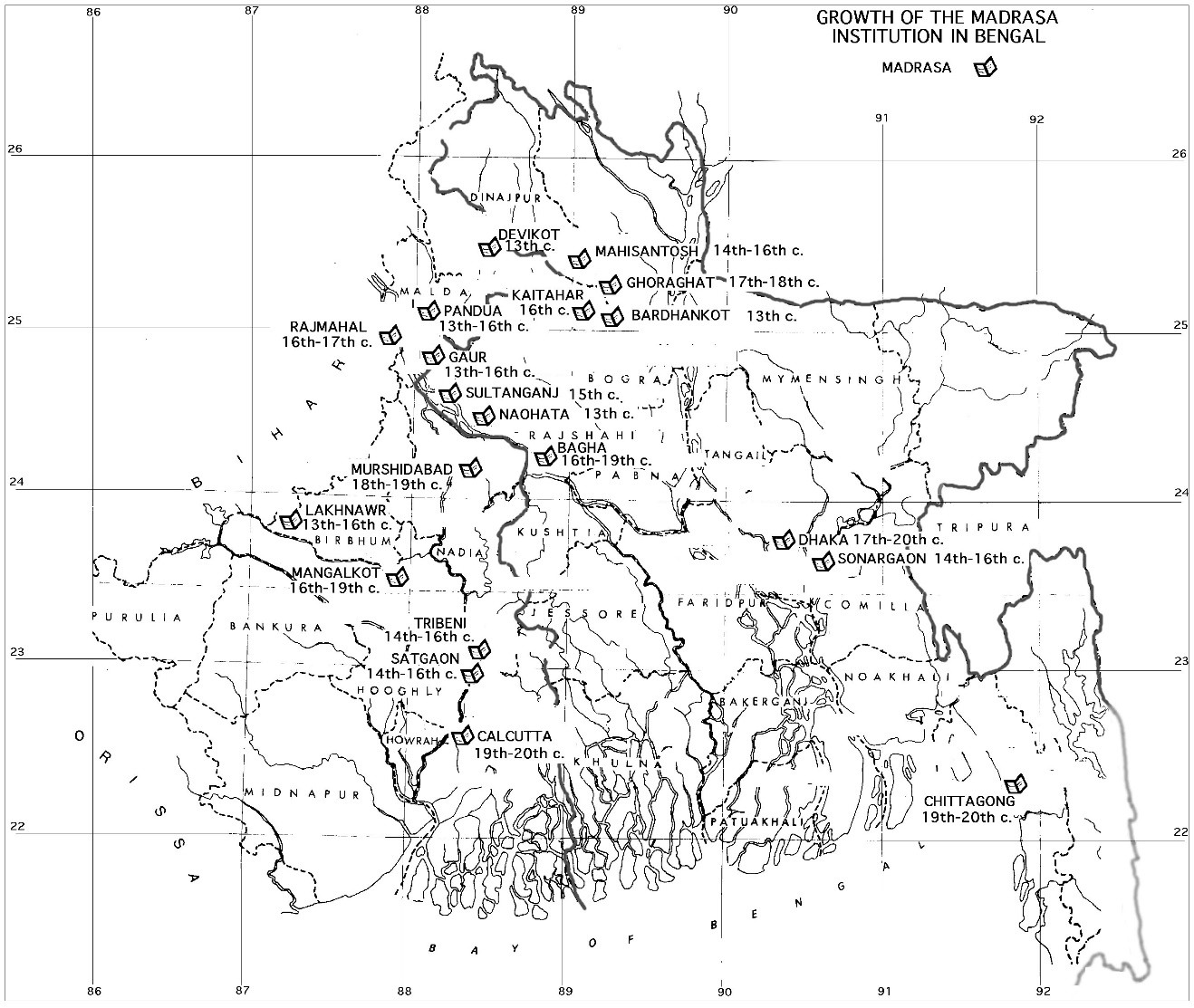
These institutions played the same role that modern educational institutions, such as universities and colleges, play in our contemporary period. The educated elite from madrasas assumed various roles and responsibilities in society. Thus, qādīs would act as teachers and imāms, while ‘ulamā’ would also be engaged in scientific investigation or in medical practice. Minhāj al-Dīn Sirāj provides us with some information about the establishment of madrasas in Bengal by the early Muslim rulers. Inscriptions offer information on the locations, dates of construction, names of patrons, and so on, and help us identify centres of learning. In some cases, this information sheds light on links between various institutions, the transmission of ideas, student-teacher connections, and intellectual genealogies.
There were many famous madrasas, madrasa-bāris, and dars-bāris (i.e., schools and colleges; dars means lesson, bāri in Bengali means house or building) throughout the country, where learning flourished. Congregational mosques often served as centres of higher learning, and masjids frequently functioned as maktabs, as they still do in many cases.
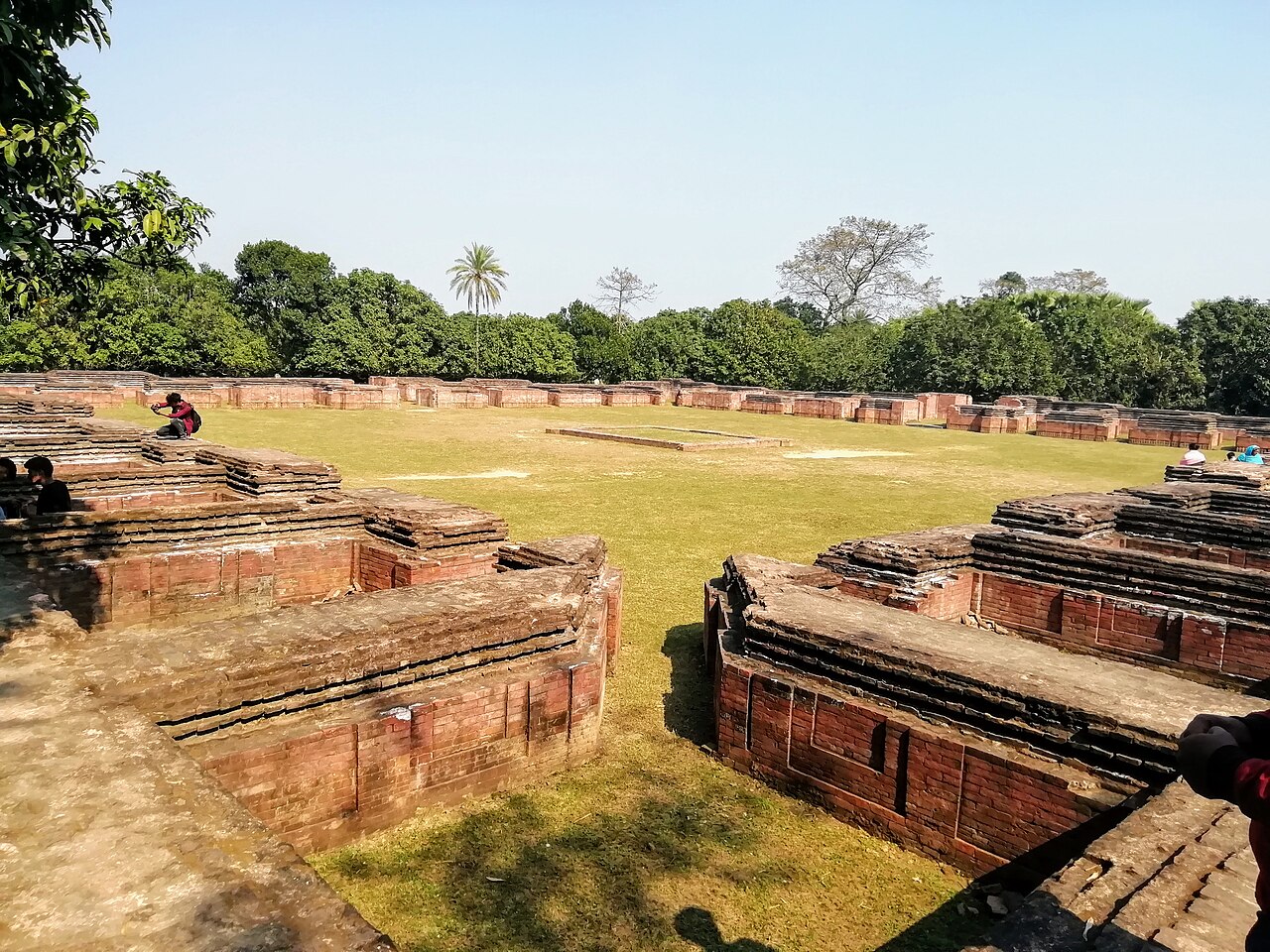
An early inscription from Naohata, from the reign of Balkā Khān (626–628 AH, 1229–1231 AD), records such a mosque that also served as an advanced academy in the region, where scholarly issues were debated and discussed. Epigraphic texts suggest that the capital, Gaur, evolved as one of the earliest intellectual and cultural centres in the north. It had numerous mosques (more than fifty mosque inscriptions have been discovered in the area), madrasas, and khanqahs as early as the thirteenth century. Another early capital of the north, Ḥadrat Pandua (similarly rich in inscriptions), also became a prosperous cultural centre, where many mosques and madrasas flourished.
In eastern Bengal, Sonārgā’on (near Dhaka) became a famous educational centre after the arrival of the renowned Ḥanbalī scholar Shaykh Sharaf al-Dīn Abū Tawwāma in the middle of the fourteenth century. Abu Tawwāma’s fame attracted many students to the Sonārgā’on madrasa from different corners of the Islamic world. Shaykh Sharaf al-Dīn Yahyā Manerī, who became a well-known sufi figure of the Subcontinent, also attended this madrasa. Tandah, Rajmahal, Murshidabad, and Jahangirnagar (today’s Dhaka) became noted centres of learning in the sixteenth and seventeenth centuries.
In northern Bengal, Ghoraghat, in the present district of Dinajpur, attracted many ‘ulamā’ and students during the Mughal period. In southwest Bengal, Tribeni and Chhoto Pandua (in the present district of Hooghly) had a number of madrasas (the earliest one, Dār al-Khayrāt, was established around 713AH/1313AD according to an inscription) during the Sultanate period. The town of Mangalkot (in the present district of Burdwan), not far from Tribeni, also earned fame as a great seat of learning, a reputation it maintained until the nineteenth century. In the southeast corner of Bengal, Chittagong evolved as the main educational centre, where the Madrasa Muḥsiniyyah in the nineteenth century and the Hathazari madrasa in the twentieth century played a crucial role in spreading Islamic education.
The cultural interactions of the Bengal Sultanate often surpassed the political and geographical boundaries of South Asia. Many ‘ulamā’ and sufis travelled from Central Asia, Asia Minor, and the Arab world and settled in Bengal. Some of the madrasas and khanqahs that they established attracted students from various parts of the old world. Sultan A‘ẓam Shāh had two madrasas built during 1410–11, one near the Umm al-Hānī gate (situated on al-Rukn al-Yamani or Yamani corner) of the Grand Mosque at Makkah, and the other near Bāb al-Salām (the Gate of Peace) of the Prophet’s mosque at Madinah. He also endowed a large property to support these two institutions, which were considered among the best seminaries in the region during that period.
Renowned scholars, such as Shaykh Taqī al-Dīn al-Fāsī (1374–1428), a pioneer in the field of epigraphy, taught the Maliki school of fiqh (jurisprudence) at the al-Madrasa al-Sultāniyyah al-Ghiyāthiyyah al-Bangāliyyah (named after its Bengali patron, al-Sultān Ghiyāth al-Dīn A‘ẓam Shāh) in Makkah. Construction of this madrasa began in the month of Ramadān in 1411 and was finally completed in 1412. A number of scholars from the family of Shībī (who became famous through their educational and scholarly activities in Makkah during the fifteenth century) taught at this madrasa.
A few prominent international scholars attached to this madrasa, as mentioned by al-Fāsī, were Qādī Jamāl al-Dīn Muhammad ibn ‘Abd Allāh al-Qarshī (d. 1414), Shihāb al-Dīn Abu ’l-Khayr Ahmad ibn Muhammad al-Sāghānī (d. 1422), Qādī Muhy al-Dīn ‘Abd al-Qādir al-Husaynī al-Fāsī (d. 1424), and Shaykh Abu ’l-Hasan ‘Alī ibn Ahmad al-Mārdīnī al-Haskafī (d. 1422). The syllabus of this madrasa covered the four famous schools of Islamic jurisprudence, which, in a way, indicates the liberal policy and religious tolerance that prevailed in Bengal.
Sultan Jalāl al-Dīn (r. 1414–33), the heir-apparent from the house of Ganesh, also sent generous endowments to Makkah and Madinah to establish two madrasas there, which came to be known as al-Madrasa al-Bangāliyyah over time, and set a precedent for the globalisation of the name “Bangala” in those days. Bengali students often travelled for their religious training to famous centres of learning in Jaunpur and Delhi, and sometimes as far away as Khurasan, Central Asia, and Arabia. The Dār al-‘Ulum in Deoband, Maẓāhir al-‘Ulum in Saharanpur, Madrasa Rahmāniya in Delhi, and Nadwat al-‘Ulamā’ in Lucknow attracted many students from Bengal during the colonial period and afterwards. Many of the ‘ulamā’ who graduated from madrasas in North India, and at times in Central and West Asia, returned to establish their own madrasas in Bengal, a tradition that still continues.
Most of these madrasas followed a model known as al-Madrasa al-Niẓāmiyya, which first appeared in Baghdad, Nishapur, and many other important cities in Khurasan under the patronage of Niẓām al-Mulk, the famous intellectual Abbasside vizier, in the eleventh century. Soon afterward, these institutions spread to the central and eastern parts of the Islamic world, from Anatolia in the West to Bengal in the East. In South Asia, the curriculum was known as Dars-i-Niẓāmi (after Mulla Niẓām al-Dīn of Aurangzeb’s time), in which special emphasis was given to the Hanafī fiqh. At times, these institutions contributed significantly to promoting al-‘ulum al-naqliyyah (namely, classical religious scholarship) as well as al-‘ulum al-‘aqliyyah (rational knowledge or sciences).
After the first war of independence in 1857, the vast majority of ‘ulamā’ focused their attention on theological education only, which they considered an alternative to armed struggle against colonial rule or jihād. They regarded this effort to equip the younger generation with educational empowerment as a form of lesser jihad (a struggle to establish justice), albeit a passive one, as it neglected the modern sciences and focused solely on classical religious scholarship.Undoubtedly, the changing political environment led these ‘ulamā’ to follow this passive path, as the participation of many of them in the jihad movement had made the colonial powers suspicious of their activities, and madrasa institutions came under special scrutiny.
Most of the pre-colonial madrasas during Muslim rule were supported by endowments until the East India Company passed orders in 1828 to acquire all awqāf (endowments) of madrasas, depriving these institutions completely of their main source of income. The final blow came during the time of Lord Harding, when he passed a law in 1844 forbidding graduates of Persian and Arabic (non-governmental Islamic) madrasas from being given employment in government. Even the official jobs of qādī (justice) with the government, previously exclusively reserved for madrasa graduates, were now offered only to those formally trained in British law. Still, the colonial power could not completely override local custom, law, and culture, since they needed to understand them to run their administration smoothly. To find a solution, they embarked on introducing a new curriculum and institutions which would accommodate both classical and modern education, effectively serving the needs of the British administration without abruptly upsetting the traditional values of local communities.
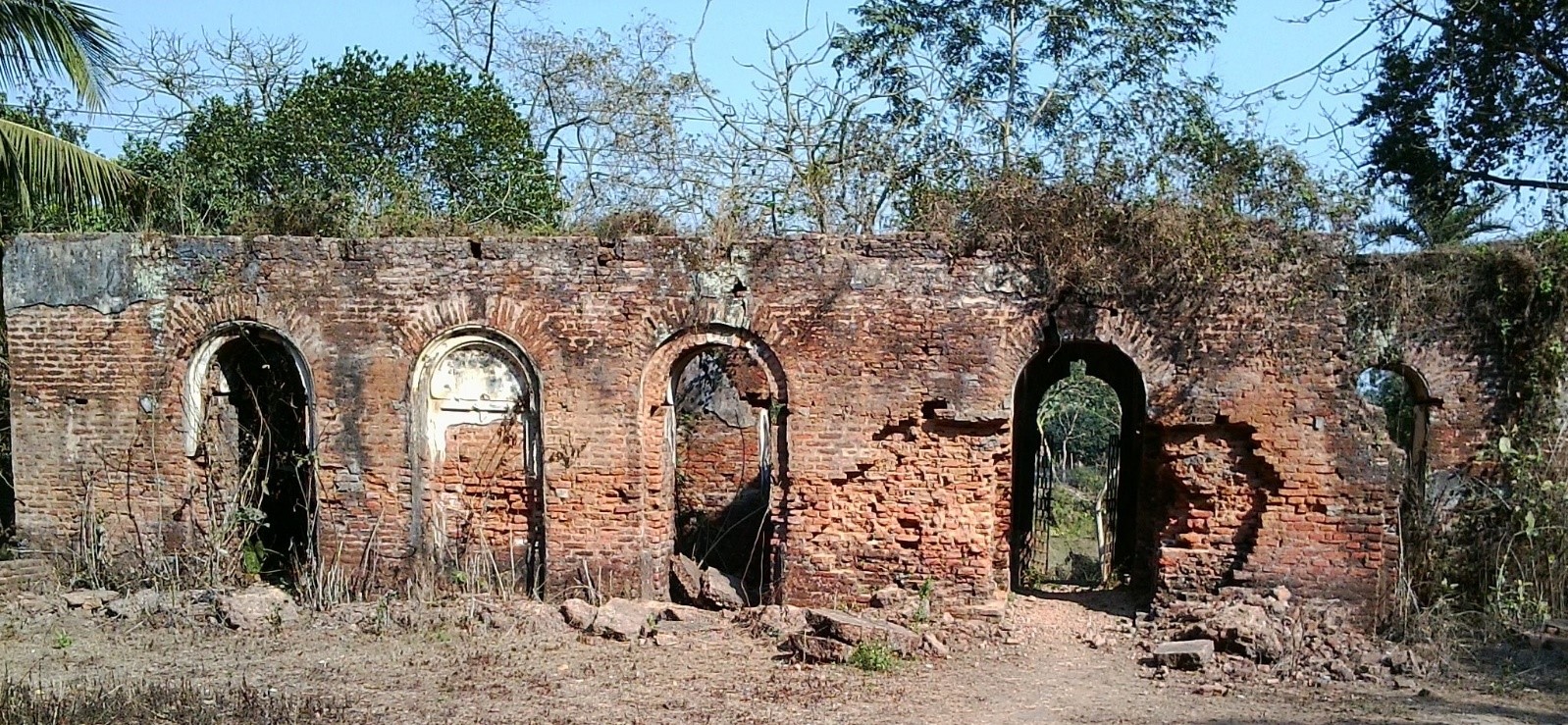
Thus, towards the end of the eighteenth century, a new curriculum was introduced under government patronage at Calcutta madrasa, which was established in 1781 during the time of Governor-General Warren Hastings (1773–84). With the passage of time, it became famous as Calcutta ‘Ālia madrasa, which is still in operation today (with a recent change in its name as ‘Ālia University). In this institution, secular subjects such as Bengali and English language and literature were added. Later, all government-sponsored madrasas which taught this new curriculum became known as ‘āliya madrasas (literally: higher institutes). Though they were not popular initially with the mainstream rural Muslim population, as they received support from the British raj, slowly and gradually, ‘āliya madrasas spread throughout Bengal. Since independence, ‘āliya madrasas have spread further in the region; thousands of students graduate from ‘āliya madrasas every year.
At the end, one has to accept the fact that the institution of the madrasa, which once contributed greatly to the growth of intellectual and scientific advancement in the old world for nearly a millennium or so, adopted a closed-door policy during the past few centuries, reducing its sphere of academic interest to the study of some outdated classical Islamic scholarship, which is completely irrelevant to the needs of the day.
One classical example of blind adherence to the outdated tradition (تقليد) is the peculiar use of the Arabic phrase (السلطان ظل الله في الأرض فمن أهانه فقد أهان الله), which translates as ‘Sultan is the shadow of Allah on the earth, and to disgrace him amounts to disgracing Allah’. It is used in Friday congregational sermons (khutba al-Jum‘a خطبة الجمعة) in many parts of South Asia (and the neighbouring regions). This Arabic metaphor, which never existed during the time of the Prophet (PBUH) or in the successive period, must have been skillfully and ingeniously introduced by the ruling class to legitimise their rule inherited through kingship.
Its strange continuance, even after the lapse of sultanate rule long ago, followed by a long interval of European colonial rule for nearly two centuries, is an eye-opening example of the irrational blind adherence of some traditional societies to certain fixed ritualistic texts, even if they do not make any sense. The use of this Arabic phrase, though not prescribed by the Prophet (PBUH), indicates the illogical attachment of conservatives as well as dogmatists to a set of fixed sacred texts without scrutinising their relevance to time and space. Obviously, this is one of the detrimental factors to the future growth and development of any society, spiritually, religiously, and intellectually.
The time has come to adapt the madrasa curriculum to the challenges of our modern time, embracing the modern advances in logic (منطق), philosophy (فلسفة), scholarly reasoning (اجتهاد), and other fields, as was tradition in the past. Even the theological study in the madrasa can be developed in line with the scientific study of religion followed in many advanced institutions in the developed world. It is high time that madrasa education should gradually move out from the narrow dogmatic approach based on certain stereotyped sectarian views of religion and move towards a more creative and innovative approach in the field of Islamic Studies.
Prof. Dr Mohammad Yusuf Siddiq is a former Harvard Senior Fellow, Visiting Professor at the International Centre for the Study of Bengal Art, and President of BANI. He can be reached at siddiq.mohammad@gmail.com.
Send your articles for Slow Reads to slowreads@thedailystar.net. Check out our submission guidelines for details.
Dhaka accidentally built the city planners now want. Can we make it liveable?
Can Bangladesh produce its own knowledge?

How we are killing Dhaka

Can Bangladesh afford not to invest in Bhola’s gas?

Bangladesh’s renewable policy: Still too little but not too late
Prabhat Patnaik speaks / Why the Global South must rethink export-led growth

Bhotekoshi flood: Another warning from the Himalayas. Are we listening?
Renewing the Ganges Water Sharing Treaty: What should Bangladesh do?

What it really costs to live in Dhaka