


Why survivors still struggle to be heard

Suppose you learn about a case of sexual harassment at your workplace or educational institution.
- Do you know where and how to file a complaint?
- Are you aware of the laws and rights that protect employees, learners or co-workers from sexual misconduct?
- Is there a designated person or mechanism in your organisation responsible for addressing sexual harassment?
- Have you ever seen a case of sexual harassment formally reported and acted upon?
If your answer to any of these questions is ‘no’, this article is for you. Even if your answers are ‘yes’, it is still worth asking whether existing systems function in practice and are aligned with national law and international standards.
 For all latest news, follow The Daily Star's Google News channel.
 Over the past two decades, cases of sexual harassment have repeatedly surfaced in court proceedings, media investigations, institutional inquiries and public debate. Yet each episode tends to follow a familiar pattern: intense public attention followed by gradual silence, with limited institutional accountability or systemic reform. Yet the recurrence of similar incidents across sectors suggests that the underlying problem remains unresolved.
The data dilemma and fragmented evidence
One major obstacle to addressing sexual harassment in Bangladesh is the absence of reliable and consolidated data. There is no central database tracking workplace or educational institution harassment, and law enforcement and labour authorities do not routinely publish sector-specific statistics.
Most available evidence comes from broader violence-against-women or gender-based violence surveys, which mainly focus on domestic or intimate-partner violence. While these studies provide valuable context, they rarely isolate workplace, campus, or professional setting harassment as a distinct category.
Women working in private-sector offices have reported harassment by colleagues or supervisors. In tightly connected professional circles, many employees hesitate to report sexual misconduct, concerned that speaking out could damage their career prospects or professional reputation.
A limited number of sector-specific studies—covering universities, predominant industries and healthcare institutions—have documented harassment in particular environments. However, these studies remain narrow in scope and geographic coverage. As a result, Bangladesh still lacks a comprehensive national assessment measuring the prevalence and patterns of sexual harassment across sectors.
Harassment across workplaces and educational institutions
Women labour force: The ready-made garment (RMG) sector—the backbone of Bangladesh’s export economy—employs around 4 million workers, many of them women. A study reported that 79.3% female and 82% of garment workers had experienced or witnessed sexual violence and harassment at work.
Another study in 2025 found that within six months of the study period, 22% of workers reported frequent factory sexual harassment, primarily by co-workers (37%) and supervisors (33%).
Studies indicate nearly 52% of female tea workers have experienced some form of harassment or torture.
Young, unmarried women experienced nearly double the harassment rates of married or older female workers.
Rigid management hierarchies and intense production pressures often discourage complaints. Many workers fear that reporting harassment could jeopardise their employment.
Media houses and the entertainment industry: Female journalists have described harassment both inside newsrooms and during field reporting. Investigative reporting by various media outlets has documented cases where women journalists experienced harassment from colleagues, interview subjects and sources while carrying out professional duties.
Performers in Bangladesh’s entertainment sector have also raised concerns about harassment during casting and production processes. The “casting couch” has emerged as a widely discussed issue in social media videos shared by many female performers, underscoring how such practices are normalised yet rarely addressed formally. These accounts highlight the risks created by informal employment arrangements and unequal power dynamics in the industry.
Health facilities: A cross-sectional study of nurses in Bangladesh found that around 70% of respondents had experienced workplace violence in the previous year, underscoring the vulnerability created by steep hierarchies and high-pressure institutional environments. While this is broader than sexual harassment alone, it points to conditions in which abuse and intimidation can thrive.
Hospitals and medical colleges operate within steep professional hierarchies. Junior doctors, nurses and medical trainees often work under the authority of senior physicians who influence training opportunities, evaluations and career progression. Such power imbalances can create conditions in which harassment goes unchallenged.
Some trainees report that long working hours, academic pressure and dependence on supervisors for career advancement discourage formal reporting of misconduct.
Educational institutions and children in the workplace: Students in institutions and children in workplaces in Bangladesh are facing recurring allegations of sexual harassment and abuse, raising serious concerns about student safety and institutional accountability.
Cases involving teachers accused of sexually harassing students periodically appear in national media, highlighting the need for stronger child-safeguarding frameworks and accessible reporting mechanisms.
Reports have also emerged from madrasa institutions across different districts, highlighting gaps in oversight and complaint systems within parts of the religious education sector. Available reporting suggests that boys are especially vulnerable in some of these settings, though the issue remains underreported and lacks robust national data.
A 2013 UN Women situational analysis covering eight universities in Bangladesh found that about 76% of female students reported experiencing sexual harassment in educational environments.
At the tertiary education level, complaints range from inappropriate comments and intimidation to pressure for sexual favours by teachers or peers. Yet many victims still avoid formal reporting due to fear of retaliation, reputational damage or institutional reluctance to act against influential faculty members.
Bangladesh Bureau of Statistics found that 82.9% children face abuse or harassment by pedestrians, and 49.8% cent were subjected to violence at the place of work.
Social welfare institutions: Children living in orphanages and other residential care institutions remain particularly vulnerable to sexual harassment and abuse because they depend entirely on caregivers and institutional authorities for protection and daily support.
Broader child protection data illustrates the scale of vulnerability. UNICEF estimates that around nine out of ten children aged 1–14 in Bangladesh experience violent discipline each month, affecting more than 45 million children. While violent discipline is not the same as sexual abuse, it reflects a broader culture of acceptance of violence and weak child protection that can enable abuse in settings meant to provide care.
Political party: Political environments can complicate responses to allegations of harassment. Many cases have surfaced in which complainants reported harassment within political organisations. In at least one instance, the complainant reportedly received no redress after filing a formal complaint with the senior leaders and was instead compelled to resign from the organisation.
In 2026, women participating in election campaigns have also reported harassment during political mobilisation activities. Media reports suggest that most political parties lack formal protection policies or complaint mechanisms for campaign workers.
Sporting arena: Sport is often portrayed as a realm of discipline, merit and national pride. Yet it is also shaped by sharp power imbalances between administrators and athletes, coaches and players, selectors and aspiring professionals. The recent case involving cricketer Jahanara Alam is a living example of prolonged institutional inaction. Her complaint was lodged in 2022, but the Bangladesh Cricket Board acted only in February 2026, following the High Court’s intervention.
Allegations of sexual harassment and abuse of authority have surfaced in several sports, including cricket, football, shooting and tennis.
Women athletes often face difficult choices when reporting misconduct, as speaking out may jeopardise their careers. These cases highlight broader structural weaknesses in safeguarding and accountability systems within sports institutions.
In several cases, responses from sports federations were delayed or contested, sometimes requiring judicial or administrative intervention. Taken together, these incidents point to a broader structural failure to meet safeguarding and accountability obligations that institutions are already expected to uphold.
Government offices: Sexual harassment in Bangladesh government offices, including law enforcement and military institutions, has been documented in various reports, encompassing physical abuse, sexual assault, and harassment during investigations.
Reports suggest that security forces (including police and paramilitary units like RAB) have been accused of engaging in violence, including sexual assault, and using torture to gather information or intimidate individuals, particularly in sensitive areas.
Cost of sexual harassment in the workplace
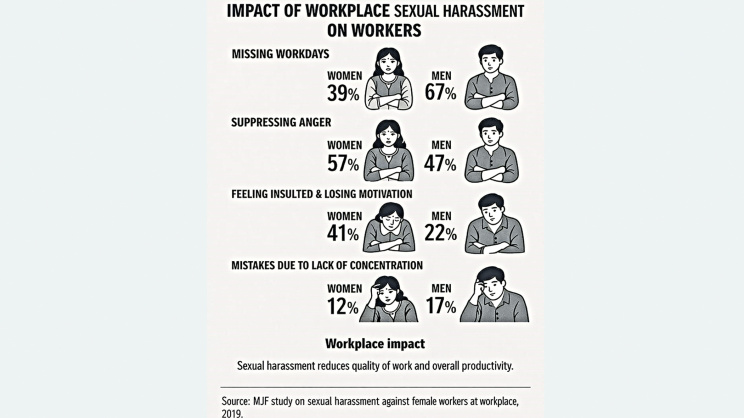
A study on RMG found that sexual harassment leads to absenteeism, emotional distress, reduced motivation, and errors at work. It also lowers productivity and the overall quality of work. Nonetheless, it is often seen as a personal ordeal, but its financial consequences can also be profound.
A study titled Paying Today and Tomorrow: Charting the Financial Costs of Workplace Sexual Harassment estimates that survivors pushed out of well-paid professions may lose up to $1.3 million in lifetime earnings due to job loss, stalled careers and lost benefits.
Organisations also face high costs. Research on the business impact of harassment shows that investigations, legal proceedings, reputational damage, productivity losses and declining staff morale can impose substantial financial burdens.
In international research, local authorities spent around £1.7 million paying the salaries of employees suspended during harassment investigations. Such examples illustrate how institutional failures to prevent or address harassment can generate significant financial liabilities.
Evolving laws, lack of protection and implementation
Bangladesh’s legal response to sexual harassment has evolved gradually, though enforcement gaps remain.
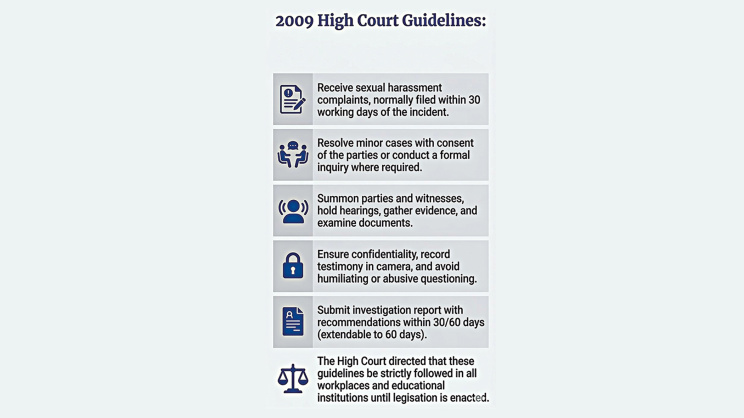
The turning point came in 2009, when the High Court delivered its landmark judgment in Bangladesh National Women Lawyers’ Association (BNWLA) v Government of Bangladesh. The Court recognised sexual harassment as a violation of constitutional rights to equality and dignity. It issued binding guidelines requiring all public and private institutions to establish complaint committees, ensure confidentiality and investigate allegations within defined timelines.
The Court declared that these directives would remain enforceable until Parliament enacted specific legislation.
Before recent reforms, responses to workplace harassment relied on several overlapping laws. The Bangladesh Labour Act 2006 addresses workplace misconduct but does not clearly define sexual harassment. The Bangladesh Labour Rules 2015 require grievance procedures in workplaces, though they do not by themselves create a comprehensive sexual harassment regime.
Criminal provisions such as the Women and Children Repression Prevention Act 2000 and sections of the Penal Code may apply in cases involving sexual abuse or assault. Still, these laws were not designed specifically for workplace harassment.
Public-sector employees are governed by the Government Servants (Discipline and Appeal) Rules 2018, under which harassment may be treated as misconduct or abuse of authority.
A new legal framework has recently emerged. On 9 January 2026, the interim government gave final approval to the draft Prevention of Sexual Harassment at the Workplace and Educational Institutions Ordinance, 2026. The draft codifies the 2009 High Court guidelines, provides clearer definitions, including digital harassment, and mandates institutional complaint mechanisms. It is expected that the Parliament will pass the law soon.
The Bangladesh Parliament unanimously passed the Bangladesh Labour (Amendment) Bill, 2026, on April 9, 2026. A major pillar of the amendment is its alignment with ILO Convention No. 190, which introduces strict legal prohibitions against forced labour, violence, and sexual harassment. Notably, sexual harassment has been clearly defined for the first time, and all institutions are now required to form dedicated complaint committees with a prioritised focus on female representation.
International commitments and norms
International obligations also shape Bangladesh’s legal approach. The country has ratified the Convention on the Elimination of All Forms of Discrimination Against Women (CEDAW), which obliges states to ensure women’s right to work free from discrimination and violence.
In the BNWLA judgment, the High Court relied on CEDAW. It is related to UN guidance, noting that gender-based harassment undermines equality in employment and must be addressed as a form of discrimination.
Bangladesh has also ratified the ILO Convention on Violence and Harassment at Work (ILO Convention 190) in 2025, committing the country to adopt stronger prevention policies, complaint mechanisms and enforcement systems.
UN agencies and NGOs operating in Bangladesh are required to adhere to Protection from Sexual Exploitation and Abuse (PSEA) standards, grounded in the UN’s zero-tolerance policy and reaffirmed in United Nations General Assembly Resolution 73/302 (2019). These mechanisms are embedded across both humanitarian and development programming through inter-agency coordination and compliance frameworks. However, integration within government-led systems remains uneven, highlighting persistent gaps in institutionalisation and accountability.
Accountability and enforcement: beyond law to practice
Despite legal progress, enforcement remains uneven. Complaint committees are often absent or exist only on paper, lacking independence and authority. In practice, many fail to function, leaving survivors without effective recourse.
Strengthening accountability requires more than laws—it demands institutional capacity and oversight. Police, labour inspectors and judicial authorities need targeted training, clear procedures, and consistent application of standards.
Accessible reporting systems are essential. Workplaces and educational institutions should offer multiple safe channels—independent committees, helplines and digital platforms—backed by strong protections against retaliation.
Digital systems, if designed responsibly, can play a transformative role. Secure online reporting platforms can lower barriers to disclosure, allow anonymous or confidential submissions, and enable timely tracking of cases. However, their effectiveness depends on safeguards for data privacy, protection against misuse, and clear links to offline response mechanisms so that complaints lead to real action rather than remaining within digital interfaces.
For children, this must include a child-sensitive approach for schools, madrasas, residential care, and sports. Reporting should be simple and safe, with clear pathways to trusted adults and caregivers, ensuring complaints can be made without fear or procedural burden.
Trade unions, universities, professional bodies and civil society also have a role in reinforcing standards and encouraging reporting, helping shift harassment from a private issue to a matter of rights.
Turning the legal regime into real protection
Bangladesh has made important progress in recognising sexual harassment as a legal and social issue. The 2009 High Court ruling laid the foundation for institutional safeguards, and the 2026 draft law represents a step towards a dedicated framework. Parliament must now enact and implement it without delay.
Yet laws and guidelines alone are not enough. The real test lies in whether institutions enforce mechanisms, protect complainants, and ensure impartial investigations as part of organisational culture.
Safe and respectful workplaces are not only a matter of rights and dignity—they are essential for economic progress, social stability and international credibility. The responsibility now lies with the government, employers and educational institutions to turn legal commitments into real protection.
Badrul Hassan is a development and humanitarian professional. He can be reached at badrulsocial@gmail.com
Comments