The Islamabad paradox: What middle powers can learn from Pakistan

When analysing the commentary around the US-Iran-Israel war, what has mostly been ignored is: why is it Pakistan that has emerged as the key mediator in the most consequential war that’s impacted the world? And what does the answer tell us about how diplomacy actually works now? At the time of writing, Iran’s Foreign Ministry Spokesperson Esmaeil Baqaei has said that the Foreign Minister will travel to Pakistan, while an Iranian state media report that Islamabad can act as a “bridge” to “convey Iran’s consideration for ending the conflict.”
Classical realism holds that mediators draw their leverage from material power: economic weight, military credibility, or the authority of an institution that both sides respect. Liberal institutionalism adds a legitimacy condition: the mediator should be embedded in the rules-based framework. Pakistan fails both tests. It has no economic leverage over Washington or Tehran. It is not neutral in any meaningful sense. Its Shia population watched their government host the negotiations that followed the assassination of a globally significant Shia leader, and protests turned violent in Karachi and Gilgit-Baltistan as a result. Pakistan had to deploy its army to suppress demonstrators while simultaneously brokering a ceasefire.
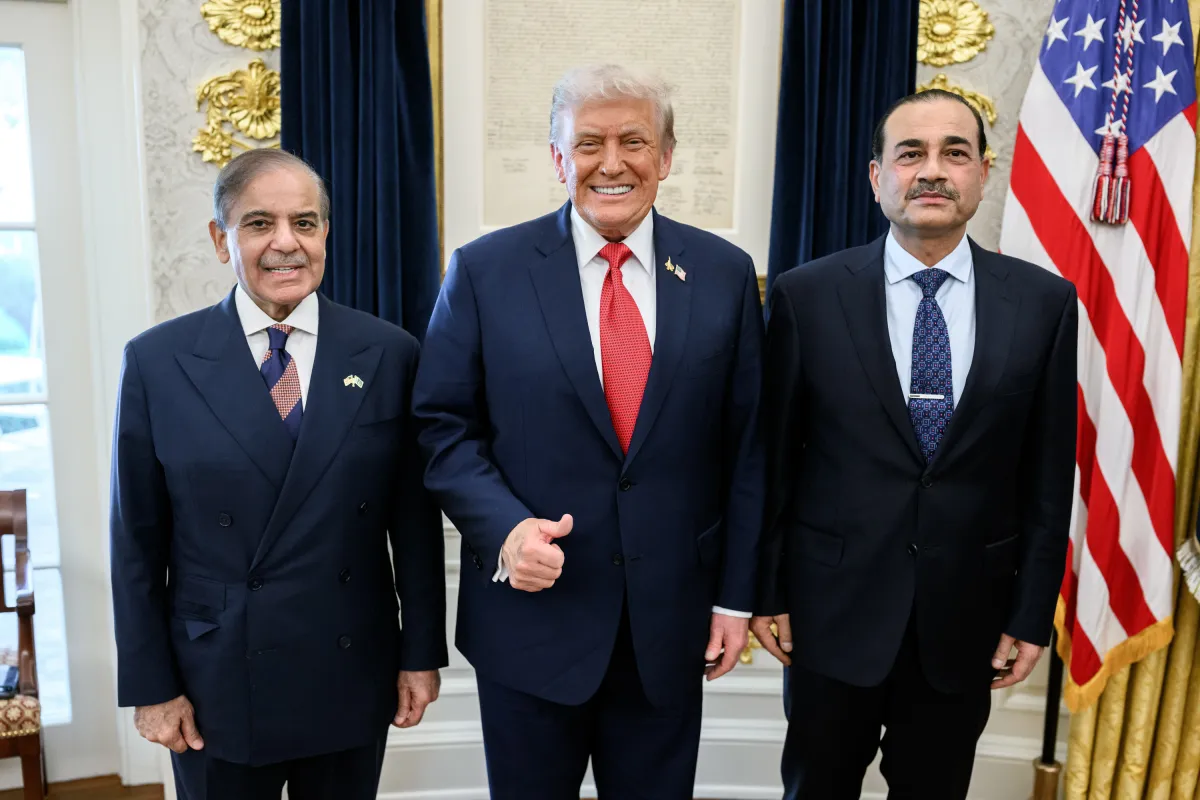
Tehran would only do talks in Pakistan and nowhere else, because they trust Pakistan. That sentence deserves more attention than it has received. It is a statement about Pakistan’s position in a web of relationships that no genuinely neutral state could occupy. Pakistan’s value is not neutrality. It is the fact that it is compromised in all directions simultaneously, which turns out to be exactly what both Iran and the US needed. Islamabad holds Iran’s interests’ section in Washington, a residual arrangement from 1979 that has never been replaced. Army Chief Asim Munir has cultivated a working relationship with Trump. He was the first non-head-of-state military leader invited for a White House lunch by a sitting US president. Pakistan shares a long border with Iran. It is bound to Saudi Arabia through a mutual defence agreement and tied to China through CPEC. It is pulled simultaneously by actors who are pulling in opposite directions. What reads as weakness in conventional power terms reads as credibility when both sides need someone the other cannot veto.
The Islamabad process is not just a story about Pakistan. It is an indication that the middle-power agency in the current international system has migrated toward states that Western theories of international relations consistently wrote off as too fragile, too messy, or too compromised to matter.
Italian philosopher Antonio Gramsci’s argument about hegemony was not simply that powerful states impose their will, but that they get other actors to internalise the rules of the game as natural and inevitable. US conflict management for three decades ran on this logic. Washington led negotiations directly, or worked through institutions it largely shaped. The unstated assumption was that legitimate mediation happened in Western capitals or Western-designed multilateral spaces. The Islamabad talks broke that assumption. The first direct, high-level engagement between the United States and post-revolutionary Iran happened not in Geneva or New York but in a city that was triggered by the same war. It is a sign of how the old Gramscian geography of diplomacy has shifted.
American political scientist Alexander Wendt’s constructivism helps explain the Iranian side of this calculation. For Wendt, the structure of international relations is partly constituted by shared identities and meanings, not just material facts. Iran’s insistence on Pakistan as the venue is partly an identity claim. It refuses to negotiate where Washington can frame as its own. Pakistan sits outside the Western security architecture without being anti-Western. It is Muslim-majority without being Arab. For Iran, talking in Islamabad is a way of making the talks themselves look different from a surrender. For the US, it is a way of talking to Iran at all. Pakistan is the grammar that makes the sentence possible.
The Islamabad process is not just a story about Pakistan. It is an indication that the middle-power agency in the current international system has migrated toward states that Western theories of international relations consistently wrote off as too fragile, too messy, or too compromised to matter. Bangladesh navigates its own version of structural overdetermination: between India and China, between the requirements of the garment sector’s Western buyers and the infrastructure financing on offer from Beijing, between Islamic solidarity as a political idiom and secular developmentalism as a governing project. The lesson from Islamabad is not that Pakistan has found some diplomatic secret. It is that the old assumption, that strategic clarity means picking a side and sticking to it, is increasingly obsolete.
As the war is on temporary ceasefire, Brent crude is trading at record high prices. The Strait of Hormuz has been intermittently shut. Bangladesh’s fuel import costs and the remittance flows from its workers in the Gulf are both directly exposed to how this ends. NATO allies refused to join the military campaign. China and Russia declined. Japan, South Korea and Australia stayed out despite their security dependence on Washington. The Global South watched a US-Israeli strike begin in the middle of active negotiations and drew conclusions about what diplomatic assurances are worth. As Ali Vaez, director of the Iran Project at the International Crisis Group put it, in trying to prevent Iran from building a weapon of mass destruction, the US handed it a weapon of mass disruption, which turned out to be the Strait of Hormuz.
The Pakistani foreign ministry has started calling this the “Islamabad process,” which is diplomatic branding. It’s an attempt to turn a crisis intervention into a standing track. The fact of the matter is that decisions of enormous consequence have been made in last-minute phone calls between Islamabad and Tehran. That is the texture of the current world. The diplomatic currency of this moment is not alignment but structured ambiguity: the capacity to be trusted by adversaries simultaneously. Pakistan, for all its dysfunctions, has that capacity right now. Whether it can translate a single mediation into durable institutional weight is a different question.
Tehran would only do talks in Pakistan and nowhere else, because they trust Pakistan. That sentence deserves more attention than it has received. It is a statement about Pakistan’s position in a web of relationships that no genuinely neutral state could occupy. Pakistan’s value is not neutrality. It is the fact that it is compromised in all directions simultaneously, which turns out to be exactly what both Iran and the US needed. Islamabad holds Iran’s interests’ section in Washington, a residual arrangement from 1979 that has never been replaced. Army Chief Asim Munir has cultivated a working relationship with Trump. He was the first non-head-of-state military leader invited for a White House lunch by a sitting US president. Pakistan shares a long border with Iran. It is bound to Saudi Arabia through a mutual defence agreement and tied to China through CPEC. It is pulled simultaneously by actors who are pulling in opposite directions. What reads as weakness in conventional power terms reads as credibility when both sides need someone the other cannot veto.
For Bangladesh, the immediate concern is economic. But the strategic question is worth sitting with. In a world where the old institutional grammar of conflict management has broken down, where the UN Security Council is deadlocked and Western-led frameworks are losing legitimacy across the Global South, which states will matter? The answer now is that it is not necessarily the most powerful or the most stable states that matter. The ones that will matter are those that have managed to remain legible to multiple competing actors at once. That is a harder thing to build than GDP or military capability. But it is increasingly what counts.
Aishwarya Sanjukta Roy Proma is a lecturer in the Department of International Relations at the University of Rajshahi.
Send your articles for Slow Reads to slowreads@thedailystar.net. Check out our submission guidelines for details.
More capability, less autonomy? Bangladesh’s emerging security dilemma
An anti-West network is emerging: How should Bangladesh respond?
The Mecca Pact: Deterrence, Israel, and the new Gulf security equation
What Nepal’s flood devastation means for Bangladesh, India and China
Five reasons why Bangladesh shouldn’t join the Mecca Pact
Why Gaza peace deals keep falling apart
Rohingya genocide: Will the ICJ verdict bring justice?
Should Bangladesh join the Mecca Pact?

Documenting Rohingya history / Rohingya repatriation needs more than diplomacy