


Who produces the workers?
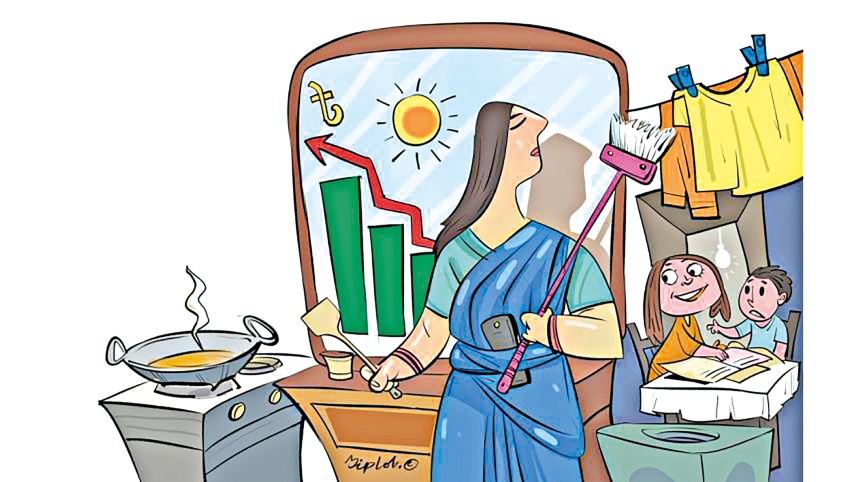
In the days following the election, as we found ourselves drifting through the familiar routine of scrolling endlessly on Facebook, we began noticing posts from friends and colleagues reflecting on the results. Some of them joked, half in satire and half in frustration, that it was unfortunate Jamaat had not won the election. Had the party come to power, they quipped, perhaps the eight-hour workday might have disappeared. The remarks carried the tone of political dark humour, perhaps even a hint of wishful thinking. Yet behind the jokes lies a serious question: what would it actually mean if women’s working hours were reduced?
Within the domestic sphere, women’s work is often dismissed as “non-economic,” yet it is central to the reproduction of the labour force. In mainstream society, this role has been viewed as a charitable yet mandatory contribution by women and is therefore treated as unpaid domestic work.
 For all latest news, follow The Daily Star's Google News channel.
 Recently, policymakers have attempted to calculate the economic value of this unpaid labour. According to a Bangladesh Institute of Development Studies (BIDS) report, women spend around 4.6 hours a day on household work while men spend only 0.6 hours. Unpaid household and caregiving labour was valued at Tk 5.3 trillion in 2021.
In a capitalist labour market built on cost minimisation and efficiency maximisation, attempts to reduce work hours rarely unfold as intended. Instead, they risk reinforcing the very structures of inequality they claim to challenge.
In a system where employers evaluate workers by output per unit of cost, a policy that formalises women as “five-hour workers” inevitably labels them as less productive. No matter how wages are paid by the company or the state, employers will see women working fewer hours for the same monetary cost. Over time, this incentivises employers to quietly avoid hiring women, especially in competitive, low-margin industries such as garments, where profit depends on maximising every labour minute. Women become economically “risky hires”. This solidifies the idea that women’s “real duties” remain at home. Instead of challenging the burden of unpaid work, it validates the assumption: if women are expected to work fewer hours outside, who is expected to cover the rest? Women themselves, through a repackaging of domestic confinement.
Even more troubling is the potential for long-term exploitation through informalisation. Employers may offer temporary or under-the-table contracts, or piece-rate, home-based work. If wages are partly subsidised by the state, women’s economic security becomes vulnerable to political cycles and austerity cuts. A policy masquerading as “relief” actually deepens vulnerability. Instead of reproductive justice, it offers reproductive containment. Instead of empowerment, it cements women as a secondary, subsidised, and easily discardable labour force.
To understand why talk of reducing women’s work hours reinforces inequality, we turn to Social Reproduction Theory (SRT), which begins with a fundamental question: “Who produces the workers?” It focuses on life after 5 pm and before 9 am as something that sustains the structure outside the formal workspace. In the capitalist system, the family, as the basic unit of society, functions as the space of reproduction of both the existing structure and, in a literal sense, the workforce.
This leads to the question: who actually does the work of reproduction? It is the women in the family who are disproportionately impacted, as their efforts sustain the capitalist labour supply, yet remain unseen in the economy and dismissed as “unpaid” work. Social reproduction occurs through three processes: regenerating workers for the next day’s work by looking after the family, cooking and feeding them, and managing the household; preparing and caring for non-workers, such as children and students, to function within the existing system; and producing future workers through childbirth.
We need to addresses the unpaid labour behind this reproduction of labour, challenging the invisibility of this work and the disproportionate burden placed on women.
Furthermore, recognising the unpaid work of women highlights the magnitude of their workload, but does it benefit women economically? The answer is no. Recognition in documentation or statistics is ineffective unless it results in tangible improvements, such as economic independence, social protection, or a reduction in the persistent double burden.
Here, the government can play a crucial role. Instead of subsidising institutes for the five-hour workday, it can initiate comprehensive policy reform. A sustainable approach would be revisiting labour regulations and policies to redistribute care infrastructure, alongside universal social protection and enhanced childcare and public transportation systems.
Care work in households should not be seen only as a woman’s responsibility, but rather as socially necessary work to be shared, supported, and mitigated by the state. The state can redistribute the workload by building infrastructure that supports these efforts, including affordable childcare (e.g., public or community childcare), community kitchens to reduce the burden of cooking and feeding, and the enforcement and incentivisation of paid parental leave for both parents.
Without acknowledging and addressing the unpaid burden placed on women within the existing structure, reducing work hours merely re-establishes existing inequality by banishing women to the house and the kitchen, sustaining the social reproduction of the workforce and the system, and failing to challenge the structures that invisibilise women’s labour.
Social Reproduction Theory ultimately reveals a paradox: capitalism survives on women’s unpaid labour, yet refuses to value or redistribute it. Recognition without redistribution cannot bring justice. Whether through policy proposals to reduce women’s work hours or through government initiatives to include unpaid care work in GDP, these measures do not challenge the fundamental logic that sustains gendered economic inequality.
True liberation of women requires dismantling the system that profits from women’s unpaid work, not decorating it with new incentives. Instead, new policies need to redistribute care work, expand public services, and restructure labour markets. Otherwise, such proposals will merely preserve the status quo under a veneer of progress, creating a reserve army of labour in which women become part-time workers and full-time caregivers, while employers continue to pursue control over the supply–demand dynamics of the labour market.
Khairul Hassan Jahin is a journalist at The Daily Star. He can be reached at khairul.jahin@thedailystar.net.
Aishwarya Ahmed is a PhD Student in Sociology, at the University of Tennessee, Knoxville. She can be reached at aahmed37@vols.utk.edu.
Nipun Sarker is a recent graduate in Development Studies. She can be reached at nipunsarker34@gmail.com.
Comments