Can I still be the daughter they need?

It is almost noon, and I find myself looking at the clock a little more often. I am at work, with things still waiting to be finished, but I am already looking forward to lunch. Not because I am hungry, but because this is usually when I call my mother.
Living thousands of miles away means learning to live by two clocks. When it is noon for me, it is already late evening for my family in Bangladesh. My workday is only halfway through, while theirs is almost over. So, this little window during lunch has somehow become our time. I call Ammu, and we try to fit our different days into those few minutes.
She tells me what is going on at home, where she went, who called, the new recipe she is experimenting with, and all the interesting little things she discovered on YouTube or social media that day. She asks about work, whether I have eaten, whether I am sleeping enough. And she never forgets to ask, “Are you taking care of your hair? Did you put oil on it?” I usually laugh. Sometimes I say yes when I probably haven't done it in weeks. It is a small question, but I know it is one way she still takes care of me from so far away.
There was a time when I could barely spend a night away from home. Staying at a friend's or relative's house sounded exciting until evening came, and then I just wanted to go back. Somehow, that girl has now spent four years living on the other side of the world.
If I am lucky, I get to go home once a year, and I know even that is a blessing. Still, I think about how much life can happen in one year. When you see someone every day, you probably don't notice a few more grey hairs, someone getting tired a little earlier, or something around the house changing. When you return after a year, you meet all those changes at once, along with everything that happened while you were gone.
I miss birthdays and family gatherings, but often I miss the ordinary things more: my cousins and the random conversations when everyone is together. Most of all, I miss my sister. She has always been my best friend, the person with whom I shared pretty much everything growing up, from clothes, stories and secrets to the smallest details of our days. We still talk, of course. But our calls usually start with, “So, what happened?” When you live together, you don't need to ask. You already know.
Maybe that is what I miss most about home: not only the people but knowing their ordinary lives without needing an update.
Somewhere along the way, I realised the distance works both ways. While I am missing their everyday lives, they are missing mine too. I send pictures and tell them stories. They know my friends' names and hear about the places I go. But there is an entire ordinary life here that is difficult to explain through a phone.
Somewhere along the way, I realised the distance works both ways. While I am missing their everyday lives, they are missing mine too. I send pictures and tell them stories. They know my friends' names and hear about the places I go. But there is an entire ordinary life here that is difficult to explain through a phone.
There are familiar streets and train rides, little cafés I like, and people who have become part of my life. Sometimes I see a beautiful place, or something completely ordinary, and immediately think, Ammu would love this. I take a picture and send it to her. She tells me how beautiful it is, and I tell her that one day I will bring her here.
But sometimes I don't want a picture. I want my parents to actually be here. I want them to walk these streets with me, see where I spend my days, and meet the people whose names they have heard so many times. I want them to know the life I have built, not because it is extraordinary, but simply because it is mine.
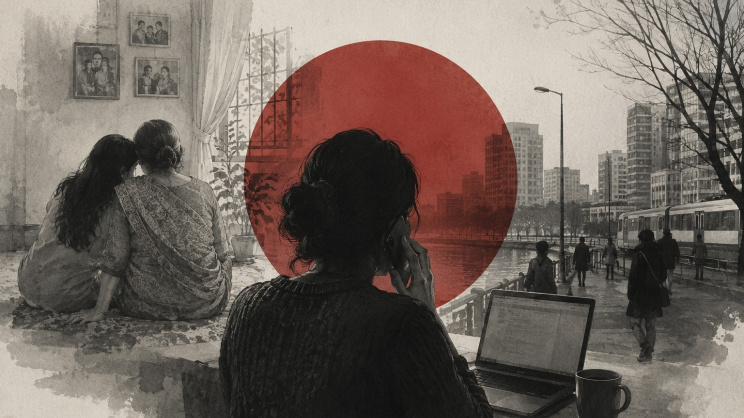
And I want the same in reverse. I want to be there for the stories that aren't important enough for a phone call, and to notice the small changes while they are still small.
When I first left home, I thought the hardest part would be how much I would miss everyone. I didn't understand then that another question would eventually start bothering me: what happens when my parents need me?
They are getting older. It is an unavoidable fact of life, but distance makes me think about it differently. What happens on a day when a phone call is not enough? There are things you cannot do over WhatsApp, no matter how often you call. Sometimes you need to sit beside someone, make them a cup of tea, go somewhere with them, or simply be in the next room.
I knew I would miss them. What I was not prepared for was wondering whether, as my parents grow older, loving them from far away will always be enough.
I am building a life that my parents have always wanted for me. They are proud of me and have never made me feel that I should give it up and come home. I am grateful for this life too. Yet I still wonder what it means to be a good daughter from this far away. Can I still be the daughter they need when I am absent from so much of their everyday life?
I am building a life that my parents have always wanted for me. They are proud of me and have never made me feel that I should give it up and come home. I am grateful for this life too. Yet I still wonder what it means to be a good daughter from this far away. Can I still be the daughter they need when I am absent from so much of their everyday life?
I don't know the answer. For now, maybe this is why those lunch-break calls mean so much. For a few minutes, my afternoon and Ammu's evening meet. I tell her about my morning, and she tells me about her day. She reminds me to eat properly and, of course, asks again about my hair. I ask what she had for dinner and what Abbu is doing.
Eventually, she says, “Okay, go, you have work.” I tell her it is getting late and that she should sleep. We hang up, and our days move in opposite directions again.
Tomorrow, around noon, I know I will start looking at the clock.
Afsana Alam is a doctoral researcher in public policy at the University of Massachusetts Boston and a Rappaport Public Policy Fellow with the Harvard Kennedy School. Her research and writing focus on gender, development, public policy, and personal reflections on home, belonging, and everyday life.
Send your articles for Slow Reads to slowreads@thedailystar.net. Check out our submission guidelines for details.
What death teaches us about life

How to help children fall in love with reading

Why Christopher Nolan's The Odyssey disappoints in its portrayal of women
10,000 steps a day: Health myth or medical fact?
Why Dhaka University should rethink its rules for female students
Inherited Memories / One railwayman's line-box, three eras of history

The strange grief of seeing our parents age
After the PhD: The loneliness nobody talks about
The Palestine lesson from Spain's World Cup victory