Why are we in such a hurry to live?
Does it ever happen to you that you sit down for an hour on a weekend, hoping to do absolutely nothing, but somewhere in the back of your mind, you are calculating everything you should have accomplished by now? You are technically resting, but your mind is not really at rest. You are lying in bed on a Friday morning, yet somehow feel guilty for not getting up and “doing something productive”. If that guilt sounds familiar, welcome to the productivity trap.
The guilt of doing nothing
Being in my late 20s, and despite working six days a week, I too often find myself thinking that I am still not doing enough. I constantly fear wasting time and feel strangely guilty for spending a day doing nothing, as though every hour that isn't spent learning, working, exercising or accomplishing something is an hour wasted. The irony is that, without even realising it, I have become one of the most active participants in the very rat race of our 20s.

That is perhaps an unsettling truth about modern ambition. You do not necessarily choose the race; sometimes, you simply find yourself running in it. The more you achieve, the more you want for yourself, and once you have started running the race, slowing down begins to feel like a crime.
Obsession with optimisation
We are constantly told that our 20s are supposed to be our “golden years”. Eat healthily, go to the gym, build a career, save money but also travel, build a social life, learn as many new skills as you can, network as much as you can, and start investing. And, of course, somehow manage to enjoy all of it.
We should be careful about wasting our 20s in endless distraction, running away from discipline and postponing everything meaningful. We should work hard, be disciplined and have goals; we just should not let ambition convince us that every moment has to be optimised.
In the modern world, there is an invisible and constant pressure to optimise every aspect of our lives. Even leisure has become something we feel compelled to do correctly. We don't simply travel; we have to travel enough to post about it on social media. We don't simply exercise; we need the perfect fitness routine that shows results. We don't simply have hobbies; they should perhaps become side hustles and give us something in return. And sometimes, social media can make this pressure considerably worse.

Reels vs. reality
You open Instagram or LinkedIn and encounter people who seem to have figured everything out. Someone is getting promoted, someone is buying a house, someone is travelling across Europe, someone has launched a business, and someone is getting married.
You see hundreds of people displaying the highlights of their lives and then look at your own behind-the-scenes footage. Naturally, you feel inadequate. Many a time, I have heard my friends tell me that I seem to have a perfect life with no significant challenges at all.
Now we need to “settle down”. This phrase, particularly for people in their late 20s, often becomes another form of social pressure.
And I often wonder: Do they really see my life, or do they only see the carefully framed moments that make it onto my social media? They see the edited version; I live with the unedited one.
They don't see the things I struggle with privately, the uncertainties I face, the plans that didn't work out, or the moments when I feel completely lost. And perhaps that is the problem with the way we consume other people's lives today. We mistake visibility for reality. What someone chooses to show us is not necessarily a lie; it is simply not the whole truth. Social media is an edited version of reality. We are comparing our entire lives with someone else's carefully selected moments. We see the success, but rarely the sleepless nights, self-doubt and years of trying that preceded it.

The shifting finish line
And just when we think we have finally figured out our careers, another deadline appears.
Now we need to “settle down”. This phrase, particularly for people in their late 20s, often becomes another form of social pressure. “Settling down” loosely translates into finding the ideal life partner, getting married and starting the next chapter before you supposedly run out of time. Something that should ideally be one of the most intimate, organic and beautiful decisions of our lives can suddenly start feeling like a deadline. Notice the pattern? There is always another milestone to prove whether we are “on track”. There is always a next level.
Busyness isn't contentment
There is nothing inherently wrong with ambition. Wanting more from life is not a flaw, and neither is working really hard for it. The problem begins when achievement becomes the only measure by which we evaluate our lives. Being constantly busy is not necessarily the same as being productive. And being productive is certainly not the same as being content. We can optimise our lives so efficiently that we eventually forget to actually live them. In this race, sleep gets sacrificed, friendships become occasional WhatsApp messages, family dinners become interruptions, and hobbies disappear. And somewhere along the way, we convince ourselves that this is simply what adulthood is supposed to look like.

Reclaiming the present
We should be careful about wasting our 20s in endless distraction, running away from discipline and postponing everything meaningful. We should work hard, be disciplined and have goals; we just should not let ambition convince us that every moment has to be optimised. Our 20s should not feel like a productivity competition or an examination in which we have to submit evidence that we maximised every possible opportunity before turning 30. It is okay if we don't have everything figured out in our 20s. It is okay to take a trip without turning it into Instagram content. It is okay to meet a friend without the purpose of networking. And it is okay to pursue a hobby that will not make us money.

If we are earning money, we should enjoy some of it while we are young enough to enjoy the experiences it can buy. If we have people we love, we should make time for them and spend quality time with them. If we have hobbies, we should find time to protect and nurture them. Because there is one uncomfortable truth that productivity culture rarely acknowledges: we will never be this young again. There will always be another task waiting, another goal to achieve, another email to answer, another reason to believe that we should be doing more.
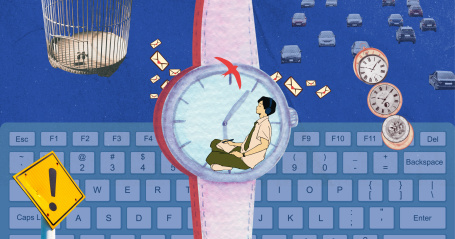
But life is not meant to be a treadmill where the faster we run, the faster we are expected to run. Ambition matters, discipline matters and building a future matters. But so does having a present. Perhaps the real achievement is not squeezing every possible ounce of productivity out of our 20s. Perhaps it is building a life we do not constantly need to escape from.
Adrita Islam is a Lecturer at BRAC University specialising in political science and streaming media culture. She can be reached at adrita027@gmail.com
Send your articles for Slow Reads to slowreads@thedailystar.net. Check out our submission guidelines for details.

Why I chose teaching over a corporate career

The moral hierarchy of blood

The curious case of Bangladeshi ‘tension’

What can a teacher give that AI cannot?

What phuchka and jhalmuri can teach us about the science of taste

Remembering Yayoi Kusama: My encounters with the master of infinity

Dress and morality : The politics of what women wear

Is being single at 35 a failure?

Travelling through books / One more page please, Mama