


Rachin feels Mirpur wicket was a ‘one-off’
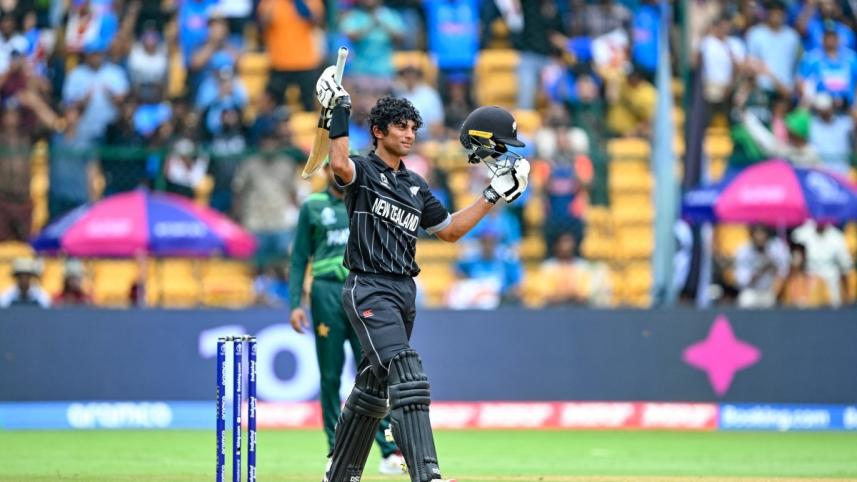
New Zealand's Rachin Ravindra did not exactly hit the ground running on his international breakout but turned eyes in the World Cup in India. Setting records, Rachin has been doing it his own way. He may have had a quiet tour of Bangladesh, not getting a game in the Test series but true to his keen eyes, he has been watching on. Here he talks about the Kiwi side's environment, a fantastic debut World Cup and the Mirpur wicket as he sat with The Daily Star's Abdullah Al Mehdi after the second Test.
DS: You've played here before and what's been the experience including this tour?
 For all latest news, follow The Daily Star's Google News channel.
 RR: I guess, uh, it's pretty contrasting. I mean, we had also had a one-day series here before the World Cup, too. Being able to play three different formats in a country in which conditions are so foreign and what we're definitely not used to at home, has been quite cool. Obviously, it's tough cricket, like we've seen in Mirpur. It's a very very tough surface to play on. I think that develops your game and makes you a better cricketer at the end of the day. I think it's nice to have a drawn series. It was a reflection of the way the two games went. So, yeah, it's always cool to visit Bangladesh.
DS: What's the specialty of the challenge here and how you approach given criticism of the kind of wickets at Mirpur?
RR: I mean, for one it produced a result so I always think that in Test cricket you want results and you want to be given the opportunity to win or lose game cricket.
I mean, in terms of criticism, I think it's good for us as players. Yeah, you might not get the runs you wanted, and maybe a good score isn't 150-180 in Test matches. For me, look, 50 or 60 [individually] is a really good score. So, I think bringing back your expectation on that, and, hey, as an international cricketer, you have to play on different surfaces around the world.
I think the challenge of it is the ball that turns and sometimes it doesn't. So, I think it showed the way Glenn Phillips batted, his aggression and the way he took the game on is something that, if I got the opportunity, maybe the way I'd go about it. Because, obviously, if you sit there, you're gonna get a good ball and the Bangladesh spinners are very accurate. I mean, we talk about surface all we want, but I guess at the end of the day it's a Test match, and you want tough conditions to play in.
DS: Have you ever faced something like that?
RR: Nah, I mean, you might get it once in a while in subcontinent, maybe in India, but the bounce is usually more true.
I think here it's a true reflection of your technique in terms of how you get in a position to score and defend the ball that turns away past your bat or skids on and hits your pads. It's most certainly testing as you saw. Look even though there was rain out and a lot of bad light, the game only finished and it could have ended in two days if we had full 90 every day. But I guess if you go back to Sylhet, you'll get another different surface, nice cricket wicket, and supposedly, goes to day five, so it's just nice to get two extremes.
DS: How do you prepare for something like Mirpur though? Would you consider it a one off?
RR: It definitely is difficult, so yeah [one-off]. But you're always trying to turn every stone you can in terms of prep before you go out. I guess those practice wickets help a lot in being able to just challenge yourself with that. Especially when you're on tour, it's quite difficult. I guess for us being in World Cup cricket mode, you get on nice sort of true wickets in India, flat wickets they would say. So, it's definitely a challenge to try and balance that when you're on the road so much.
I think it's also being specific in whatever training you have. Even if the training wicket isn't as good, there's always something to work on and improve on.
DS: Special World Cup for you setting a record for most hundreds at a World Cup before age of 25. What are your feelings how did you show that kind of confidence?
RR: I guess it was pretty surreal, I think the way it all happened, the freedom came from the environment, being able to express myself as a cricketer. That too with guys who are so reliable. Obviously better with Devon [Conway] that first game [England]. He's a world-class cricketer. I've spent a lot of time with him, one of my closest mates So it's nice to have that familiar face and you know you could just sort of go through your thing and play your natural game. That's what's been important here in terms of our New Zealand environment. Everyone's kind of 'be yourself and play the game' that you believe is going to help the team. During that World Cup I guess I was lucky enough to be in situations where I could take the game on and it all sort of worked out luckily.
DS: The community and friendship separate New Zealand from other international sides?
RR: To be honest, it's hard to speak for different international sides obviously, because I haven't been involved in their environment, so I wouldn't know. Speaking for the New Zealand one, I guess we're all sort of good mates, we enjoy sharing the field, we enjoy each other's company off the field. We always like to have a laugh and a joke and stuff, but I guess at the end of the day, we all understand what the common goal and objective is: being able to push the team forward. All the personal accolades, runs, wickets, etc, will come as part of that. I mean, not necessarily me, but the guys have been a group, been together for such a long period of time, so everyone knows each other very well and knows each other's games and that trust is there. For me it's been a couple of years in the group and seeing the guys put their trust in me is pretty special.
DS: You talked about Conway. How about Williamson or Tim Southee as friends and mentors?
RR: I've spent time with Timmy and Kano the last couple of years, but obviously not as much as I have with Dev and [Tom] Blundell but they're all such great mentors.
The way they carry themselves on and off the field, how level they are, and how competitive they are and how they go about their processes. There's a reason why they've played international cricket for the better part of a decade and had so much success with this team. So, I think you do whatever you can to can learn from them.
They're like awesome teammates to share the field with. Amazing mentors and such great students of the game, they teach you the game.
DS: New Zealand have had great all-rounders in the past. Growing up did you look at all-rounders, for instance, someone like Shakib Al Hasan?
RR: Yeah obviously, Shakib's done a lot of his time. Jadeja too, so those guys obviously. People who bowl left-arm spin and bat left-handed are always ones you gonna have a little affinity towards, but personally I didn't necessarily follow around as I wanted to be like Vettori, and really wanted to bat like Sachin, Dravid, Ponting, Lara, all those guys.
I guess from New Zealand, I really loved watching Ross Taylor bat. He was my favourite growing up. And then obviously through teenage years you see what Kane sort of did and you want to be like Kane.
DS: Did you get to work out things with Kane even before making the team?
RR: No. I think it was just watching from afar and being able to observe and what he did was cool. It was a real sort of pinch yourself moment when you're able to share a dressing room with those guys and you know, you're banding with them and stuff and it puts things into perspective as a kid watching them play and you're like 'wow one day you could be involved with these guys.' So, it's definitely a special feeling.
DS: As an all-rounder, where do you see yourself heading into any format?
RR: I guess if you ask most people around me, they'd probably say, 'he shows maybe a little more interest in his batting or is more of a batting all-rounder', which I think is true right now, but I want to continue trying to be a serious all-rounder in the future. One who is very valuable for a team if you have someone in the top three who can bowl four overs in the T20s, 10 in one-dayers or long spells in a red ball game. I think it's more just trying to contribute to the team, whatever I can do to improve my skills to be able to have my mark on a game. I guess it's cool always being involved like even if you don't get necessarily the runs you want with the bat, you can have an effect on the game with the ball and vice versa. So that's what interests me about the all-rounder tag.
DS: Would you be able to name someone who you actually generally looked up to?
RR: I didn't necessarily think like 'oh, it'd be cool'. I think it's important for me to be myself and do what I do well and hopefully it can contribute to winning games no matter what team I'm playing for. I obviously look up on all those guys that have come before me and my models, but I guess I'm just trying to do it the way I know how and keep improving my skills.
DS: How disappointing was it not to make the Test eleven?
RR: I think the thing with the Black Caps Test side at the moment is there's a lot of guys in front of me who have done it for a number of years and who have amassed great records and have contributed so much to the team. For me it's about not being impatient. I'm young enough, I'll end up playing a lot of cricket, whatever might happen, but I think it's understanding that the guy in front of me is a very, very good cricketer, so it's just the nature of the beast and, you know, it's so good to see someone like Glenn come back in and gets a man of the match. Yeah, definitely watching them here was about a learning curve whether you're playing or not.
DS: Did you enjoy the environment and did not have a hard time not playing?
RR: Definitely. I think you always try to help each other out and help the team out. It's really rewarding to have a Test win, you know, they don't come around so easy so accumulation of you know amount of days of work for it to finish and the way we did was pretty cool.
Not really [had a hard time]. I think it's about enjoying each other's success and I think If you're disappointed about not playing and you carry that sort of negativity and stuff around then it probably doesn't bode well for the team.
DS: You are named after two of India's great cricketing icons Sachin Tendulkar and Rahul Dravid. Did you later ask, like, who these guys were when young?
RR: Well, I think I probably knew when I was four or five years old. When I was young, Dad used to watch a lot of cricket and it always used to be on, so I think I probably naturally picked it up at some stage. It's pretty special to be named after those two Indian greats but we don't really talk about that much anymore.
DS: Any message for Bangladesh fans?
RR: Thanks for the hospitality and the fanfare. Obviously, being here a couple of times, you see how crazy Bangladesh is about their cricket. It's cool to experience it all and we've taken in every single experience from a hard-fought series and looking forward to seeing you come visit New Zealand.
Comments