


FIFA Congress: Sport meets politics
The FIFA Congress, which concluded yesterday in Vancouver, brought together global football leaders but was marked as much by controversy as by decision-making.
A central issue was Iran’s participation in the upcoming 2026 World Cup. Despite political tensions following a conflict involving the United States and Israel, FIFA president Gianni Infantino confirmed that Iran will compete in the USA as scheduled. This decision rejected Iran’s earlier request to relocate their matches to Mexico.

However, Iran’s absence from the Congress drew attention. Federation president Mehdi Taj and his delegation withdrew after being detained and questioned by Canadian authorities in Toronto over alleged links to the Islamic Revolutionary Guard Corps (IRGC).
Although cleared to enter, reports indicated the officials faced restrictions and ultimately chose to leave, fuelling claims that Iranian officials had effectively been denied entry and escalating diplomatic tensions. Iran now seeks urgent talks with FIFA in Zurich to avoid further complications.
Beyond geopolitics, FIFA made several significant decisions.
Financially, the organisation announced a 15% increase in funding for all 48 World Cup teams, reflecting its strong economic position.
Additionally, Infantino revealed unprecedented demand for the tournament, with 500 million ticket requests already recorded -- ten times more than previous editions.
At the same time, FIFA acknowledged criticism over soaring prices for the 2026 tournament and said it would review its ticketing strategy for the 2030 World Cup amid fan backlash.
Infantino confirmed his intention to run for a fourth term as FIFA president, with elections scheduled in 2027. His tenure has been defined by expansion, including the move to a 48-team World Cup.
FIFA also announced a stricter crackdown against racism on the pitch. Under new rules, players who cover their mouths during confrontations -- often seen as an attempt to conceal discriminatory language -- could face a red card, signalling a tougher stance on abusive behaviour.
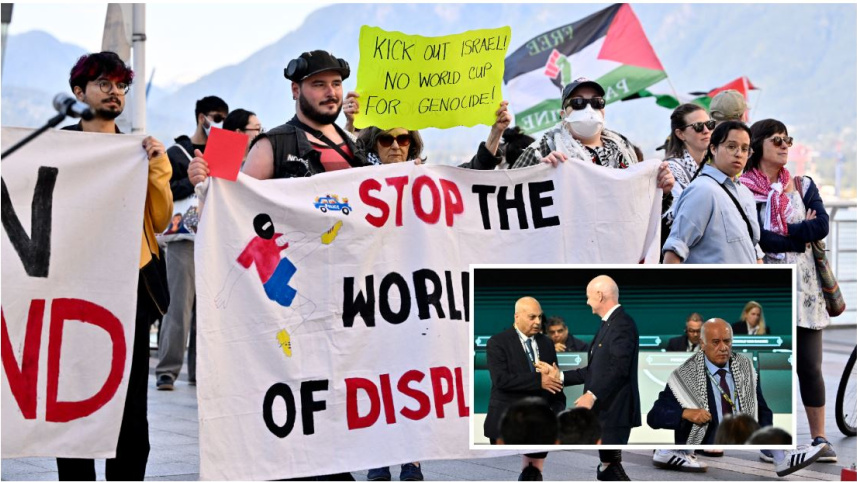
Outside the Congress venue, protests highlighted growing concerns about the social impact of mega events.
Activists and workers criticised rising living costs, displacement of homeless populations and lack of fair wages. Calls for a “FIFA dividend” emphasised the need for the organisation to reinvest in host communities.
Football-related tensions also surfaced inside the Congress. A notable moment involved Palestinian and Israeli officials, reflecting broader geopolitical divisions. Meanwhile, fans of the Vancouver Whitecaps FC protested against the possible relocation of their club.
The FIFA Congress showcased major financial and structural progress for global football but also revealed deep political and social challenges.
As the 2026 World Cup approaches, FIFA faces increasing pressure to balance sport, politics and social responsibility on the world stage.
 For all latest news, follow The Daily Star's Google News channel.
Comments