


The Pep effect lives on

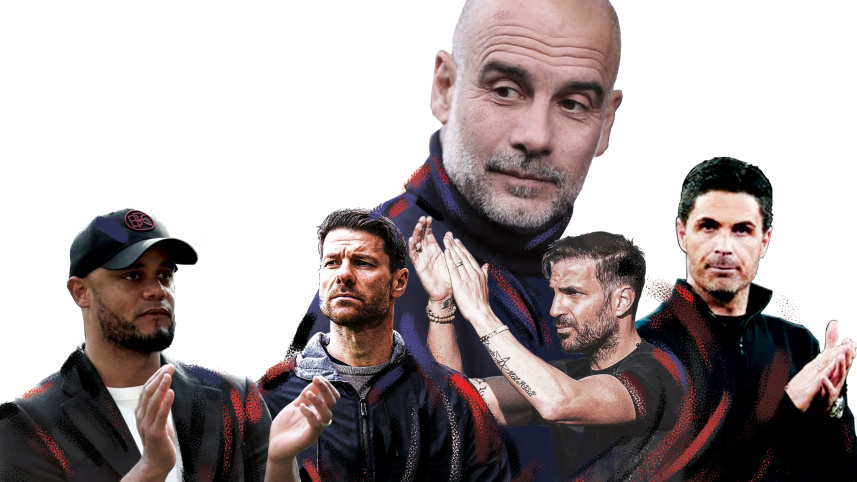
Regular football followers may feel a little estranged from the game this season. Fans, admirers and even rivals are bound to miss one familiar figure from the dugouts of the past two decades -- Pep Guardiola.
The Spaniard, who carved out a philosophy of his own, has stepped away from Manchester City after a trophy-laden 10-year reign. For the first time in years, the European football landscape will unfold without Guardiola standing on the touchline, orchestrating from the dugout.

Yet his absence may not mean the absence of his ideas. His disciples, former assistants and even rivals have taken pieces of his football and moulded them into their own styles. Now, they are scattered across Europe, entrusted with some of the continent’s biggest jobs and most ambitious projects. That makes the new season more intriguing: Guardiola may be away, but his football could be everywhere.
The most obvious case is Enzo Maresca, who has been handed the daunting task of succeeding Guardiola at City. Maresca was part of Guardiola’s staff during the historic 2022-23 treble-winning campaign and later forged his own path, winning promotion with Leicester and the Conference League and Club World Cup with Chelsea. His return to the Etihad is therefore not simply a change of manager, but a continuation of sorts -- albeit with Maresca expected to put his own stamp on the team. His 3-0 defeat to Mikel Arteta’s Arsenal in the Community Shield offered an early reminder of how difficult that transition will be.
Arteta’s evolution perhaps best illustrates how Guardiola’s influence can develop beyond the master himself. The Spaniard spent three years as Guardiola’s assistant at City before taking charge of Arsenal in 2019. After three successive runners-up finishes, Arteta finally guided the Gunners to their first Premier League title in 22 years last season. Arsenal have since strengthened their squad and already made a statement by beating City in the season’s curtain-raiser. But Arteta is no longer merely a Guardiola disciple; he has become a manager with an identity of his own, shaped partly by the lessons learned in Manchester.
Then there is Xabi Alonso at Chelsea. As a player, Alonso spent three seasons under Guardiola at Bayern Munich, where possession, positional intelligence and control were central to the team’s identity. He later translated some of those principles into his own managerial philosophy, most spectacularly at Bayer Leverkusen, where he guided the club to an unbeaten domestic double in 2023-24. His brief spell at Real Madrid ended in January, but Chelsea now offer another major test of his ability to turn his ideas into sustained success.
Vincent Kompany offers another fascinating variation. The former City captain played under Guardiola and is now flourishing at Bayern Munich. His side are aggressive, high-pressing and relentlessly forward-thinking. The results have also followed: by his 100th competitive game, Kompany had overseen 76 wins, with Bayern scoring over 300 goals under him so far. His football is not a carbon copy of Guardiola’s, but the fingerprints of the environment he experienced in Manchester are difficult to miss.
And then there is Cesc Fabregas, perhaps the most romantic example of the movement. A former Guardiola player at Barcelona, Fabregas has transformed Como from newly promoted outsiders into a Champions League club. Como finished fourth in Serie A last season to qualify for Europe’s premier competition for the first time in their history, just two years after promotion. Fabregas has built something recognisably his own, but his emphasis on possession, movement and technical quality reflects the footballing education of his Barcelona years.
Even Jose Mourinho remains part of this Guardiola story. The Portuguese was one of the Spaniard’s defining rivals, particularly during their Barcelona-Real Madrid battles in the 2010s, and his teams often sought to counter Guardiola’s possession-heavy football through compact defending and devastating transitions. Mourinho’s return to Real Madrid this season adds another layer to the story. Guardiola’s philosophy once forced Mourinho to adapt; now, the old foe returns in a different era.
That is what makes this season so fascinating. Guardiola may be absent from the dugouts, but his influence has already travelled far beyond Manchester -- carried by disciples, former players and even opponents who learned to respond to him. They have borrowed, adapted, rejected and reinvented parts of his football.
So the coming season may not be about watching Guardiola. It may be about watching what Guardiola has left behind -- and discovering how many different versions of his football can exist once the original is no longer on the touchline.
 For all latest news, follow The Daily Star's Google News channel.
Comments