


Can Spain conquer the world without a true No. 9?

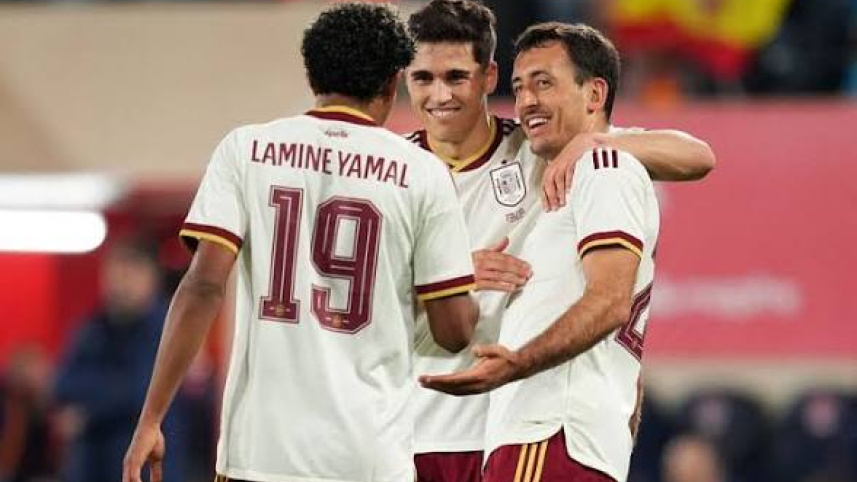
Spain begin their FIFA World Cup 2026 campaign tonight in Group H against debutants Cape Verde in Atlanta, arriving as heavy favourites.
Yet, as "La Furia Roja" take the pitch, a glaring tactical paradox looms over coach Luis de la Fuente’s side whether they can conquer the world without a recognised center-forward to lead the line.

For the first time ever, Spain have travelled to a World Cup without a single Real Madrid player in the squad. Furthermore, foundational pillars like Alvaro Morata are no longer leading the setup. For Spanish fans, the most pressing tactical concern remains the lack of an out-and-out No. 9 – a traditional target man whose primary role is to physically occupy centre-backs, hold up play, and punish teams inside the box.
Spain's golden era, which won the Euro 2008, the 2010 World Cup, and the Euro 2012, was defined by tiki-taka, but each triumph was anchored by strikers willing to do the unglamorous work.
David Villa was electric at Euro 2008, finishing as the tournament's top scorer while a young Fernando Torres stretched defences to create vital spaces.
At the 2010 World Cup, Torres arrived out of form and struggled for fitness, yet his presence still stretched defences and created space for Villa's decisive goals. By Euro 2012, both Torres and Villa were approaching the latter stages of their careers, but Spain continued to benefit from the focal point they provided.
De la Fuente, however, successfully transitioned Spain toward a faster, more vertical passing philosophy.
Mikel Oyarzabal is slated to start as the nominal centre-forward. The Real Sociedad attacker operates brilliantly as a false nine. He excels at dropping deep, linking a fluid midfield, and probing for structural openings. His recent international form is stellar, boasting 12 goals in his last 11 Spain appearances. What he lacks, however, is the raw physical profile traditionally needed to pin elite, low-block defenses.
Tactically, Spain remain a beautifully balanced machine. Behind Oyarzabal, a fully fit Rodri anchors the midfield, dictating the tempo alongside the creative genius of Pedri and Fabian Ruiz. In defence, Unai Simon starts in goal behind a back four of Marcos Llorente, Pau Cubarsi, Aymeric Laporte, and Marc Cucurella.
The main nuance for tonight's opener lies on the flanks. Dynamic breakout stars Lamine Yamal and Nico Williams are recovering from late-season hamstring injuries. While both have returned to full training, De la Fuente is expected to take a cautious approach against Cape Verde. Ferran Torres and Alex Baena are there to offer a highly disciplined press and direct goal-threat to support Oyarzabal if needed.
Spain possess the technical perfection to breeze through a group featuring Cape Verde, Saudi Arabia, and Uruguay. However, their ultimate test will arrive in the strict margins of the knockout rounds. When spaces dry up and matches are dictated by fine details, a team often requires a physical presence to win an aerial duel or relieve pressure.
Whether De la Fuente’s strikerless system can transcend this structural void will determine if Spain can lift the trophy for a second time.
 For all latest news, follow The Daily Star's Google News channel.
Comments