


Europe’s supremacy showing in North America

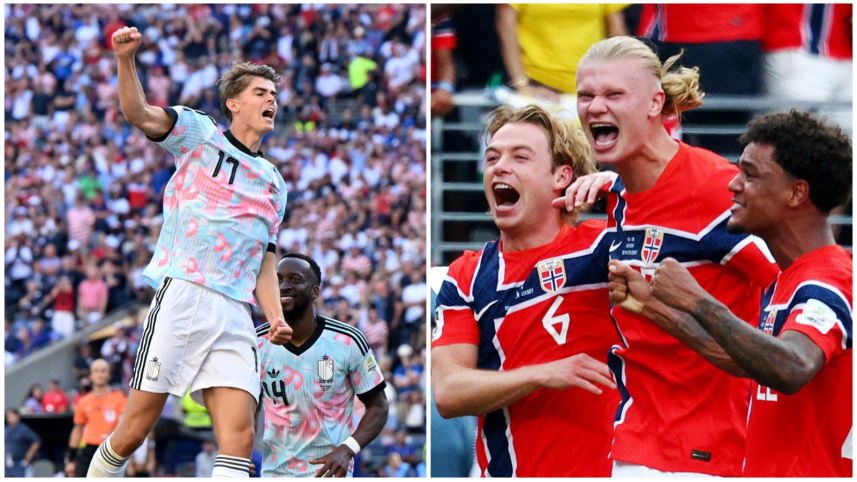
Before the start of the 2026 FIFA World Cup, European heavyweights France and Spain were widely regarded as the leading contenders for the title, thanks to the remarkable depth and quality of their squads as well as their recent form.
History, however, was not on Europe's side. In the previous three World Cups held in North America -- Mexico 1970 and 1986, and the United States 1994 -- South American nations lifted the trophy, with Brazil winning twice and Argentina famously triumphing in 1986.

Yet as this edition reaches its decisive stage following the completion of the Round of 16, Europe has asserted its supremacy, with six of the eight quarterfinalists coming from the continent.
Alongside favourites France and Spain, the last eight also feature England, Norway, Belgium, and Switzerland. Defending champions Argentina and Morocco are the only remaining representatives from South America and Africa, respectively, with no teams from Asia, North America, or the Pacific regions.
The expanded 48-team tournament featured a record 16 European nations, of which 12 progressed to the knockout stage -- indicating a chance for history to be rewritten.
Europe did suffer setbacks in the Round of 32, where five teams were eliminated, including four-time champions Germany, three-time runners-up the Netherlands, and 2018 finalists Croatia. While none of them entered the tournament as leading title contenders, their early exits still came as a surprise.
The continent's biggest powers, however, responded emphatically. France and Spain cruised into the Round of 16 with identical 3-0 victories over Sweden and Austria, respectively, while England, Portugal, and Belgium survived stern tests to keep their title hopes alive.
Displays in the last 16 further underlined Europe's dominance. Seven European teams reached this stage, with Portugal the only side to bow out after losing to Spain -- an unavoidable outcome given the all-European tie. However, in the remaining five knockout matches involving European teams, all emerged victorious.
Norway produced one of the biggest upsets of the tournament by defeating five-time champions Brazil 2-1, while Belgium stunned hosts USA 4-1. It was also fitting that Switzerland impressed by edging high-flying Colombia in a dramatic penalty shootout to form the quarterfinal lineup.
The contrast with other confederations has been striking.
South America and North America each had three teams in the Round of 16, but only Argentina survived -- that too after producing a dramatic comeback against Egypt. Meanwhile, all three host nations -- USA, Mexico, and Canada -- saw their campaigns come to an end.
Europe's sustained success is no coincidence. The continent has dominated world football for decades, driven by its elite domestic leagues, financial strength, and player development systems.
Following Brazil's World Cup triumph in 2002, European nations won the next four editions through Italy, Spain, Germany, and France before a Lionel Messi-led Argentina ended that streak by lifting the trophy in Qatar in 2022.
The world's finest talents, regardless of nationality, continue to gravitate towards Europe's top leagues, further strengthening the continent's footballing ecosystem.
France's formidable attacking trio of Kylian Mbappe, Ousmane Dembele, and Michael Olise has been among the standout units of the tournament, while Spain have yet to concede a goal. Norway have emerged as one of the surprise packages, inspired by Erling Haaland, while England continue to rely on the influential partnership of Harry Kane and Jude Bellingham.
Europe's growing influence is also reflected in the numbers. Five European teams reached the quarterfinals in Qatar 2022 alongside Argentina, Brazil, and Morocco. This year, that figure has risen to six.
Still, Argentina and Morocco can draw hope from history. At the 1994 World Cup, seven European teams reached the quarterfinals, yet Brazil went on to defeat the Netherlands, Sweden and Italy to lift their fourth World Cup title.
Whether history repeats itself remains to be seen. Football is decided on the pitch, not on paper. For now, though, Europe's elite appear well placed to reclaim the World Cup and end the long wait for a champion from the continent on North American soil.
Highlights
** Out of Argentina's 26-man World Cup 2026 squad, 19 currently play their club football in Europe. Meanwhile, 20 of Morocco's 26 players also ply their trade in Europe.
 For all latest news, follow The Daily Star's Google News channel.
 ** Of the eight quarterfinalists at Qatar 2022, four have reached this stage again four years later: Argentina, England, France, and Morocco.
** Spain have reached the World Cup quarterfinals for the first time since winning the title in 2010, while Switzerland have reached the last eight for the first time since 1954. Belgium are back in the World Cup quarterfinals for the first time since finishing third in 2018, while Norway have reached the last eight for the first time.
** Morocco have already built on their success in Qatar, where they became the first African team to reach the last four of a World Cup. In North America, the Atlas Lions have become the first African side to reach the quarterfinals in consecutive World Cups.
** For the first time in World Cup history, neither Germany nor Brazil are among the quarterfinalists.
** Among the eight teams still in the competition, France are the only side to have won all five of their matches without needing extra time.
Comments