


Pele’s dummy: The art of deception

Some say true magic cannot be seen, only felt. By the time you realise something extraordinary has happened, it has already slipped into the past. You cannot catch it by reaching out, nor can you see it by closing your eyes. All that remains is a strange emptiness in your chest -- as if you witnessed something, yet cannot quite name it.
On that evening in 1970 in Guadalajara, fifty thousand people felt that emptiness. Together. In silence.

June in Mexico means blazing sun, a faint breeze, and thin air that makes even breathing a task. At Estadio Jalisco, it was a World Cup semifinal. On one side stood Brazil -- the land of samba, flair, and players like Clodoaldo, Tostao, and Jairzinho. On the other stood Uruguay -- the nation that had plunged a knife into Brazil’s heart at the 1950 FIFA World Cup final, a defeat that still haunted Brazilian dreams.
So this was never just football. It carried history, old wounds, and an unwritten ledger of unfinished business.
That day, a new page was added to that ledger. But it recorded no goal. It recorded a moment -- a moment when time stopped and fifty thousand people forgot to breathe.
Seventy minutes had passed. Brazil were ahead. But Uruguay were still alive -- exhausted, battered, but alive. In South American football, the greatest mistake is to assume Uruguay are finished.
Then came the pass. Quick, simple -- like thousands before it, and thousands after. The kind no one remembers. Except this one found Pele.
Pele was thirty. He had already done so much that it seemed nothing new remained. But he was the kind of man who treated the impossible as routine, then moved on without a glance back.
The ball at his feet, he ran.
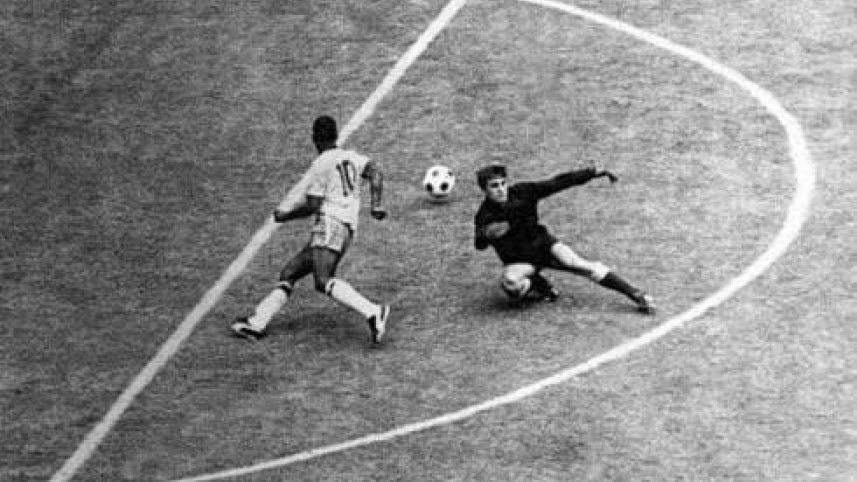
Uruguay’s goalkeeper, Ladislao Mazurkiewicz -- a name difficult to pronounce, but firmly etched in football history. Until that day, he was known as strong, intelligent, experienced. Not easily deceived.
Seeing Pele approach, he came off his line. That is what goalkeepers must do -- reduce the angle, reduce the chance. Mazurkiewicz did exactly that.
The distance between them shrank. The stadium noise seemed to dip -- or perhaps it was that peculiar silence that descends just before something immense occurs.
Then Pele went left.
At least, that is what it seemed.
Mazurkiewicz dived left -- with his entire body, his experience, his instinct. Because the ball was going there. His eyes said so. His brain said so. His entire being believed it.
But the ball did not go there.
In fact, it went nowhere.
It remained at Pelé’s feet. And Pele -- calmly, almost casually, as if strolling through a park on a Sunday morning --moved around him on the right.
Mazurkiewicz lay on the ground. Pele was through. The goal lay open.
The stadium was still trying to understand.
 For all latest news, follow The Daily Star's Google News channel.
 Pele took the shot. The ball rolled just wide of the post.
No goal.
And that is the most astonishing part of the story. Despite the miss, the world seemed to stop. Because everyone knew what they had just witnessed was not a footballing trick. It was something else. Something far greater.
What was it? No one could say then. Perhaps no one fully can even now.
In football, a dummy is a familiar technique. It exists in textbooks, is taught in training, happens thousands of times every season. But Pele’s dummy did not fit any textbook definition.
Because that day, he did not merely fool a goalkeeper. He altered a man’s reality, if only for a second. Mazurkiewicz saw something that never happened -- and believed it enough to act.
What do you call such power? Poets might call it hypnosis. Philosophers, a manipulation of perception. Scientists, an illusion shaped by mirror neurons. But those in Estadio Jalisco that day know no word fully captures it.
What Pele did was tell a story. A fictional one, lasting a second -- where the ball travelled left. And Mazurkiewicz was so absorbed in that story that he leapt into it.
That night, journalists asked him: what happened? Why did you dive?
He stayed silent for a long time. Then said: I thought the ball was going that way.
“I thought.”
Two simple words. Yet within them lies the essence of that moment. Pele did not change reality -- he changed perception. And when perception becomes stronger than reality, the body follows perception.
That day, Mazurkiewicz’s body did not trust his eyes. It trusted his feeling. And that feeling belonged to Pele.
Brazil won the match 3-1. In the final, they swept aside Italy 4-1 to become world champions for the third time at the 1970 FIFA World Cup. The Jules Rimet Trophy became theirs forever. The weight of that golden trophy may be known, but the weight of the football Brazil played in that tournament has never diminished.
Without touching the ball again, without scoring, with a single dummy, Pele placed a feeling into the hearts of fifty thousand people -- one that still lingers. Quiet, soft, undiminished.
That is how magic works.
Comments