


The four minutes defining Maradona's legacy

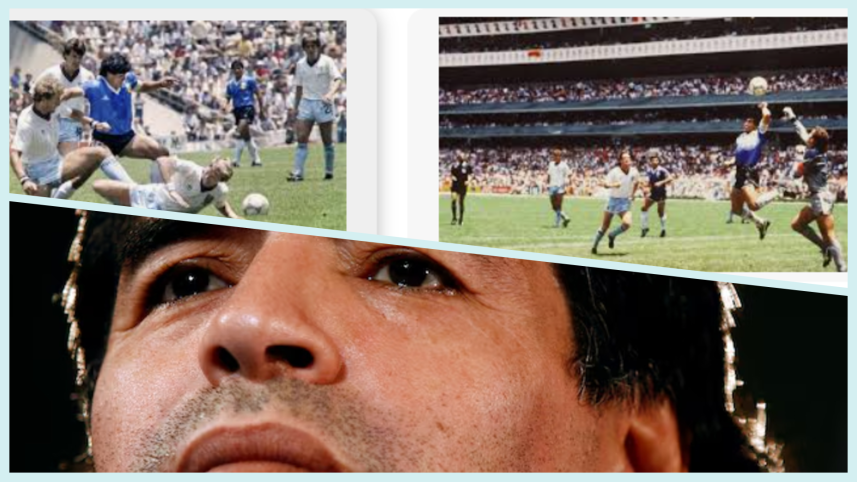
The moment was so fleeting that it could have been missed in the blink of an eye. Yet, that single moment has lived on through generations. In a sea of millions of goals, countless memories fade, but some strikes leave a permanent scar on the face of time. They cease to be mere goals; they become a strange concoction of history, controversy, politics, emotion, and legend.
The name of one such moment is the “Hand of God”.

A hand. Just a single hand. On that day, that hand took revenge for an entire nation, healed the wounds of a war, and created a moment in footballing history that still haunts the sleep of referees, players, and spectators alike. And at the centre was a man whose name makes the history of football pause in its tracks: Diego Maradona.
Even today, if you were to ask football fans in any corner of the world, "What is the most controversial goal ever scored?" the most frequent answer would likely be this one. For this is not just a story of breaking the rules. It is the tale of an event where truth and lies, right and wrong, and genius and deception all became one.
The date was June 22, 1986. The quarterfinal of the FIFA World Cup.
However, to the people of Argentina, this was no mere football match. The raw wounds of the Falklands War from four years prior were still bleeding in every Argentine heart. The cries of hundreds of young soldiers who perished at the hands of British forces in the icy waters of the Atlantic seemed to echo through the Mexican air. The fire of unspoken revenge burned in the eyes of Maradona and his teammates. In the stands, a cold war raged between supporters of the two nations, while on the pitch, an invisible battlefield had been drawn.
The first half ended in a goalless draw. Maradona’s magical rhythm was repeatedly disrupted by the fierce tackles and tight marking of the English defenders. But the landscape began to shift in the second half. In the 51st minute, Maradona dribbled the ball near the box and played a pass to his teammate Jorge Valdano. However, English midfielder Steve Hodge made a catastrophic error while trying to clear the ball. It sliced off his foot and looped high into the air, straight back into his own penalty area.
And right then, as if pulled by an invisible thread, Maradona pursued that ball like a predatory hawk.
England's towering goalkeeper, Peter Shilton, rushed off his line to claim the ball. Physically, there was no comparison between the 6-foot-1-inch Shilton and the 5-foot-5-inch Maradona. Moreover, the goalkeeper had the advantage of using his hands. Everyone in the stadium assumed Shilton’s massive pair of gloves would easily pluck the ball from the air.
But Maradona’s mind was busy with a different, daring calculation -- the cunning instinct of a boy raised in the back alleys of Latin America. He leaped into the air, using every ounce of his strength and his spring-like muscles. It was a desperate, almost impossible attempt to reach an inch higher than Shilton’s outstretched arms.
At that precise fraction of a second, just as the ball came within Shilton’s reach, the unbelievable happened. Maradona craftily brought his left hand up just beside his head. Before anyone could realise what had occurred, he outwitted Shilton's gloves; with a gentle yet precise touch from his clenched fist, the ball changed direction. After one bounce on the grass, the ball nestled into the English net, and the Azteca Stadium erupted in wild, primal celebration.
As soon as he hit the ground, Maradona stole a glance at the referee. When he saw no whistle had blown, he began sprinting towards the corner flag. His teammates were initially hesitant, in doubt. Maradona shouted to them, "Come and hug me, or the referee will disallow the goal!"
Meanwhile, the English players were bursting with rage and despair. Terry Fenwick, Glenn Hoddle, and Peter Shilton rushed towards the Tunisian referee, Ali Bin Nasser. The accusation in their eyes was singular and fierce: it was a handball.
But the referee’s eyes had completely failed to catch the subtle trickery of that magical hand. He looked to the linesman, Bogdan Dochev. The Bulgarian linesman remained frozen in his position; his flag stayed down. Consequently, the goal stood.
Maradona’s masterful acting that day fooled everyone, from the officials on the pitch to the entire footballing world. The protests and tears of the English were lost in the Mexican breeze.
The most extraordinary part is that just four minutes after this incident, Maradona produced a feat that eclipsed even his previous controversy. Carrying the ball from his own half and dancing past six English players, he scored the “Goal of the Century”. It was as if he was telling the world that while deception might be a temporary tool, supernatural footballing genius was his birthright.
In the press conference following the match, facing sharp questioning from journalists, Maradona delivered the most famous and poetic quote in history. With a smirk and a strange glint in his eye, he remarked, "The goal was scored a little with the head of Maradona, and a little with the hand of God."
Since then, this goal has been immortalised in football history as the “Hand of God”. Was it merely a cheat? Or was it the ultimate expression of Latin American “Viveza Criolla” (native cunning)?
What the English saw as unpardonable theft, the Argentines saw as epic retribution. The healing of a nation’s sigh, the birth of an unforgettable myth, and the eternal signature of a rebel god upon the football pitch.
 For all latest news, follow The Daily Star's Google News channel.
Comments