


The man who made the goalpost look smaller

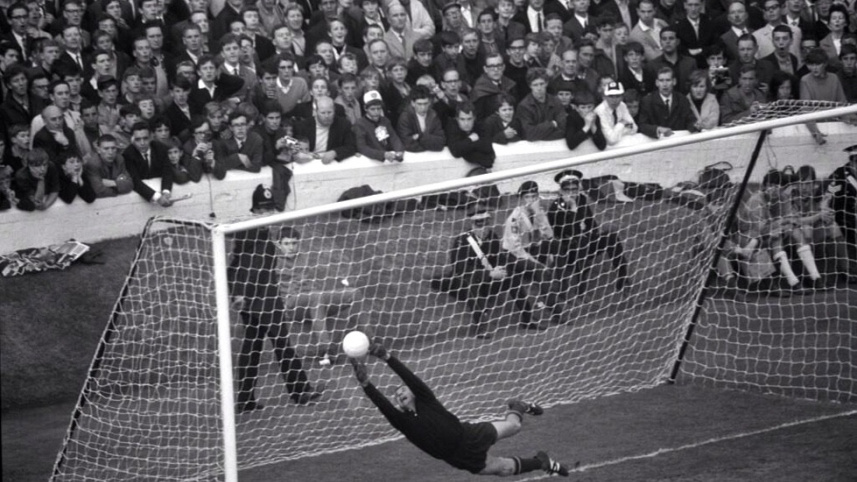
That day, the sky over Liverpool was heavy with clouds. A gentle breeze blew through the July afternoon, and the crowd at Goodison Park was sparse -- just over thirty-eight thousand.
This figure was the lowest among the five World Cup matches held at the same stadium in that edition in 1966. The reason was simple: the people of this city had expected to see England.

But FIFA, at the last moment, moved the England vs Portugal semifinal to Wembley and sent this other semifnal between the Soviet Union and West Germany to Merseyside. The people of the city were fuming with rage; the local paper called it "the greatest betrayal in sporting history."
But those who were in the gallery that day became witnesses to a page of history -- whether they wanted to or not.
The 1966 England World Cup was a document of a strange time. World War II had ended only twenty-one years prior. Europe was still divided into two: capitalism in the West, socialism in the East.
The wind of the Cold War blew over every match. National anthems were not played for socialist countries because the organisers did not want Soviet or North Korean melodies floating across the Wembley pitch. Amidst that political tension, the Soviet team took to the field, led by a 36-year-old goalkeeper whom the world then knew as the "Black Spider."
Lev Yashin. Dressed in black from head to toe. A black jersey, black shorts, black socks -- on the green canvas of the pitch, he was a living enigma. There was a strange tranquility on his face, yet a gunpowder-like agility hidden in his muscles. When an opponent's striker would enter the D-box alone with the ball, his nerves would fail for at least a moment upon seeing that familiar black silhouette. Beneath the goalposts, he was not a human being; he was an invisible wall.
The Soviet team in that World Cup was extraordinary. Captain Albert Shesternyov, midfielder Valery Voronin, striker Igor Chislenko, and Galimzyan Khusainov; every name was a cause for fear in that generation of European football. Young Dynamo Kyiv striker Valeriy Porkuyan was added to the squad at the last minute -- a decision that was vindicated on the pitch.
Winning every match in the group stage, they reached the quarterfinals. There, against Hungary, Yashin’s goalkeeping was like a fortress. Hungary could only score once, and even that was merely a consolation. For the first time in history, the Soviet Union reached the World Cup semifinals.
Ahead of them: West Germany.
July 25, 1966. Goodison Park.
Fifteen thousand German supporters had arrived. Their voices drowned out all others. But the local Liverpool people -- who had actually wanted to see England play but didn’t get to -- made a strange decision. They cheered loudly for the Soviets. Perhaps it was an expression of their anger against FIFA; perhaps it was the affection built throughout the tournament for that Soviet team, as the Soviets had won the hearts of the English spectators with their brave play.
The match began. From the start, it was clear this would not be a match of subtle football. The Times later wrote that it was "a battle of dreadnoughts, a clash of heavy armor." The sound of every tackle reached the top rows of the gallery.
The German attack, built with stars like Franz Beckenbauer and Uwe Seeler, was the terror of football at the time. Attack after attack crashed against the Soviet defense. But the name of the last sentinel of the Soviet fortress was Lev Yashin! Like a magician, he parried one German cannonball shot after another. He dived and dived again, as if gravity had no effect on him.
Behind these inhuman reflexes and steel-hard nerves lay a difficult past. Amidst the chaos of World War II, at just twelve years old, he had to take a job in a factory. It was in the dusty fields of that factory that he first caught a ball. He also played ice hockey with great skill in the land of ice. The experience of stopping a high-speed puck as an ice hockey goalie perhaps gave him such superhuman agility on the football pitch. His two hands were like magnets, and the football a piece of iron.
The freekick from that match remains an immortal scene in football history. A German player stood behind the ball. The gallery was silent. The shot was taken. The ball cut through the air toward the corner of the goal. And right then, Yashin flew. Yes, not a dive -- he flew. His whole body extended, his black outfit floating in the air as if a great bird had spread its wings. His hand touched the ball. The trajectory of the ball changed. Thousands of spectators screamed in unison with amazement. But Yashin stood up with such an indifferent demeanor, as if he had merely fulfilled his duty.
This very indifference made him even more terrifying. Many goalkeepers celebrate with a shout after a big save. Yashin did not. There would be a strange peace on his face. As if saving the impossible was a common task for him. And for that reason, opposing strikers gradually lost their self-confidence. Even before striking the ball, they probably would think, "Is it even possible to defeat this man?"
In terms of saving penalties, he was almost superhuman. It is said that he stopped more than 150 penalties. But Yashin cannot be explained by numbers. His real strength was mental dominance. Before a shot was taken, he would stare into the strikers' eyes in such a way that it felt like he was entering their minds. Many players later admitted that the goalpost felt smaller when standing before Yashin.
There is also a separate chapter regarding his black attire. While others wore bright-colored jerseys, Yashin intentionally chose entirely black clothing. Black jersey, black shorts, black socks, and often even a black cap. From a distance, he looked like a shadow of the night. From that, the name "Black Spider" was born. Because it was as if he caught every shot in his own web.
Before Yashin, goalkeeping was quite monotonous. He threw the idea that a goalkeeper's duty ends with standing along the goal line and catching the ball into the dustbin. He realised that a goalkeeper is not just the team's last line of defense; they can be the first attacker. After clutching the ball, he would start the team's counter-attack with a lightning-fast, precise throw. The scene we see in modern football today -- coming out of the D-box to clear the ball -- was pioneered by this Black Spider.
 For all latest news, follow The Daily Star's Google News channel.
 In recognition of his extraordinary feats, the Ballon d'Or was placed in his hands in 1963. As the only goalkeeper in football history, this achievement remains his sole property to this day. Yashin was the greatest proof that a goalkeeper can write the fate of an entire match simply by saving goals.
On that afternoon at Goodison Park, the Soviet Union may have lost to West Germany, but Yashin’s gravity-defying diving saves gained immortality in football history. Whenever a goalkeeper makes an unimaginable save beneath the crossbar, the football world still seems to see the shadow of that "Black Spider" there today.
Comments