


Two contrasting models: France and Morocco show how migration is reshaping modern global football

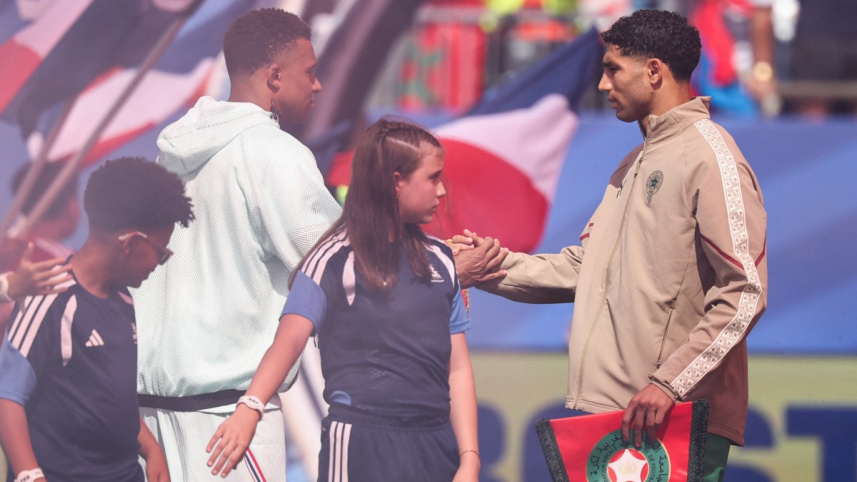
The scoreline in last night's FIFA World Cup quarterfinal -- France 2, Morocco -- tells many stories. Beyond the result, it offers a powerful lesson about migration and modern football.
Few countries illustrate this better than France and Morocco. In recent decades both have built their football on the strength of migration and diaspora communities, yet they have done so in strikingly different ways.

France integrates migrants and their descendants into its national identity, producing a multicultural team that mirrors the country's changing society. Morocco, by contrast, has built one of the world's most successful diaspora recruitment systems, turning millions of Moroccans living abroad into a reservoir of football talent.
France's approach is rooted in integration. Of the 26 players selected for the 2026 FIFA World Cup, 16 are either migrants themselves or first-generation descendants of migrants. They include Mike Maignan, Jules Koundé, Dayot Upamecano, William Saliba, Theo Hernandez, Aurélien Tchouaméni, Ousmane Dembélé and Kylian Mbappé -- players whose family histories stretch across Africa, the Caribbean and Europe.
France has long been described as Africa's "sixth team" because of the large number of players with African heritage who have worn the blue shirt.
Their success reflects decades of investment in youth development, one of the world's finest academy systems and an ability to integrate diverse communities into a shared football identity. Immigration has expanded France's talent pool, while the country's football institutions have transformed that diversity into sustained sporting excellence.
The results speak for themselves.
France has reached four FIFA World Cup finals, winning in 1998 and 2018 and finishing runners-up in 2006 and 2022. Before lifting its first World Cup trophy in 1998, its best performances had been third-place finishes in 1958 and 1986.
Victory over Morocco has moved France closer to another final. If Les Bleus reach the 2026 final, they will become only the third nation in history to appear in three consecutive World Cup finals, after Brazil (1994, 1998 and 2002) and Germany (1982, 1986 and 1990).
France is also emerging as the world's leading exporter of footballers.
Ninety-nine players selected by the 48 competing nations at this summer's tournament were born in France, more than any other country. The Netherlands ranks a distant second with 67.
Of those 99 France-born players, 23 represent France itself, while 13 play for Algeria, 12 for Haiti, 11 for DR Congo, 10 for Senegal, eight for Côte d'Ivoire, seven for Tunisia and six for Morocco. Others represent Cape Verde, Ghana, Egypt, Qatar and Spain.
In 2015, legendary former Arsenal manager Arsène Wenger argued that São Paulo in Brazil was the world's greatest breeding ground for football talent.
A decade later, Greater Paris has arguably inherited that title, with 53 players born in Paris or its suburbs representing countries at FIFA's showcase in North America.
Morocco's story is equally remarkable, but follows a very different path.
Only seven members of Morocco's 26-man World Cup squad were born inside the country. The remaining 19 were born abroad, including 18 in Europe.
That story began in the 1960s, when France, Belgium and the Netherlands recruited thousands of Moroccan workers to meet labour shortages during the post-war economic boom. Spain later became another major destination. What began as temporary migration evolved into permanent settlement, creating large Moroccan communities across Europe.
Their children grew up with dual identities -- European by birth and Moroccan by heritage. Many were eligible to represent either country in international football.
Rather than seeing this as a challenge, the Royal Moroccan Football Federation turned it into an opportunity. It built one of football's most sophisticated diaspora scouting networks, identifying talented youngsters across Europe and persuading them to don the Atlas Lions jersey.
Morocco's rise demonstrates that a nation's footballing strength is no longer defined solely by the people living within its borders. In an era of global migration, diaspora communities have become strategic national assets capable of transforming sporting fortunes.
 For all latest news, follow The Daily Star's Google News channel.
 The payoff has been historic.
Morocco became the first African nation to reach consecutive World Cup quarterfinals in 2022 and 2026. In 2022, it also became the first African country ever to reach a World Cup semifinal, inspiring millions across the continent.
In 2025, Morocco was officially awarded the Africa Cup of Nations title after Senegal forfeited the final, although the decision remains under legal challenge before the Court of Arbitration for Sport.
Comments