


World Cup 2026 new rules: VAR overturns yellow card after play restarts
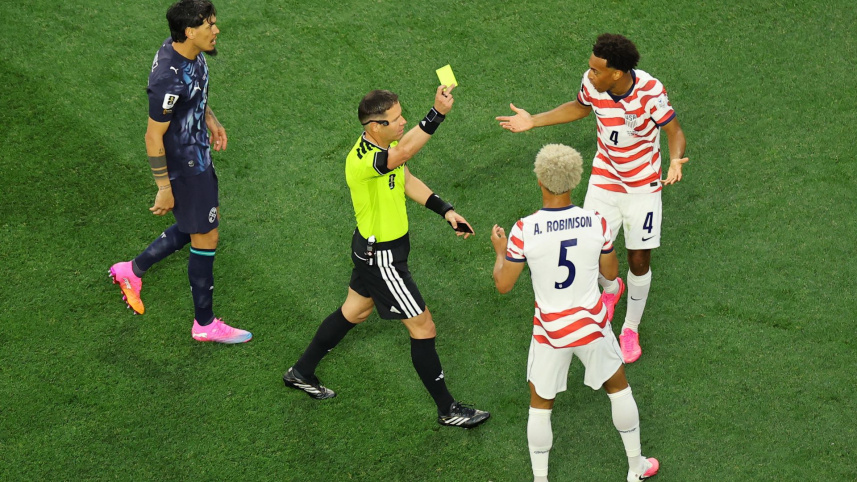
At the SoFi Stadium in Los Angeles, the opening Group D match between United States and Paraguay at the 2026 World Cup became a landmark moment in football officiating, not because of the scoreline, but because of how the Video Assistant Referee (VAR) was used under newly expanded rules.
The incident began early in the second half during a physical duel between veteran U.S. defender Tim Ream and Paraguay forward Miguel Almiron. Referee Danny Makkelie judged Ream to have committed a heavy foul and immediately issued a yellow card. Play continued without interruption, and Paraguay restarted quickly with a free kick, believing the decision had been fully settled.

Under previous laws, that restart would normally have closed the door on any further intervention unless it involved a straight red card review or a major factual error before play resumed. However, the 2026 World Cup introduced a significant expansion to VAR authority, specifically allowing corrections for mistaken identity and clearly incorrect disciplinary actions --even in situations where play had already restarted --provided the correction could be made without unduly disrupting the match.
Moments after the restart, the VAR room reviewed the incident and identified a problem: the foul and the resulting caution had been incorrectly attributed. It was not clear that Tim Ream had committed the infringement on Almiron. The officials also flagged that the action involved a possible simulation rather than a genuine foul.
Crucially, under the new interpretation of Law 5, VAR was permitted to intervene because this fell under “mistaken identity” and clearly incorrect disciplinary action. Even more unusually, the law allowed a review despite the fact that the game had already resumed, because the restart was considered “incorrectly based on an error” that could still be rectified without replaying significant phases of play.
Referee Makkelie was instructed to stop play and go to the pitchside monitor. After reviewing the footage, he concluded that Ream had not committed the foul as originally believed. Instead, Miguel Almiron had gone down too easily, and the incident was more consistent with simulation than a legitimate challenge.
In a rare reversal, Makkelie rescinded the yellow card shown to Ream and instead cautioned Almiron for simulation. This decision effectively rewrote a disciplinary action after play had already moved on, something that was previously not permitted under traditional VAR limitations.
The moment was significant for two reasons. First, it marked one of the first high-profile applications of the expanded VAR “mistaken identity” correction rule at a World Cup. Second, it demonstrated the competition’s willingness to allow VAR to intervene even after a restart, breaking with the long-standing principle that play continuity limited retrospective changes.
Officials emphasized that such interventions would remain narrow in scope. The rule applies only to clear cases—mistaken identity, obvious disciplinary errors such as incorrect bookings, or extreme foul play situations—and only when the correction can be made immediately without affecting the flow of the match excessively.
After the confusion was resolved, the match continued normally, but the VAR incident became the defining talking point. While the United States went on to win comfortably 4–1, the lasting impact was the sense that football’s officiating framework had entered a new era—one where even a restarted phase of play was no longer entirely beyond correction if justice demanded it.
 For all latest news, follow The Daily Star's Google News channel.
Comments