


Behemoth Bleeds
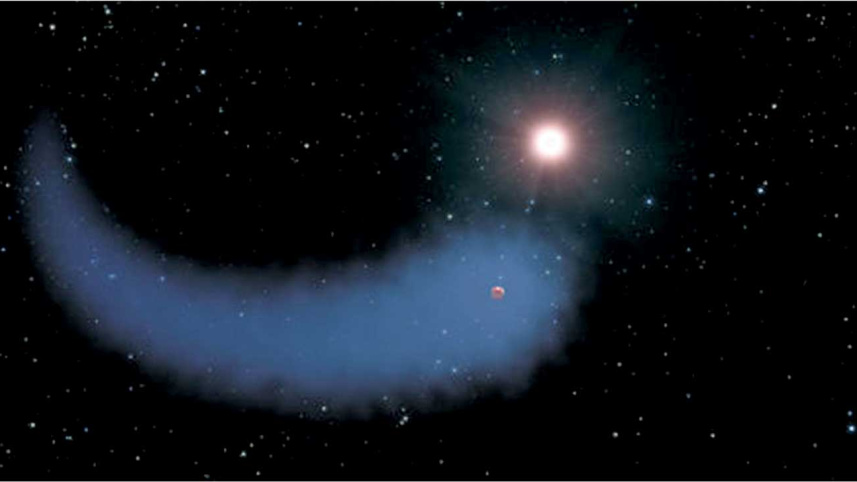
Astronomers using NASA's Hubble Space Telescope have discovered an immense cloud of hydrogen dubbed "The Behemoth" bleeding off a planet orbiting a nearby star. The enormous, comet-like feature is about 50 times the size of the parent star. The hydrogen is evaporating from a warm, Neptune-sized planet, because of the extreme radiation from the star.
A phenomenon this large has never been seen around any planet. Given this planet's small size, it may offer clues to how hot super-Earths – massive, rocky, hot versions of Earth – are born around other stars through the evaporation of their outer layers of hydrogen.

"This cloud is very spectacular, though the evaporation rate does not threaten the planet right now," explains the study's leader, David Ehrenreich of the Observatory of the University of Geneva in Switzerland. "But we know that in the past, the star, which is a faint red dwarf, was more active. This means that the planet evaporated faster during its first billion years of existence. Overall, we estimate that it may have lost up to 10 percent of its atmosphere."
The planet, named GJ 436b, is considered to be a "warm Neptune," because of its size and is much closer to its star than Neptune is to our sun. Although it is in no danger of having its atmosphere completely evaporated and being stripped down to a rocky core, this planet could explain the existence of so-called hot super-Earths that are very close to their stars.
WHY PARROTS IMITATE
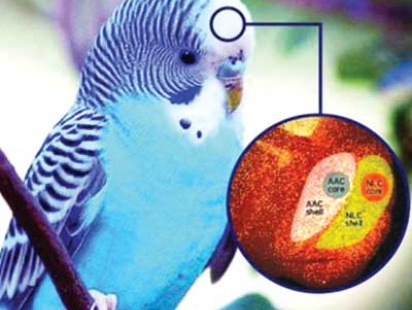
An international team of scientists led by Duke University researchers has uncovered key structural differences in the brains of parrots that may explain their unparalleled ability to imitate sounds and human speech.
Reported June 24 in Plos One, these brain structures had gone unrecognized in studies published over the last 34 years. The results may also lend insight into the neural mechanisms of human speech.
"These findings open up a huge avenue of research in parrots, in trying to understand how parrots are processing the information necessary to copy novel sounds and the mechanisms that underlie imitation of human speech sounds," said Mukta Chakraborty, a post-doctoral researcher in the lab of Erich Jarvis, an associate professor of neurobiology at Duke and a Howard Hughes Medical Institute Investigator.
Parrots are one of the few animals considered 'vocal learners,' meaning they can imitate sounds. Researchers have been trying to figure out why some bird species are better imitators than others. However, no other potential explanations have yet surfaced other than the differences in the sizes of particular brain regions.
Source: www.sciencedaily.com
 For all latest news, follow The Daily Star's Google News channel.
Comments