


Methane in Mars
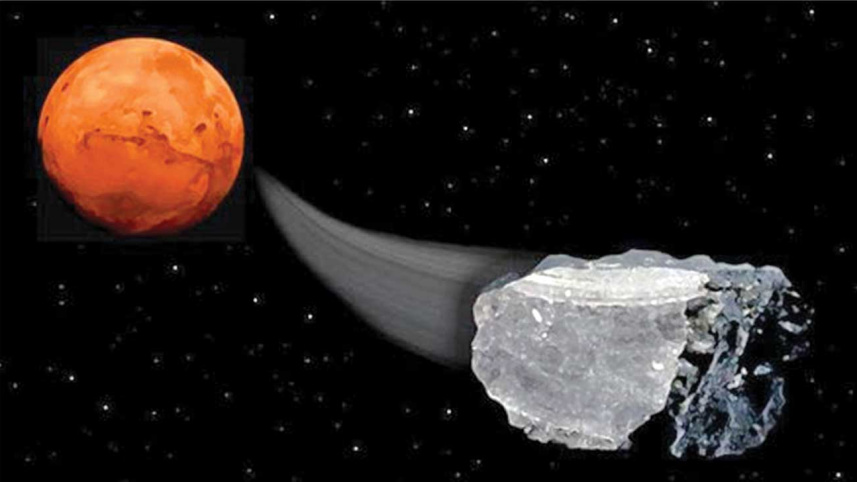
An international team of researchers has discovered traces of methane in Martian meteorites, a possible clue in the search for life on the Red Planet.
The researchers examined samples from six meteorites of volcanic rock that originated on Mars. The meteorites contain gases in the same proportion and with the same isotopic composition as the Martian atmosphere. All six samples also contained methane, which was measured by crushing the rocks and running the emerging gas through a mass spectrometer. The team also examined two non-Martian meteorites, which contained lesser amounts of methane.

The discovery hints at the possibility that methane could be used as a food source by rudimentary forms of life beneath the Martian surface. On Earth, microbes do this in a range of environments.
"Other researchers will be keen to replicate these findings using alternative measurement tools and techniques," said co-author Sean McMahon, a Yale University postdoctoral associate in the Department of Geology and Geophysics. "Our findings will likely be used by astrobiologists in models and experiments aimed at understanding whether life could survive below the surface of Mars today."

BEHAVIOR RELATED TO BIO MARKS
Preschoolers with oppositional defiant behavior are more likely to have shorter telomeres, a hallmark of cellular aging, which in adults is associated with increased risk for chronic diseases and conditions like diabetes, obesity and cancer.
This phenomenon was uncovered by UCSF researchers, who also identified maternal clinical depression as an independent predictor for shortened telomeres in young children, according to a study published in the journal Translational Psychiatry.
Likened to the plastic tips of shoelaces, telomeres cap the ends of chromosomes and act as buffers against the loss of protein-coding DNA during cell division. While telomere shortening happens naturally with aging, mounting research indicates the process is accelerated by psychological and biological stress.
"These are the first steps in a new field aiming to understand early determinants of children's telomeres. There are not any studies yet that examine telomere length changes from birth to adulthood, so the long-term implications are unknown," said lead author Janet Wojcicki, PhD, assistant professor in the UCSF Department of Pediatrics. "In adults, however, short telomeres predict earlier onset of many diseases, and shorter telomere length likely tracks from childhood throughout life."

GPS Hits Curve Balls
Our brains track moving objects by applying one of the algorithms your phone's GPS uses, according to researchers at the University of Rochester. This same algorithm also explains why we are fooled by several motion-related optical illusions, including the sudden "break" of baseball's well known "curveball illusion."
The new open-access study published in PNAS shows that our brains apply an algorithm, known as a Kalman filter, when tracking an object's position. This algorithm helps the brain process less than perfect visual signals, such as when objects move to the periphery of our visual field where acuity is low.
However, the same algorithm that helps our brain track motion can be tricked by the pattern motion of an object, such as the seams on a spinning baseball, which causes our brain to "see" the ball suddenly drop from its path when, in reality, it curves steadily.
Though we often rely on Global Positioning System (GPS) to get us to our destination, the accuracy of GPS is limited. When the signal is "noisy" or unreliable, your phone's GPS uses algorithms, including the Kalman filter, to estimate the location of your car based on its past position and speed.
"Like GPS, our visual ability, although quite impressive, has many limitations," said the study's co-author, Duje Tadin, associate professor of brain and cognitive sciences at the University of Rochester.
Source: Sciencedaily.com
 For all latest news, follow The Daily Star's Google News channel.
Comments