


SINKHOLES IN COMET
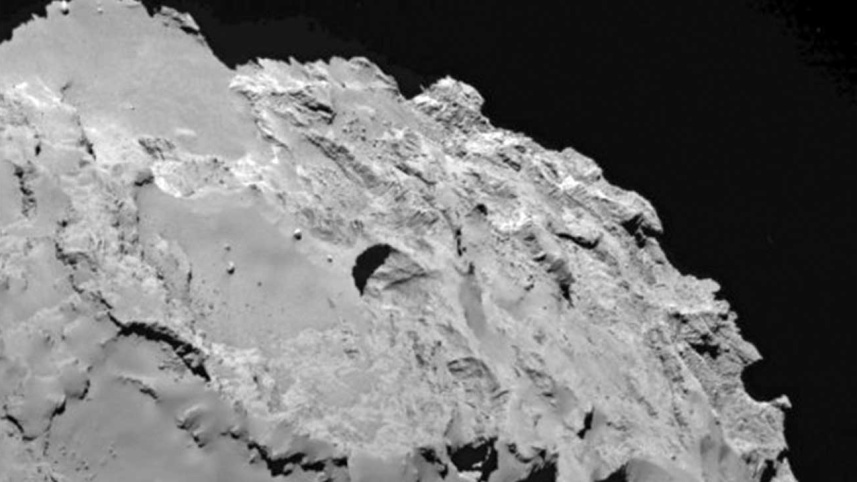
The European Space Agency's Rosetta spacecraft first began orbiting comet 67P/Churyumov-Gerasimenko in August 2014. Almost immediately, scientists began to wonder about several surprisingly deep, almost perfectly circular pits on the comet's surface. Now, a new study based on close-up imagery taken by Rosetta suggests that these pits are sinkholes, formed when ices beneath the comet's surface sublimate, or turn directly to gas.
The study, which appears in the July 2, 2015 issue of the journal Nature, reveals that the surface of 67P/Churyumov-Gerasimenko is variable and dynamic, undergoing rapid structural changes as it approaches the sun. Far from simple balls of ice and dust, comets have their own life cycles. The latest findings are among the first to show, in detail, how comets change over time.

"These strange, circular pits are just as deep as they are wide. Rosetta can peer right into them," said Dennis Bodewits, an assistant research scientist in astronomy at the University of Maryland who is a co-author on the study. The pits are large, ranging from tens of meters in diameter up to several hundred meters across.
BIRTH OF A PLANET
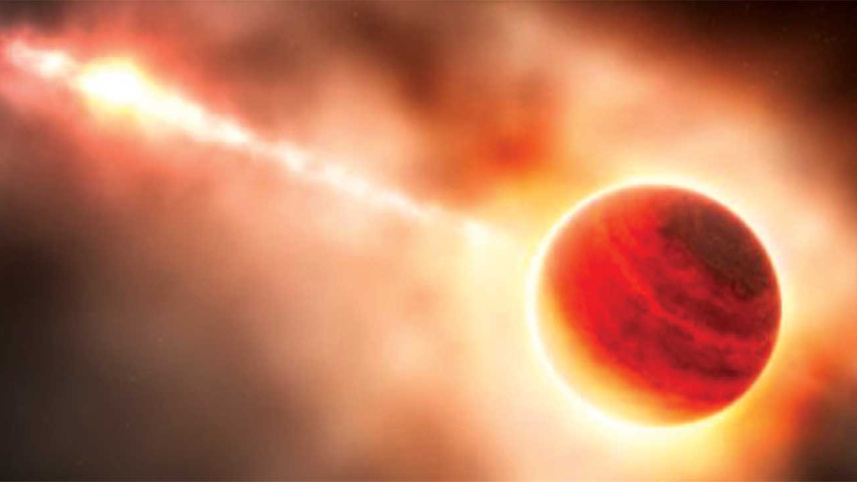
Observing time at the European Southern Observatory (ESO) on Paranal Mountain is a very precious commodity – and yet the Very Large Telescope (VLT) in Chile spent an entire night with a high-resolution infrared camera pointed at a single object in the night sky. The data collected by the Naco optics instrument enabled an international team headed by ETH Zurich's Sascha Quanz to confirm its earlier hypothesis: that a young gas planet – presumed not unlike Jupiter in our own solar system – is orbiting the star designated HD 100546.
At "just" 335 light years away, HD 100546 is one of our cosmic neighbours nearby, and its age of five to ten million years makes it relatively young in astronomical terms. Like many young stars, it is surrounded by a massive disk of gas and dust. The outer reaches of this disk are home to the protoplanet, which lies at a distance from its parent star that is some fifty times greater than the distance between Earth and the Sun.
Source: Sciencedaily.com
 For all latest news, follow The Daily Star's Google News channel.
Comments