


Inside Hasina’s fall

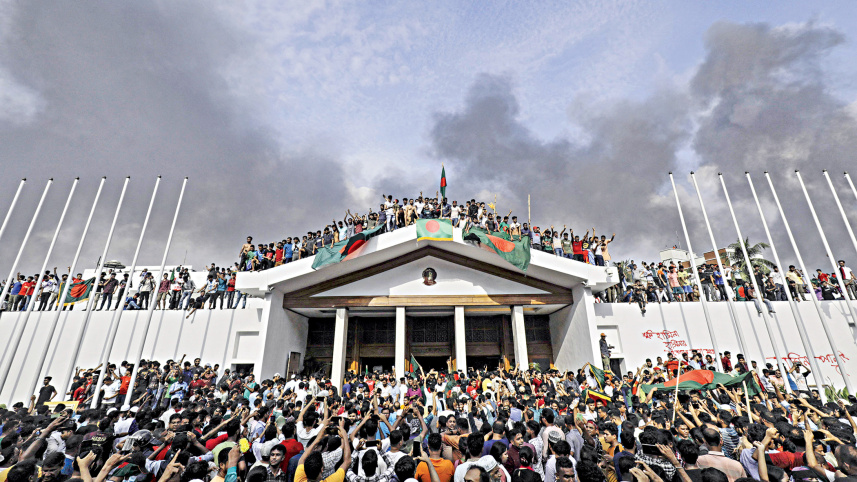
To call it a tumultuous time would be an understatement. The state-sponsored massacre had reached a bloody crescendo, yet the iron grip of Sheikh Hasina seemed firmer than ever in late July and early August 2024. On some days, it felt as though law enforcement agencies would continue shooting until the bullets ran out.
Yet beneath the facade of absolute control, the gears of the regime were already stuttering.

While much of an uprising’s success lies in pure adrenaline-driven public momentum, the rest lies in the foresight to prepare for the inevitable.
From hidden safe houses, the student leaders of the July Uprising had carefully structured an all-out non-cooperation movement designed to economically choke Sheikh Hasina’s autocracy over several weeks. Yet the regime fell apart with a speed that defied almost everyone’s expectations.
Based on interviews with five people directly involved in discussions before and after Sheikh Hasina’s departure on August 5, this reconstruction sheds light on how political actors, military officials, student leaders and civil society figures navigated the collapse of the Awami League government and the emergence of Bangladesh’s interim administration.
While The Daily Star could not reach out to all the actors mentioned by our interviewees, together their accounts offer a glimpse into decisions made during one of the most consequential political transitions in the country’s history.
With Hasina’s collapse on the horizon, the clock had just struck 00:20am on August 5, 2024, when Maj Gen (retd) Fazle Elahi Akbar, former security adviser to Khaleda Zia, received a call from army chief General Waker-uz-Zaman. Gen Waker asked Akbar to meet him later that morning.
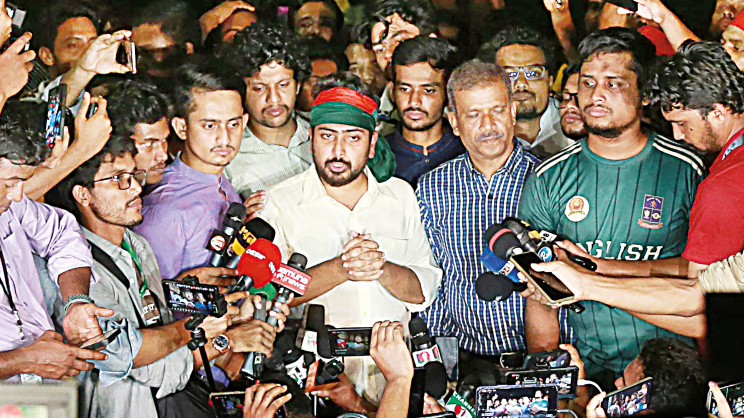
That meeting started around 10:00am on August 5 at the army chief’s residence and lasted about half an hour, Akbar told The Daily Star last week.
“He was very keen to solve this issue. He said, ‘I want to conclude this present situation by discussing with the major political stakeholders, and I task you to bring them together as soon as possible so that I can discuss and reach a final decision.’ That decision, of course, concerns the exit of Hasina and what comes next,” said Akbar.
“My talk with him lasted until around 10:30, because after that he told me himself that the Indian Army Chief was going to call. He served me coffee and, as I was drinking it, I said, ‘In that case, I should leave,’” he continued.
Upon leaving the army chief’s residence, Akbar immediately called BNP Secretary General Mirza Fakhrul Islam Alamgir, who welcomed the development. While Fakhrul noted that he needed to consult the party leadership, his initial response was overwhelmingly positive.
Reaching other key figures proved far more difficult amid the atmosphere of panic. Akbar said both Jamaat-e-Islami Ameer Shafiqur Rahman and Nagorik Oikya’s Mahmudur Rahman Manna were initially difficult to track down.
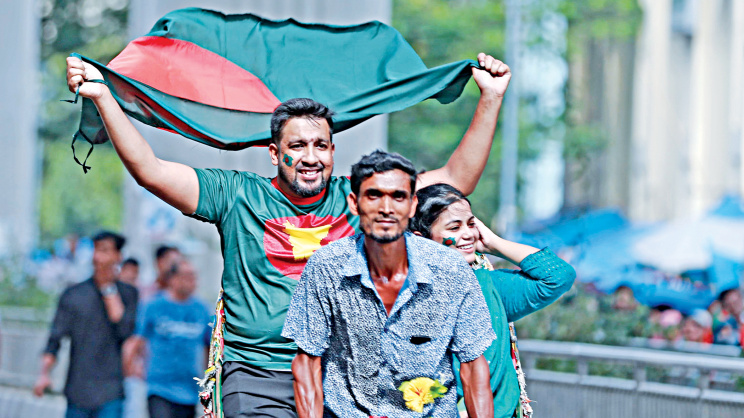
That same morning, Prof Asif Nazrul was about to join his colleagues at a protest in the Dhaka University area. His phone rang just as he stepped into the bathroom.
“The screen displayed a number with an army-type logo, making it clear who was calling. When I answered, the voice on the other end said, ‘Could you come to the Army Headquarters for a bit, sir? We will send a car for you,’” recalled Nazrul.
Caught completely off guard, Nazrul asked whom he would be meeting.
The caller replied: “Sir, you will speak with the Chief.”
Panic set in. His wife wept, fearing he would be killed or disappeared.
Torn over what to do, Nazrul consulted Syeda Rizwana Hasan and Mirza Fakhrul Islam Alamgir, who confirmed that major political leaders were already heading towards the cantonment.
Representatives from all major political parties, including the Jatiya Party, started gathering inside the cantonment after 1:00pm.
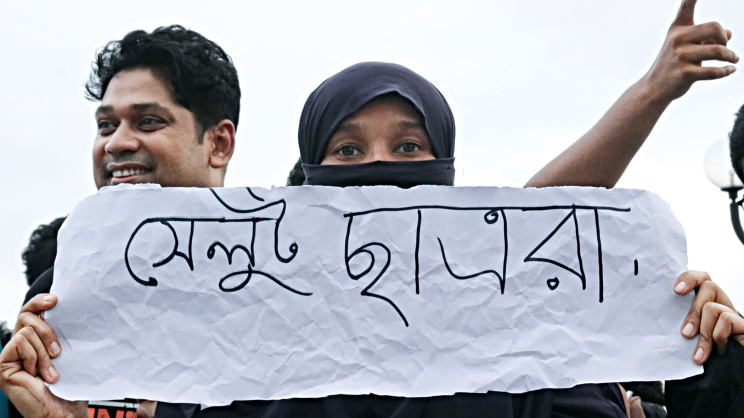
“At that point, Sheikh Hasina hadn’t fled yet. The only solid information was that she would step down. The immediate question became: once Parliament was dissolved, what came next? Would emergency rule be declared?” said Nazrul.
 For all latest news, follow The Daily Star's Google News channel.
 The discussion centred on dissolving Parliament to pave the way for an interim or caretaker government. The establishment of a “non-partisan” or “national” government was not discussed.
“To be clear, it was strictly about forming a government; elections were not even mentioned at that point,” he added.
When Sheikh Hasina’s flight took off at 3:09pm, the army chief announced her departure on television around 3:50pm. The group then left for Bangabhaban to meet the president and ask him to dissolve Parliament.
CANTONMENT TO BANGABHABAN
While political leaders gathered inside the cantonment to discuss dissolving Parliament, the meeting left the student movement’s leaders in a frenzy.
Asif Mahmud was in the midst of heavy gunfire in Chankharpul when he received a call from a diplomatic source around 11:00am saying that political parties were gathering at the cantonment to discuss an emergency arrangement.
“At that point, the government had not fallen, and the prime minister was still in power,” Asif recalled. “It appeared that the political parties were going to give their consent to a military-led transitional government, with elections on a distant horizon.”
Refusing to accept a military-steered transition, Asif immediately went live on Facebook and issued a blunt public warning: “The future of the country will not be decided from the cantonment.”
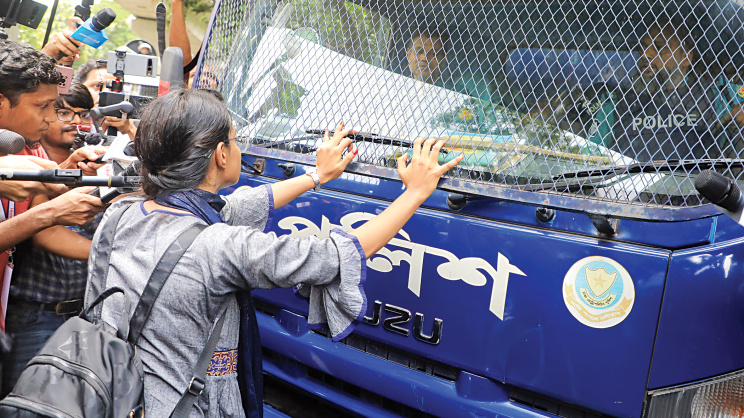
Maj Gen (retd) Akbar flatly rejected that interpretation, maintaining that martial law was never on the table.
Still, Asif acknowledged that key political figures prevented any unilateral arrangement.
“While many politicians were eager to reach an immediate understanding with the military, a few insisted that the students were the primary stakeholders and had to be consulted on any decision,” he told The Daily Star.
With the roads overflowing with jubilant crowds after Hasina fled to India, the political and military leadership reached Bangabhaban around maghrib prayers time. The president walked into the room around 7:30pm.
Describing the setting, Maj Gen (retd) Akbar said: “Mirza Fakhrul was seated in the first corner on the right, followed by the Jamaat-e-Islami Ameer and leaders from other political parties. I was seated on the other side, near the president. Next to me was the Charmonai Pir, followed by Asif Nazrul and Zonayed Saki. Seated on the opposite side were the DGFI chief, the other service chiefs and several key officials.”
The first major demand put forward was the immediate release of Khaleda Zia from custody. When a Jatiya Party politician raised the issue of legal procedure, Nazrul countered that her imprisonment itself had violated due process.
“The president was initially hesitant, saying that there is going to be a government formed and that the new government should take that decision,” said Akbar.
“At that point, the army chief intervened directly, saying, ‘No sir, you have full authority as president to pardon anybody and you should release her immediately,’” Akbar recounted.
He said the DGFI chief then briefed the group on the law-and-order situation across Dhaka, including reports of police stations being looted and weapons being taken away.
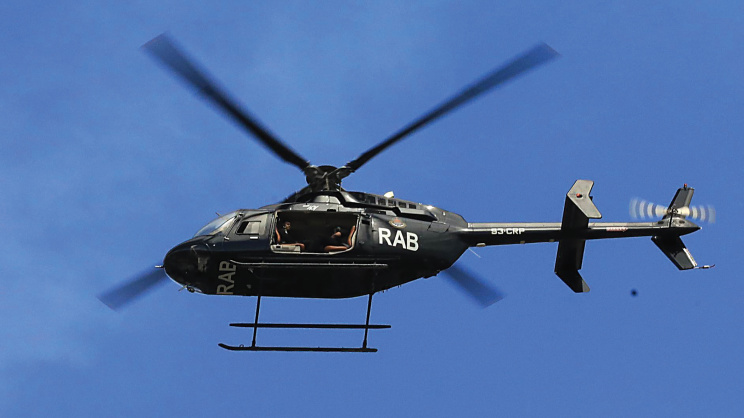
“I raised three key points. First, while the military could stabilise things for now, ultimately the police must take over. I suggested that certain senior police officers who were at the forefront be arrested and publicised in the media to calm public anger and save the rest of the police force,” Akbar recalled.
“Second, I brought up the issue of high-profile departures. I pointed out that people were still flying out of the country. In response, the air force chief ordered an immediate freezing of the entire airspace. No aircraft would be allowed to take off,” he continued.
“Third, I raised the issue of secret detention facilities,” Akbar said. “I addressed the president, saying I had just received a call that people were picketing the DGFI headquarters and demanding the release of individuals held in a place called Aynaghor.”
“To this, the president responded, ‘Is there something called Aynaghor? Is anyone actually held in Aynaghor?’” Akbar said.
According to Akbar, the president then asked the DGFI chief to respond, but the army chief stepped in first.
“I take full responsibility. Everyone will be released,” Akbar quoted the army chief as saying.
“And that is how the issue was resolved right there,” he said.
Around 11:00pm, Asif Nazrul was tasked with bringing student leaders to Bangabhaban to meet the president and Gen Waker.
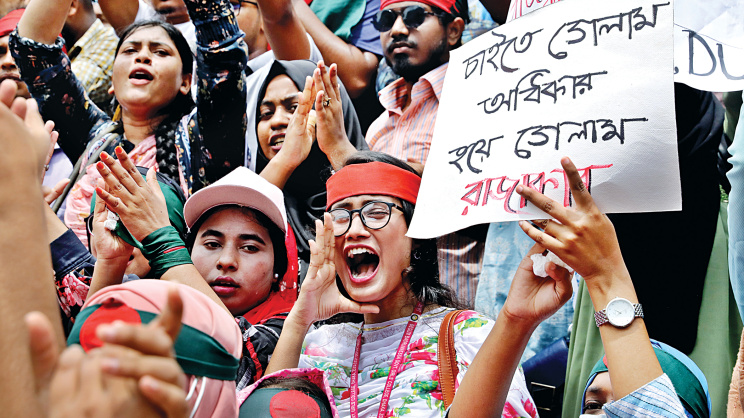
HOW YUNUS BECAME CA
Since at least five days before Sheikh Hasina’s fall, a search was under way for potential members of a future government to prevent a vacuum of power from descending into anarchy.
“I mean, there was no opportunity for red tape to get in the way. At that time, phone calls were being made directly to Tarique Rahman and Mirza Fakhrul Islam Alamgir. Names were being brought up right there on the phone, and they were giving immediate feedback: this is right, this is wrong, this person can be kept, that person cannot. That’s how decisions were being made back then,” Asif Mahmud Shojib Bhuiyan, a July Uprising student leader and former adviser to the interim government, told The Daily Star.
Nazrul found the student leaders at Curzon Hall around 1:00am on August 6.
Nahid Islam, now a lawmaker from Dhaka-11, asked Nazrul about the nature of the government. Nazrul responded by inviting the student leaders to Bangabhaban the following afternoon.
They also discussed the size and composition of the government. When Nazrul proposed including one student representative, the student leaders rejected the idea.
Nahid then asked who might lead the government.
“I suggested that a senior figure was needed. I mentioned names like Salehuddin Ahmed, Hossain Zillur Rahman and Wahiduddin Mahmud as examples of the calibre of person required, rather than identifying any one individual. That was when Nahid brought up Dr Yunus,” said Nazrul.
Nahid proposed Dr Muhammad Yunus as the head of the government, and Nazrul pointed out that Yunus might not agree.
Proposing Yunus’s name was not a spur-of-the-moment decision. According to the student leaders interviewed for this story, discussions about the possibility had begun days before the regime fell.
Dr Badiul Alam Majumder, founder-secretary of SHUJAN, said the students sought his help in establishing contact with Yunus on August 1, 2024.
“Asif contacted me and asked for assistance in getting in touch with Dr Yunus’s team because they wanted him to lead the next government. I helped put them in touch,” said Badiul. “It was a few days before Hasina’s fall, but I knew it was only a matter of time before the lid blew off the boiling pot.”
Asif said that he got in touch with Dr Yunus’s team on August 2, 2024.
“When I told Nahid Bhai we were speaking, he just said, ‘Okay, go ahead.’ Back then, it was far from certain that the government would fall,” said Asif.
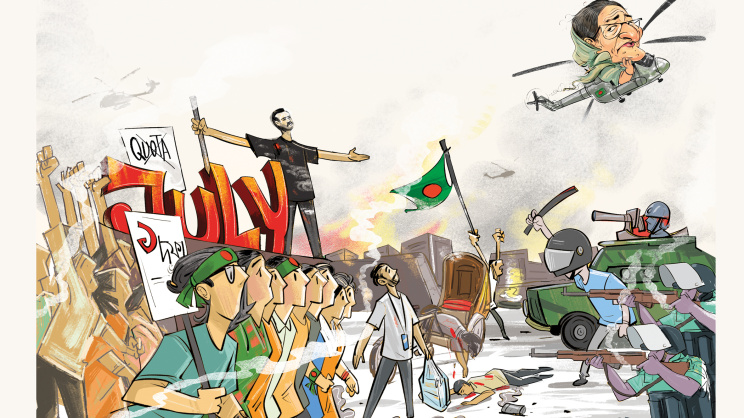
“I contacted his team because he was ill, and they arranged a call between him and me on August 3. He was able to recognise me because of the visibility I had gained through the movement,” Asif said.
“He gave his full backing to our non-cooperation movement. I then raised the possibility of him leading a transitional administration to rescue the country from political and economic ruin. Dr Yunus initially declined, asking us to seek other candidates. But for us, there was no second choice,” Asif recalled.
He said the students informed BNP and Jamaat of their choice, and both agreed.
“But the name came from us,” he said.
Hours after Hasina fled to India, the student leaders spoke with Dr Yunus again by phone on the evening of August 5. According to Asif, it was the first time that Yunus responded positively to the proposal. After several more discussions over the following hours, he relented.
That same night, they discussed forming a national government with Tarique Rahman, now the prime minister, who was then in London. The proposal envisioned a 50-50 split between political parties and civil society representatives. BNP, however, favoured a seven-member caretaker government instead.
The following day, August 6, student representatives, accompanied by Dhaka University International Relations professor Dr Tanzimuddin Khan, met the president and the army chief at Bangabhaban at 5:30pm.
As they waited for the meeting to begin, the student leaders discussed possible names for the new government with Tanzimuddin and Nazrul.
Tanzimuddin recalled that some of the names being suggested made the students uncomfortable, as they wanted individuals who had at least some connection to the July Uprising.
“I thought it would be better if only the student leaders went in to talk with the army chief, so I stepped back while four of the leaders, led by Nahid, went in,” Tanzimuddin said.
Asif Nazrul had already met the army chief earlier that morning and raised the possibility of having Dr Yunus serve as chief adviser. Shortly after the student leaders arrived at Bangabhaban, Nazrul informed Nahid that the army chief had already been made aware of their preference.
Tanzimuddin recalled the outcome of the discussion.
“The meeting between the students and the army chief lasted more than four hours, close to five. During that time, the students argued in favour of having Dr Yunus lead the government. When they came out, they indicated that they had settled the question of who would become chief adviser.”
CHOOSING THE CABINET
Following the meeting with the army chief on August 6, the group of students and teachers met the president, where potential names for the upcoming government were discussed.
President Mohammed Shahabuddin was informed of the students’ choice for chief adviser.
“Since we could not form a national government because BNP was not agreeing, we had to take people from non-political, civil society and academic backgrounds, and, of course, people who were party-neutral and anti-fascist,” said Asif Mahmud.
He said Yunus made the final selections.
“We just provided the names. Dr Yunus himself sent us a shortlist of 27 people for us to discuss with stakeholders.”
“Regarding seven or eight prominent individuals, BNP had no disagreement, nor did Jamaat or we. BNP and Jamaat objected to only a few names. Tarique Rahman himself raised objections to one or two individuals,” Asif Mahmud said.
Prof Tanzimuddin recalled that after returning from Bangabhaban, some of the students went to his residence, as he represented the University Teachers’ Network, where they brainstormed possible names for the new government.
Similarly, Prof Asif Nazrul said the students came to his residence the following day, August 7, to seek his views on some of the proposed names.
“I suggested the names for the finance adviser and the foreign adviser. I also said, ‘Include Rizwana.’ They told me, ‘Rizwana is already on the list,’” Nazrul recalled.
While Syeda Rizwana Hasan’s name had been circulating in discussions, she was unaware that she would be joining the government until just three hours before taking the oath.
“I got a call at 6:30pm on August 8 and was offered the job. If I accepted, I would have to rush over to Bangabhaban. I asked for 10 minutes to decide,” Rizwana recalled.
She eventually decided to join the interim government and became adviser for environment, climate change, water resources and information.
At 9:30pm on August 8, three days after the country had been left without a government, President Shahabuddin administered the oath of office to the 84-year-old Nobel laureate and microcredit pioneer, along with 13 advisers, in Bangabhaban’s Darbar Hall, formally installing an interim government that would later hand over power to the elected government in February.
Comments