


A festive spirit we share

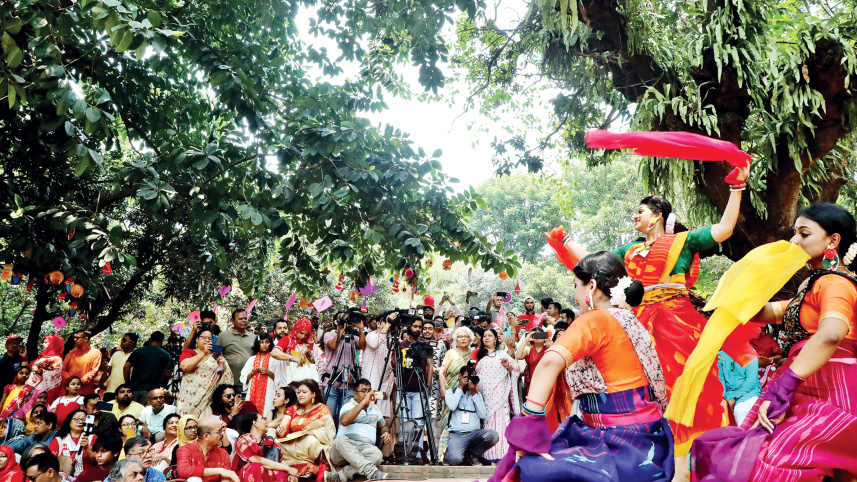
Every year, the air in Bangladesh transforms as the sun rises on the first of Boishakh. Growing up, I took the books and TV programs literally. I once asked my mother if a brand-new sun would rise the next morning. She laughed and explained that while the sun remains the same, it is the spirit of the day, the air and our surroundings, that feels brand new.
For me, Pahela Baishakh meant a holiday, new clothes, and my mother bringing out fresh earthen utensils for a family meal of Panta-Ilish, Bhorta, and sweets. Although I wasn’t a fan of the dish, I loved the togetherness; it was a meal meant for sharing. Our mornings were defined by red and white outfits and the echoes of “Esho He Baishakh” from the Ramna Batamul broadcast. We would spend the day at local fairs, club processions, and art competitions, usually ending with a dramatic Nor’wester storm. Today, the celebration has changed; while mornings still feel the same, the rest of the day is spent with friends across the city. Now it ends with a weary feet and a happy heart. This “new sun” I witnessed is part of a much older rhythm. For previous generations, Baishakh was a seasonal transformation rooted deeply in the soil of rural Bengal.

A Month of Childhood Wonder
For Ferdousi Akter Dolly, a homemaker from Comilla, Pahela Baishakh was a marathon of joy. Her memories are anchored to the banks of the Meghna River, where the landscape itself participated in the festivities. "Next to the temple, a fair was organised every Tuesday throughout the entire month of Baishakh," Dolly recalls. People arrived by launch and trawler, children playing flutes as they walked. It wasn't about commercial fashion then; it was about the tang of jujube pickles and the sweetness of naru. While children bought bangles and ribbons, the elders used the fair to buy essential household tools like winnowing fans and gail (wooden mortars). "It was a time of such excitement that students would skip school just to spend the day wandering through the fair," she admits with a smile.
This rural pulse is echoed in memories of Dr Bimal Guha, a poet who remembers the transition from the old year to the new in the village of Bajalia, Satkania. For Guha, the celebration began with Choitra Sangkranti, the final day of the year. It was a time of purification and healing. "Garlands of Neem leaves and Kathgolap (frangipani) were hung on every door to purify the air," Guha notes.
Perhaps the most unique rural tradition Guha highlights is the Saptopodi Shak, a medicinal meal of seven types of leafy greens, including bitter Gimashak and neem leaves, believed to cure the body of lingering winter ailments. As the New Year dawned, the dry bed of the Shankha River became the site of the Baruni Mela, where elders took baths in the river, and children flew kites for days on end, ignoring the scorching summer heat in favour of watermelon and cantaloupe.
The Origin of Pahela Baishakh
The beginnings of Pohela Boishakh were actually very practical. While some believe the calendar started with King Shashanka of Gaur, most historians agree that it was Emperor Akbar who brought it to life. His goal wasn't originally cultural, it was financial.
At the time, taxes were collected using the Hijri calendar, which is a lunar system. This was a problem because the lunar months did not match the actual harvest seasons, making it difficult for farmers to pay their taxes on time. To solve this, Akbar commissioned the scholar Fatehullah Shirazi to create a new system. By aligning the Islamic calendar with the harvest cycle, they created a calendar known as “Tarikh-e-Elahi”, introduced in March 1584. This eventually became the Bangabda we use today. It also gave birth to the tradition of ‘Halkhata’, where shopkeepers would open new ledgers and share sweets with customers to settle old debts, marking a fresh start for the year.
Bimal Guha adds a fascinating layer to this history, noting that the New Year was also the time for ‘Punyah’, an auspicious day for revenue collection. In the Chittagong Hill Tracts, the Bomang King would sit on his throne in royal attire to receive taxes. Historically, this tradition was so ingrained that even the British adopted it; the first English "Punyah" took place in Murshidabad, reportedly presided over by Robert Clive himself.
Pure Joy and Small Savings
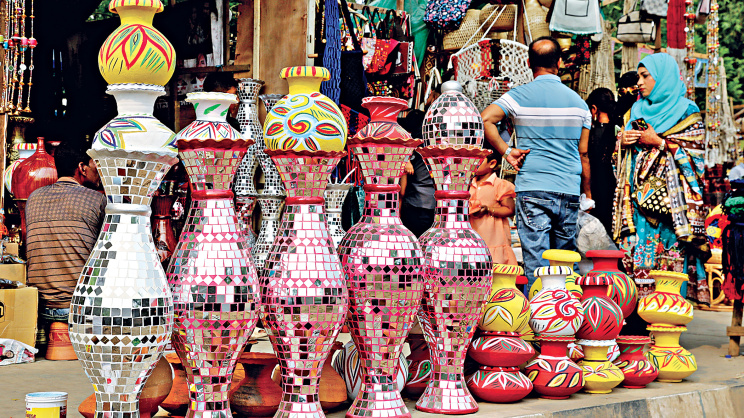
Moving into the mid-20th century, the festival remained a sanctuary of "pure, unadulterated joy." Kamrul Huda Pathik, Principal of Yunus Khan Memorial College, Lohajang, Munshiganj, recalls saving four-anna and eight-anna coins for months just for the fair. "We would buy knives to peel mangoes, toy drums to make noise, and toy pistols; we would eat watermelon and tokhma sherbet while watching puppet shows," he recalled.
For the young, the festival served as the ultimate unifier, a time when shared heritage was the only language spoken. They bought sugar-made animals and clay pots. Yet, Kamrul Huda laments the modern shift: "Now, the Baishakhi fair has become a luxury for the wealthy to eat Panta-Ilish, and the sincere warmth between families is gone." Indeed, as Bimal Guha points out, the very concept of Panta-Ilish is an urban invention; in the villages, the focus remained on the mela, the kites, and the communal sweets.
Keeping the Tradition Alive
The festival’s most significant evolution occurred in the 1960s. When the Pakistani government tried to suppress Bengali culture, the gathering at Ramna Batamul became an act of peaceful resistance. By singing Tagore’s songs under the Banyan tree, Bengalis asserted that their heritage was inseparable from their existence.
This spirit of defiance was inherited by the students of Fine Arts at Dhaka University (DU), who in the 1980s launched the “Baishakhi Shabhajatra” originally known as “Mangal Shabhajatra”. Today, Atika Anjum Aurthy, a student of the Department of Craft, DU, describes the two-week preparation as a "sleepless workshop" of mask-making and sora painting. But the struggle continues.
A Bridge of Belonging
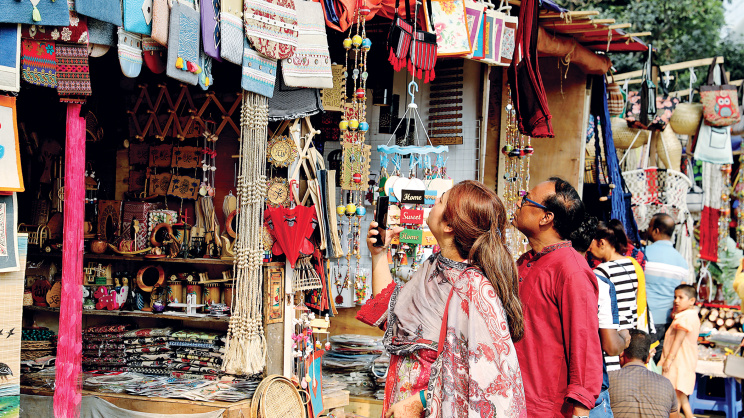
While Pohela Boishakh is rooted in Bengali history, its spirit of renewal now reaches far beyond the borders of Bangladesh, touching those who come from foreign lands. For Pramila Pam Rai, a Nepali student at the Asian University for Women (AUW), the festival was initially an unfamiliar concept. 'The idea of a New Year in the middle of April felt strange at first,' she recalls. 'I remember feeling like a quiet observer, taking in the Alpana on the roads and the rhythm of the drums.
However, that sense of being an outsider quickly vanished through the warmth of her peers. Dressed in a traditional red and white outfit her friends helped her choose, Pramila found herself swept up in the celebration. 'What struck me most was how inclusive it felt,' she says. 'No one asked where I was from. People simply greeted me with "Shubho Noboborsho" and welcomed me as if I had always belonged.' For her, the day became a beautiful moment of cultural exchange at AUW, where she shared stories of Nepali festivals like ‘Bisket Jatra’ while discovering the flavoUrs of ‘Panta Bhat’, fried hilsa, and pithas. In her eyes, the festival is no longer just a local tradition, but a universal bridge of belonging.
A Heritage Held Close
 For all latest news, follow The Daily Star's Google News channel.
 From the bliss of riverbank melas to the medicinal greens of the village, Pahela Baishakh is a story of constant movement. It belongs to no single person, but to the collective memory of a nation. Whether celebrated with a sophisticated urban parade or a simple Halkhata tradition, the core remains: a “fresh start.”
Comments