


Ayna Burir Adar: Home that brings back memories


"Ayna Burir Adar" is a home designed to live in perfect harmony with nature. Built in Natore, the home brings a daughter's childhood memories back to life. Keeping the open spaces of the old house that the family grew up in, this new design recreates that same airy, sunlit feeling. Ayna Burir Adar honours the family’s history while staying connected to nature. It is a home designed to breathe, ensuring that wind and light reach every corner just like in the past.
The Daily Star (TDS): Could you describe the underlying concept of Ayna Burir Adar and the primary architectural ideas that shaped its identity?
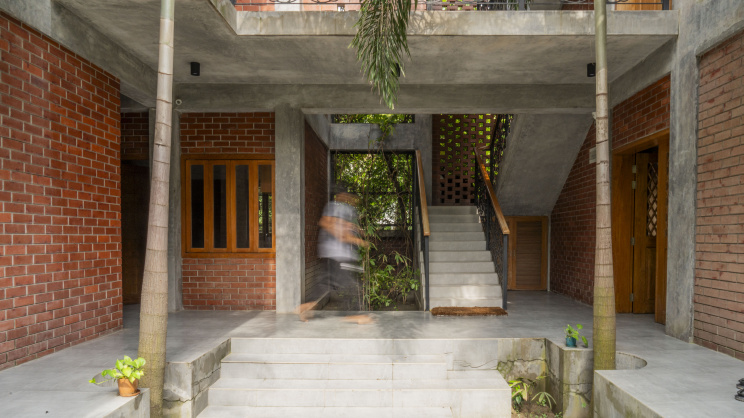
Md. Mainul Islam (MMI): Ayna Burir Adar is not just surrounded by nature, but is a part of it. The three-storeyed building was designed similarly to how a tree's shape and growth are dictated by its surroundings.
The whole building was designed with the central courtyard as a primary element. In order to create living spaces that are well ventilated and allow natural light to circulate throughout the interior spaces, the building's basic mass is reduced in such a way that creates an open space in the centre, which acts as a central courtyard. This courtyard acts as a visual connectivity for the entire building. Balconies and circulation pathways are placed within this open space to provide direct access to the courtyard, which itself offers a connection to the outside.

TDS: What prompted you to take the project in this direction, and were there specific personal or cultural influences?
MMI: The vision was to create a building that still resembled the structure before it, where its client, Sohani Hossain and her family had grown up. Their previous building had lots of open spaces and a large courtyard. The different phases of their lives were spent in that house, so they asked us to make the building feel somewhere similar to the old house and also to ensure that there is plenty of wind and sunlight as well.
TDS: How did the site and its surrounding context influence the layout and final form of the building?
MMI: The surrounding landscape was lush greenery that pulls you in. We wanted to design something that creates harmony between the building and nature. We intended to incorporate as much green as possible into each living space.
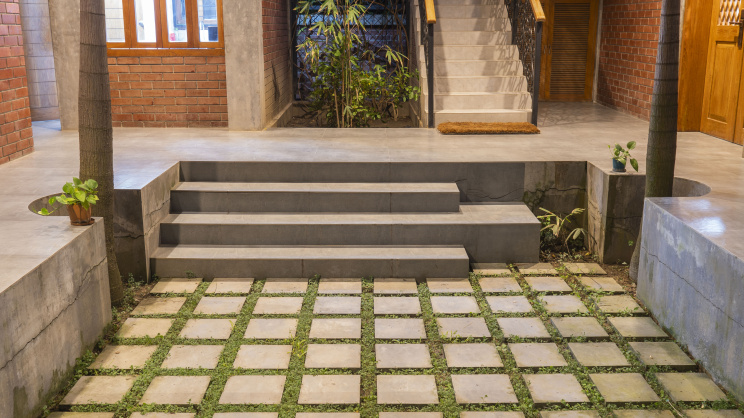
There were quite a few trees on site, which had to be cut down during the construction. However, we kept many of these spaces open so new trees can be planted there in the future. A few clusters of bamboo trees from before stand near the stairway which leads to the first floor. Furthermore, the use of soft pavement allows grass and greenery to spread. The plants hanging from the pergola and rooftop add to the aesthetics of the design. The most cherished greenery inside the structure is the coconut tree in the front, which has been there for many years.
TDS: Tell us about your material palette—how did you achieve a balance between durability, cost-efficiency, and aesthetic appearance?
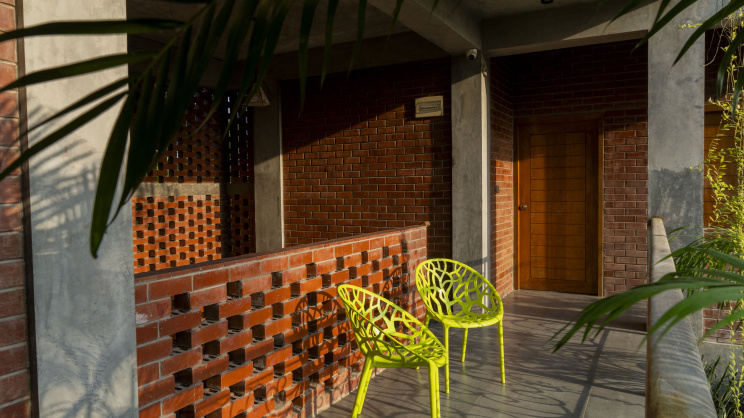
MMI: The house draws its character from its rawness, avoiding the environmental disconnect of artificial coatings. By leaving the walls in their natural, unfinished state, we prioritise material longevity and foster a direct connection with nature. This philosophy extends to the floors, where matte, cement-textured tiles provide a cohesive aesthetic and practical friction. Complementing these raw elements, extensive woodwork is done for the doors and windows.
TDS: What were the major technical or regulatory challenges you faced during design and construction, and how were they resolved?
MMI: Regardless of the building’s simplicity, it faced many challenges. One of the most prominent issues was the matter of sunlight and air circulation throughout the interior spaces, which was one of the main requirements of the client.
Another challenge was the west-facing front side of the house, which creates a few functional issues. We needed to find a way to bring sunlight to all sides of the building while minimising the heat. The central courtyard allowed us to bring sunlight into every room. Also, north-facing rooms usually get less sunlight. So, we designed a few of the rooms to have three windows for better cross ventilation.
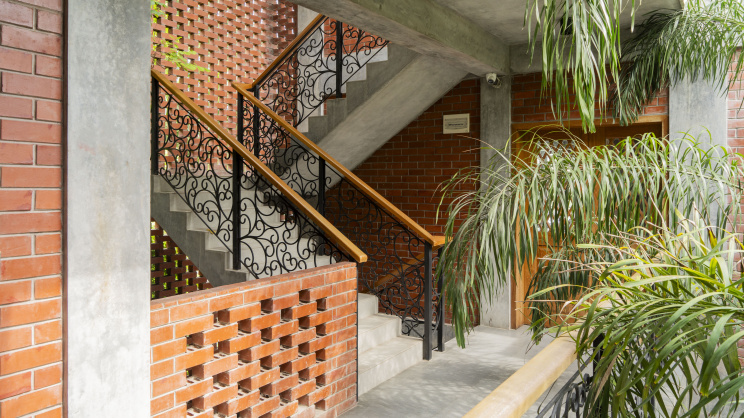
There is more to the brick-jali design than meets the eye, as its function helped solve some of the problems with the building. The design allows the air to flow through the structure from different directions through the gaps between the bricks, and also allows sunlight.

TDS: As Ayna Burir Adar is often read as a narrative piece, how did your experience in filmmaking and storytelling inform the project’s spatial sequencing and atmosphere?
MMI: The spatial sequence of the house is defined by the passage of time. It looks and feels different throughout the day. When the sun is rising in the morning, it casts soft, elongated shadows that establish a quiet, meditative ambience. In the afternoon, under the harsh sunlight, the structure creates different shadows, especially those created by the grills.
Ayna Burir Adar
Location: Kanaikhali, Natore Sadar, Natore
Size: 3400 square ft
Type: Single Family Residence
Rooms: 6 Bedrooms, Formal Living, Family Living, Dining,
Study, 2 Kitchens, 2 Storage, Helper's bed.
Year of completion: 2022
Design: Sharal Architects
TDS: How involved were the clients in the process, and how did their input shape the final design?
MMI: Apart from the building’s resemblance to the old house that stood before it and the requirements of plenty of fresh air and sunlight, the client gave us complete freedom in the layout, and they loved the final result. It is very important to understand the client's taste for any project. The client and her mother are both writers, and culture is very important to them. The design is kept minimalistic and does not resort to any loud design choices. We wanted to create a space that inspires creativity. The folding doors of the study room lead to an open-to-sky terrace encompassed by greenery, where towering trees are within arm's distance. The design is also inspired by the history of Natore, where the old cast-iron style left its mark. The spiral staircase on the second floor and the floral balcony grill were inspired by it.

TDS: Reflecting on the project, what compromises would you avoid if you had access to unlimited resources?
MMI: As the building’s 3 sides have different owners’ land, it is a given that the surrounding areas will gradually be filled with buildings, blocking the building’s view. Usually, in these cases, verandas that used to have a view will be blocked off for the occupants. However, to combat that, we reversed this design by bringing most of the balconies inward, facing the courtyard.
TDS: What considerations were made regarding environmental sustainability and the practicalities of long-term maintenance?
MMI: Our concept was to include as much green space as possible. There were quite a few existing trees on the site, which we had to cut through. However, we kept the spots of where trees used to be, to remind us of trees that had occupied that space before, and to plant new trees in the future. Also, we used exposed ceramic brick and smooth cement finish to minimise impact on the surroundings.
TDS: What systemic issues in local architectural practice did the realisation of Ayna Burir Adar expose?
MMI: It is a normal practice in our country that any duplex or single-family residence layout should have a covered inside space as a central common space. We tried to alter that idea with an open courtyard as the central space, and everything else surrounds it. It created lot of new opportunities to ensure plenty of wind and sunlight as well as a visual connection.
TDS: What lessons from this project would you pass on to young Bangladeshi architects aiming to create socially engaged and impactful work?
MMI: In our tropical climate, socially impactful architecture starts with environmental intelligence. My advice to young architects is to design buildings that truly breathe. Instead of creating sealed boxes, look for ways to maximise the building’s porosity—allowing wind and natural light to reach every corner. By mastering the balance between inviting the elements in and strategically minimising heat gain, we create naturally comfortable spaces. This reduces a building's reliance on energy, making it more sustainable and accessible for the people who live in it.
 For all latest news, follow The Daily Star's Google News channel.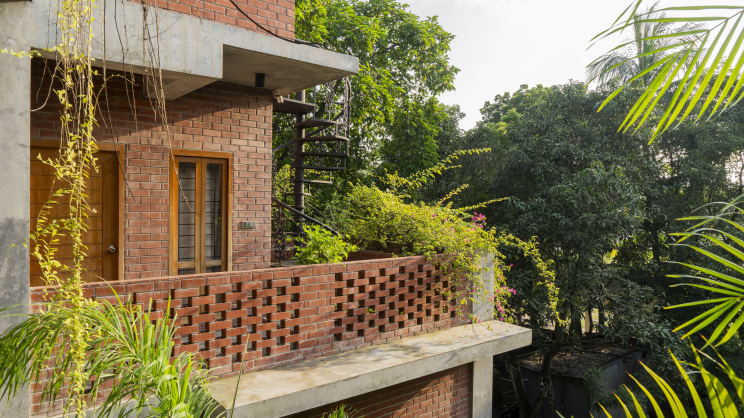
We should consider how the user interacts with other users and outsiders. At the same time, designing for cross-ventilation and natural light shouldn't be just a green initiative; it should be included during conceptualisation. Using "thermal chimneys", internal courtyards, and perforated brickwork (jali) to ensure that even on the hottest days, the house remains naturally ventilated.
Also, instead of importing expensive finishes, look at the beauty of exposed brick, raw concrete/cement finishes, and some local materials. Thus, making the home more sustainable and affordable to maintain.

TDS: Ultimately, what do you hope Ayna Burir Adar accomplishes for its inhabitants and for the future of architecture in Bangladesh?
MMI: We hope that the way the client’s previous house shaped their childhood, with the connection to greenery outside, their future generation will also benefit from the openness of this design.
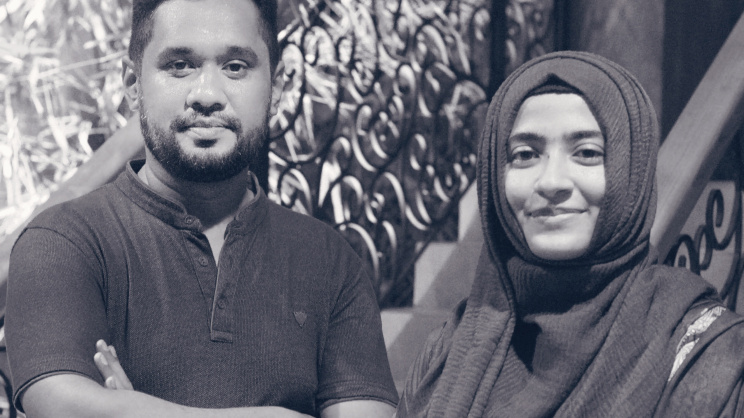
Md. Mainul Islam
Md. Mainul Islam is a promising young architect from Bangladesh and the founder of Sharal Architects. He started his architectural studies at the University of Huddersfield, England and later graduated from North South University, Bangladesh. His design approach keeps simplicity by combining traditional & contemporary ideas.
Anindita Laz Banti
Anindita Laz Banti is a young architect from Bangladesh. Anindita has received her Master of Architecture (M.Arch) from Miami University in Oxford, Ohio, in the United States. She is currently doing her PhD in the US. Her design approach keeps fostering a sense of belonging to the local environment and culture.
Interview conducted by Adrin Sarwar.
Comments