


Heritage crumbling in plain sight

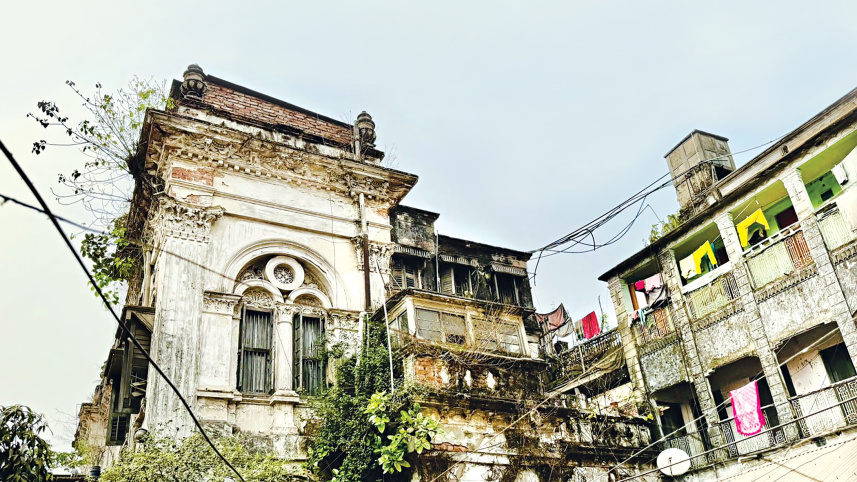
Old Dhaka is where history refuses to stay silent. It breathes through narrow lanes, faded facades and river-worn walls. Stretching from Gendaria and Faridabad to Hazaribagh Tannery Mor, and from Sadarghat to Nawabpur, this oldest part of the capital is not just a neighbourhood – it is a living archive. What stands there today is not just a dense urban neighbourhood, but a layered archive of commerce, culture and memory.
Yet many of its historic buildings are disappearing in plain sight. Rapid urbanisation, commercial pressure and years of neglect have pushed several landmarks to the brink. Some have been restored, some are partially occupied, and some are crumbling behind shopfronts and warehouses.
 For all latest news, follow The Daily Star's Google News channel.
 A walk through Old Dhaka shows how fragile this heritage has become.
Northbrook Hall (Lal kuthi)
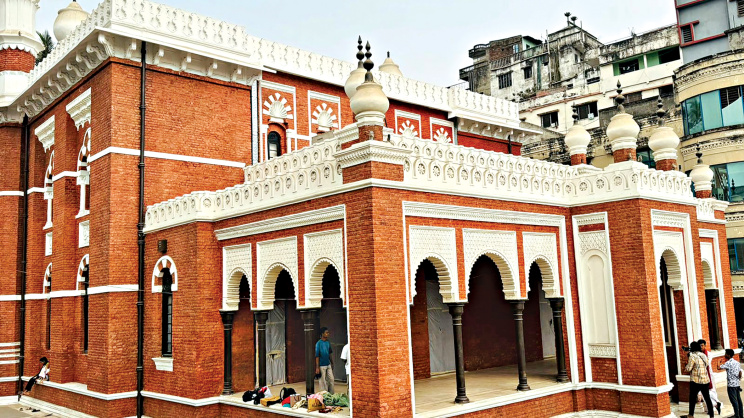
Near the banks of the Buriganga, a red-brick structure rises above the surrounding chaos. Locals call it Lal Kuthi. Officially, it is Northbrook Hall.
Built in 1874 during British rule, the building was named after Lord Northbrook, then governor-general of India. In its early years, it was also referred to as the Town Hall. Constructed in Victorian architectural style, the hall quickly became a social and cultural centre for Dhaka’s elite. Zamindars, wealthy traders and educated middle-class gathered there for theatre performances, musical soirees and civic meetings.
Over the decades, however, the structure fell into neglect. The plaster peeled off, wooden fixtures decayed and cracks appeared along the walls. For years, it stood as a reminder of what once was.
Recently, the Dhaka South City Corporation undertook renovation work with funding support from the World Bank. The restoration included structural repairs, repainting and replacement of damaged elements. Today, visitors once again gather in its courtyard. Many come to take photographs, while others simply sit on the steps and watch the river breeze pass by. The building looks renewed, though it still carries the weight of its age.
Sutrapur Zamidar Bari
Sutrapur’s name traces back to the “sutradhaars”, traditional wood craftsmen who once lived in the area. Dhaka was known for boat-building and intricate woodwork, and these artisans contributed to that reputation. Over time, the locality became associated with their craft.
Before Partition, the area was renamed Rup Lal Das Lane, but the old name continues to survive in everyday speech.
On Reboti Mohan Das Road stands a zamidar house built by Reboti Mohan Das. The complex consists of two adjacent buildings constructed in different periods. During Partition in 1947, the family left the property. It later came under state control.
The southern structure is the older and more striking of the two. Its entrance, rising nearly 50 feet, is supported by three Corinthian columns. Decorative floral patterns and circular motifs adorn the façade. Inside, there are around 35 rooms of varying dimensions, arranged around corridors and open spaces.
The northern building, constructed in 1942 by a relative of the family, is comparatively newer. It also features a broad entrance and multiple rooms. Together, the two buildings reflect a blend of colonial and classical design elements.
Today, the century-old premises house more than 50 families of the Fire Service and Civil Defence. Toilets and kitchens have been installed to make the building habitable. A two-storey barrack for officials and a shed for fire trucks stand within the compound. There are also plans to set up a Fire Service museum at the site.
A fire service official, requesting anonymity, said the building is risky but they have little choice. “Every year some repair works are done, but the structure is old,” he said. “We try to maintain it, but it still feels unsafe sometimes.”
Rup Lal House
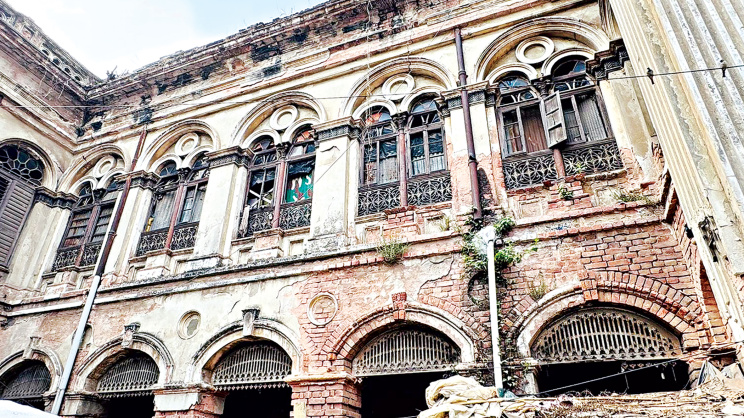
Further along the river stands Rup Lal House, one of the most talked-about mansions of nineteenth-century Dhaka. Facing the Buriganga, the building once symbolised wealth and status. European visitors were said to have admired its scale and ornamentation.
The house was originally built around 1825 by an Armenian zamidar named Aratun. Around 1835, businessman Rup Lal Das purchased it and renamed it after himself. From modest beginnings in small-scale trade and investment, Rup Lal rose to become one of the wealthiest businessmen in the city. The mansion reportedly had around 50 rooms, reflecting both prosperity and ambition.
He did not merely buy the house. He renovated and expanded it to match his personal taste. The building’s layout resembles the English letter E when viewed from above. Its longest wing stretches nearly 60 feet along the riverbank.
The most celebrated part of the mansion was its jalsaghar, or music hall, which faced the Buriganga. The western chamber featured intricate wooden ceiling work. Historical narratives claim that renowned musicians and performers from across South Asia visited the house. Among the names frequently mentioned are Alauddin Khan and Kazi Nazrul Islam.
At one time, Rup Lal House was considered one of the two most opulent residences in Dhaka, the other being Ahsan Manzil. Comparisons between the two were common in local lore.
After Partition, the property changed hands. Ownership disputes followed for years.
In 1958, Mohammad Siddique Jamal acquired the house and renamed it Jamal House. Even today, different sections of the building bear different signboards: Rup Lal House, Jamal House and Noorjahan House.
The mansion’s present condition reflects decades of fragmented ownership and limited maintenance. Portions of the walls have collapsed. Some rooms have been used as storage for spices and agricultural goods. Informal occupants have settled in parts of the structure.
Recently, the Department of Archaeology moved to free certain sections from commercial encroachment. However, the building has not yet been fully restored or opened for public access.
Standing outside Rup Lal House, Sukkur Ali, 62, who has lived in Farashganj his whole life, said the changes over the years have been painful to watch.
“When we were children, these buildings looked alive,” he said. “There were lights, programmes, people coming and going. Now most of them are just standing there, slowly breaking. We pass by every day, but nobody really looks.”
Dhola Zamidar Bari
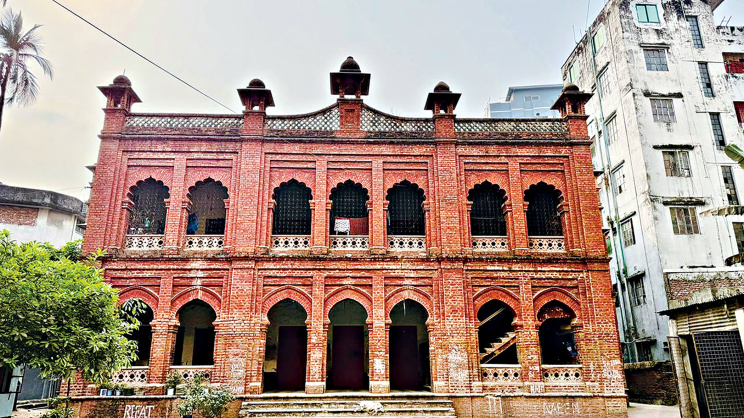
In Wari, at 38 Rankin Street, stands Dhola Zamindar Bari, a building that reflects late nineteenth and early twentieth century architectural trends. The structure blends Indo-Saracenic and colonial styles, with red brickwork and ornamental details that recall the design of Curzon Hall.
Originally built as the residential palace and recreation centre for the zamindars of Tarail in Kishoreganj, the house later entered a different chapter. In the 1950s, it became associated with Dr MN Nandi, a noted humanitarian figure. During the 1960s, the Pakistan government used it as a textbook office.
At present, the building serves as residential quarters for officials of the National Curriculum and Textbook Board. The continued use has helped maintain the structure to some extent. The gardens flanking the entrance and the open verandas still create a sense of calm amid the busy streets of Wari.
However, public access remains restricted. Visitors cannot freely explore the interiors, and much of the building’s story remains confined within its walls.
Lakshmi Villa
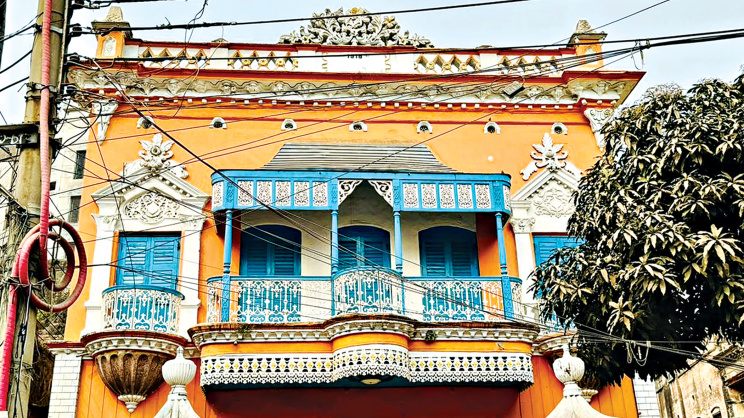
In Farashganj’s BK Das Lane stands Lakshmi Villa, a century-old residence tied closely to the story of Partition. Built in the early twentieth century by businessman Basanta Kumar Das, the house reflected the prosperity he achieved through trade in brick, conch-shell and textiles.
In 1947, the property was exchanged with that of barrister Asrarul Hossain of Calcutta. Following the riots of 1950, the Das family left East Pakistan, and the Hossain family assumed ownership. The building later functioned both as a residence and as a law office.
Years of neglect left visible damage. Cracks developed in the walls and parts of the structure weakened. Recently, partial renovation was carried out, focusing on stabilising the core framework while preserving original features. The front section remains mostly closed, while families occupy the rear portion.
The restoration has provided temporary relief, but questions about long-term conservation remain.
Old Dhaka’s historic houses are more than architectural relics. They reflect patterns of trade, migration, colonial administration and cultural exchange. Each building carries traces of prosperity, displacement and adaptation.
As the city expands vertically and commercially, these structures face increasing pressure. Some have found new uses, while others remain entangled in ownership disputes. Without consistent policy and sustained conservation efforts, many may not survive another generation.
Comments