


US, Asian allies vow tough int'l response
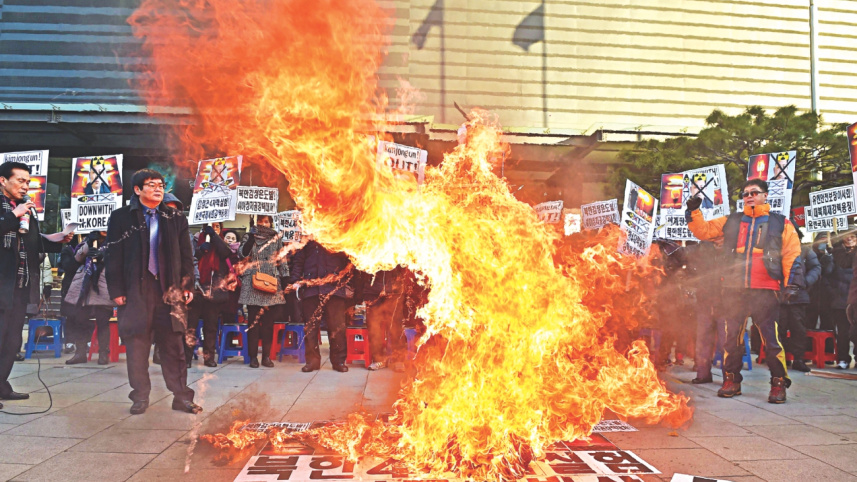
The United States and its two main military allies in Asia, South Korea and Japan, pledged a combined push to secure a comprehensive, hard-hitting international response to North Korea's latest nuclear test.
The leaders of the three countries, who have long sought to project a united front against the North Korean nuclear threat, spoke by phone a day after Pyongyang's shock announcement that it had tested its first hydrogen bomb.

While the announcement prompted widespread condemnation and calls for new stiff sanctions against the secretive state, it was also greeted with some scepticism, with experts suggesting the apparent yield was far too low for a thermonuclear device.
In Seoul, the government took unilateral action by announcing the resumption of high-decibel propaganda broadcasts into the North -- a tactic that had prompted Pyongyang to threaten military strikes when it was last employed during a cross-border crisis last year.
The consultations between the US, Japan and South Korea followed a meeting of the 15-member UN Security Council in New York which, with backing from China, Pyongyang's sole major ally, strongly condemned the test and said it would begin work on a new UN draft resolution that would contain "further significant measures".
UN diplomats confirmed that talks were under way on strengthening several sets of sanctions that have been imposed on North Korea since it first tested an atomic device in 2006.
In South Korea, the mood was uncompromising, with President Park Geun-Hye calling for a strong international response to what she called a "grave provocation".
Japanese Prime Minister Shinzo Abe also agreed to impose harsher penalties on Pyongyang after talks with Obama.
Meanwhile, Britain summoned the North Korean ambassador in London, piling onto the global scorn faced by Pyongyang.

The censure and sanctions threats had a familiar ring, given similar outrage that greeted the North's previous tests in 2006, 2009 and 2013, and some voices stressed the need to find a strategy that combined coercion with negotiation.
All eyes at the UN will now be on China, a veto-wielding council member, to see just how far it will go in tightening the sanctions grip on its recalcitrant neighbour.
Kim Jong-un, unlike his father, is not particularly sensitive to Chinese concerns. A White House spokesman said the US was encouraged by the Chinese response that it "firmly opposed" the North's move.
North Korea under Kim Jong-un has made attempts to move away from total dependence on China. It improved relations with Russia and even got India to receive its Foreign Minister in 2015 – the first time in 25 years.
 For all latest news, follow The Daily Star's Google News channel.
Comments