


EU divided over refugee quotas
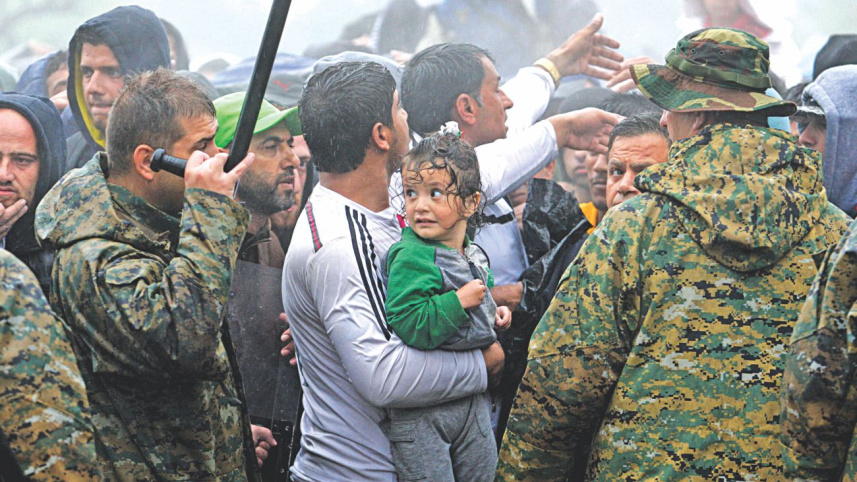
Europe was increasingly divided over its refugee crisis yesterday as record numbers of migrants streamed through the Balkans into Hungary, forcing Austria to suspend cross-border train services.
Germany warned that an EU plan to distribute 160,000 new arrivals among member states was a mere "drop in the ocean", but it faces stiff opposition from eastern members who say they will not accept binding quotas from Brussels.

Hungarian police said 3,321 people had entered in just 24 hours, hurrying to cross before harsh new anti-migrant laws take effect, an imposing new fence is completed, and the weather worsens.
Across the border in Serbia, state television reported that a record 5,000 people had arrived at the frontier.
The UN's refugee agency on Tuesday warned that at least 42,000 migrants were expected to enter Hungary by next week.
Many have endured treacherous sea journeys across the Mediterranean -- most fleeing war and poverty in Syria, Afghanistan or Pakistan and hoping to reach Germany.
Once inside Hungary, overstretched police have struggled to control and register new arrivals as they break through fences and try to board trains and buses heading for Austria.
Earlier, Denmark's train operator said it expected rail traffic across the German border to resume later in the day, after police ordered services to be suspended due to an influx of migrants.
Police meanwhile announced they were letting refugees travel freely through Denmark without registering if they didn't want to seek asylum there, allowing them to head to Sweden which is the preferred destination of many because of its more welcoming and generous asylum policy.
EU interior ministers will meet Monday to discuss a plan unveiled by European Commission chief Jean-Claude Juncker to share out 160,000 refugees across the bloc and ease the burden on frontline states.
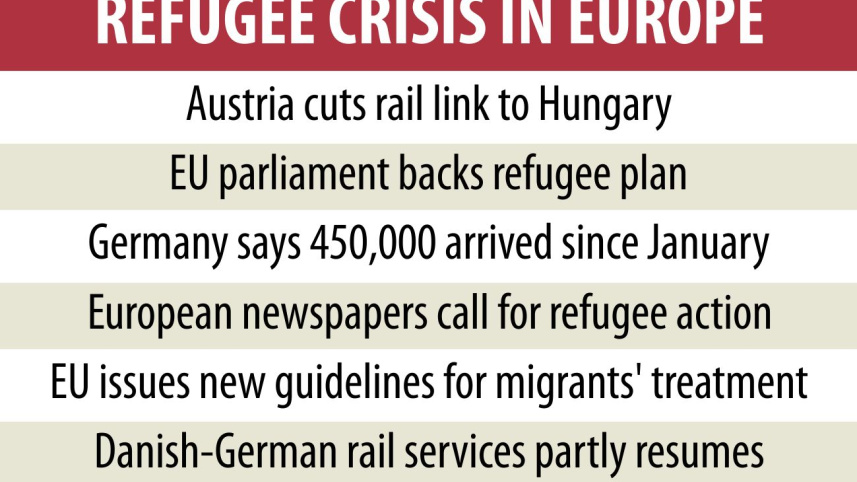
Germany, which has already welcomed 450,000 migrants this year, wants the 28-nation group to go further, calling for no limits to the quotas.
"The distribution of 160,000 refugees across Europe is a first step, if one wants to be polite," said Deputy Chancellor Sigmar Gabriel. "It's a drop in the ocean."
Gabriel said 450,000 people had arrived in Germany so far this year, with 37,000 in the first eight days of September.
The European parliament backed Juncker's plans yesterday and they will now have to get the go-ahead from member states.
But binding quotas are already facing fierce resistance from eastern EU members and Brussels may have to call a special summit to get them approved.
"It is inappropriate to talk about mandatory quotas, calculated on an extremely bureaucratic basis, almost like an accountancy exercise I might say, without consulting member states," said Romania President Klaus Iohannis.
His views echoed those of Slovakian Prime Minister Robert Fico, who said Wednesday he did not "want to wake up one day and have 50,000 people here about whom we know nothing."
German Foreign Minister Frank-Walter Steinmeier will try to win over eastern European counterparts at a meeting in Prague today.
Juncker's proposals also include a possible revision of the EU's much-criticised Dublin Treaty, under which asylum claims must be processed by the first country that refugees arrive in.
 For all latest news, follow The Daily Star's Google News channel.
 Some help may be on the way from outside, with US Secretary of State John Kerry on Wednesday seeking to drum up support for the country to accept more refugees. EU lawmakers called for an international conference on migration bringing together the US, United Nations and Arab states.
Meanwhile, on the Greek island of Lesbos, another flashpoint, the boats kept arriving.
Comments