


Treatment of migrants recalls Europe's darkest hour
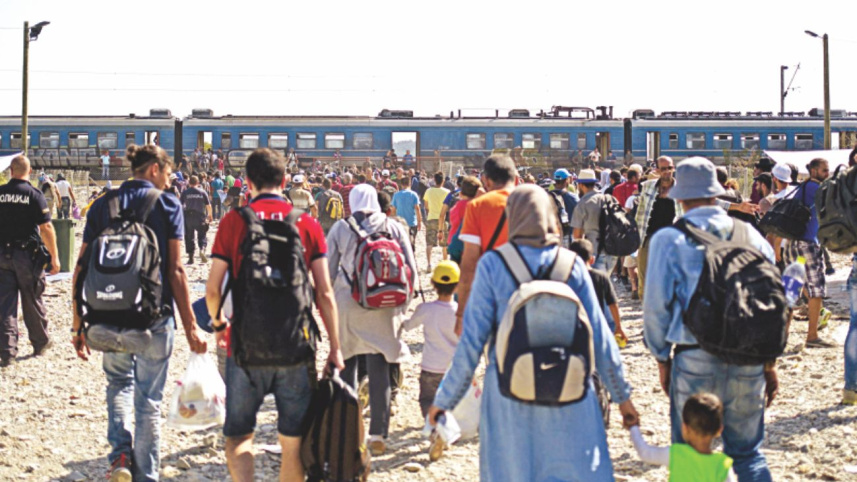
In Hungary, hundreds of migrants surrounded by armed police officers were tricked into boarding a train with promises of freedom, only to be taken to a "reception" camp. In the Czech Republic, the police hustled more than 200 migrants off a train and wrote identification numbers on their hands with indelible markers, stopping only when someone pointed out that this was more than a little like the tattoos the Nazis put on concentration camp inmates.
Razor-wire fences rise along national borders in Greece, Bulgaria, Hungary and France. Many political leaders stoke rising nationalism by portraying the migrants as dangerous outsiders whose foreign cultures and Muslim religion could overwhelm cherished traditional ways.

"It was horrifying when I saw those images of police putting numbers on people's arms," said Robert Frolich, the chief rabbi of Hungary. "It reminded me of Auschwitz. And then putting people on a train with armed guards to take them to a camp where they are closed in? Of course there are echoes of the Holocaust."
This migrant crisis is no genocide. The issue throughout the Continent is how to register, house, resettle or repatriate hundreds of thousands of migrants and refugees, a daunting logistical challenge. But perhaps not since the Jews were rounded up by Nazi Germany have there been as many images coming out of Europe of people locked into trains, babies handed over barbed wire, men in military gear herding large crowds of bedraggled men, women and children.
At the same time, the images may reveal a deeper truth about Europe and its seeming unpreparedness for a crisis so long in the making: While extolling the virtues of human rights and humanism, it remains, in many parts, a place resistant to immigration and diversity.
As a result, some here are reacting in ways that recall some of the Continent's darkest impulses.
"They must be oblivious because who would do that if they had any historical memory whatsoever," said Kenneth Roth, executive director of Human Rights Watch. "It's amazing, really. Certainly those images of the trains can't help but conjure up nightmares of the Holocaust."
Rabbi Frolich was especially struck by the lies used to manipulate the migrants.
"They tell them that the train was going to Austria and then take them to a camp instead," the rabbi said. "... it is very similar to what happened to Jews in the 1940s."
 For all latest news, follow The Daily Star's Google News channel.
Comments