


Every four years, the world cup asks who we've become
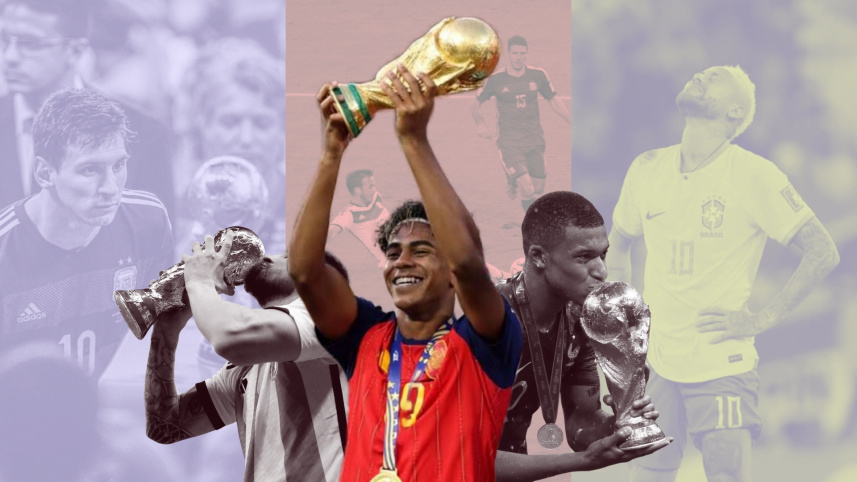
The final has been played, the confetti has been swept up, and already the arguments have started. Who deserved to win, which decision was unfair, why the politics spoilt it, and why this edition did not live up to the last. I felt the pull to join in too. Then I took a step back, and I realised I was not really thinking about the football at all. I was thinking about time.
Every four years, the world sits down together for the beautiful game, but the tournament is also a clock. It only chimes once every four years, which is exactly why you hear it so clearly. When it comes around, it holds up a mirror and asks who you were the last time and who you have become since.

I can map my whole life onto it. In 2014 I was 12, in Dhaka, staying up past my bedtime for the late games and then dragging myself to school the next morning. That was the year when Brazil suffered a 7-1 defeat to Germany in the World Cup semifinal, Mario Götze scored the extra-time winner in the final, and my brother and I fought over a sliver of bandwidth on our shared dial-up modem.
In 2018, I was in the UK for my brother's graduation, somewhere new and too distracted by the newness to care much about the football. In 2022, I was still in the UK, watching matches late on the King’s College campus with people I can barely picture now, with no idea where life was taking me. And in 2026, the tournament ended with me alone, a large pizza to myself, bracing for a nine-in-the-morning meeting on Monday because I could not stay up for the late kick-offs anymore.
Everything about it is just arithmetic. I was 12, then 16, then 20, and now I am almost 25, and these are supposed to be the years that change you the most. Still, it is strange to feel all of that change at once, in a single tournament, rather than in the slow drip of ordinary days.
The players also relinquish it too. The stars I grew up on are quietly ageing out, and a new generation of teenagers like Lamine Yamal is suddenly all anyone talks about. The players you call yours are a kind of birth certificate. They tell everyone how old you are. And the children watching this edition wide-eyed will feel the exact same ache in 2038 about players who have not even made their debuts. Nothing lasts, which is precisely what makes it worth being present for now.
Maybe that is also the honest answer to why the final felt underwhelming. Some of it is real, and some of it is that older tournaments arrive wrapped in a golden glow because I was younger and freer when I watched them, surrounded by more people and weighed down by fewer responsibilities. The match may have said less about the football than about the empty room, the pizza, and the meeting in the morning.
For a lot of us, the World Cup is stitched into childhood itself. Sticker albums traded in the playground, staying up long past when you were allowed, the whole thing bound up with being young. That is exactly why watching it as a tired adult about to head to work lands the way it does. Even the watching has changed. In 2014 it was that one crackling modem. Now I half-watch the game and half-watch the clips, the reactions, and the arguments scrolling up my phone. The tournament lives online as much as it lives on the pitch, and that shift alone measures the distance travelled.
Back home, the change wears the loudest colours. Rooftops vanish under Argentinian and Brazilian flags, whole neighbourhoods repaint themselves in someone else's colours, and friendships are genuinely tested over which team you back. It is a borrowed, ferocious loyalty, and it is its own kind of togetherness. But some of the people you argued with four years ago will not be around to argue with this time. Sudden losses, friendships that quietly faded, people you simply lost touch with. By 2030 there will be more empty chairs, and you do not get to choose which ones.
So I would rather not spend this edition arguing about who was robbed. I would rather enjoy it for what it is: a piece of our lives that comes around every four years to hand us joy, togetherness, and an excuse to talk to strangers and to the people we love. The next one is the centenary, a hundred years of all this, spread across continents. I know exactly where it will be. I just do not know where I will be or who will still be sitting beside me when it arrives.
Sharar Chowdhury is learning how to be a manager and believes "I'm confused" is not a complete sentence. Send him emails at: sharar672@gmail.com
 For all latest news, follow The Daily Star's Google News channel.
Comments