


Stepping into the ring: What it takes to get started with amateur boxing
TW: Mentions of self-harm and addiction.
Boxers display unfathomable determination in disciplining their bodies and minds, pushing themselves beyond their limits. They are undoubtedly athletes who deserve greater support and recognition. These individuals typically start their journeys early in life and compete at the amateur level before transitioning to the professional ranks. But where do they find the spark to step into the ring?

For most young people, the fascination with combat sports begins in front of a screen, watching action movies or playing video games. The same was the case for Sameer Imran Chowdhury, a BBA student at North South University who began training to compete at the amateur level in 2023. However, his parents were reluctant to let him participate in combat sports due to his poor fitness as well as the plethora of health conditions he suffered in his childhood.
“It all changed after Covid, when the diseases I had finally went away,” says Sameer, describing the beginning of the journey. A journey that, to him, has been miraculous and forged through sheer grit.
He continues, “I began to take fitness very seriously from then, and I joined the gym soon after completing my A levels. But weight lifting gradually started to feel too monotonous for me. I wanted to pursue something that would let me utilise all of my physicality — my strength, endurance, speed, and agility. I asked myself then: now that I can do all the things that I couldn’t before, why not try boxing?”
For Adib Alam Aridro, an A level student and boxer affiliated with Xcel Sports Management and Promotions, it was watching boxing matches and then sparring with a boxer that made him fall in love with the sport. He describes his experience, “I used to practise karate, and the Bangladesh Boxing Federation was not far from that place. This one time, a boxing tournament was going on, and I went to spectate to see what it was all about. I instantly loved it, and I felt that the sport was for me. After that, I started training. When I first sparred, though, I was beaten badly. Being punched was painful, but I put up a fight. I enjoyed the physical exertion, and I felt the sport was for me, that I could become a good fighter.”

But the journey to becoming a good boxer has always been an arduous one. To prepare for such a strenuous sport and excel at it, aspiring amateur boxers must endure a rigorous training regimen.
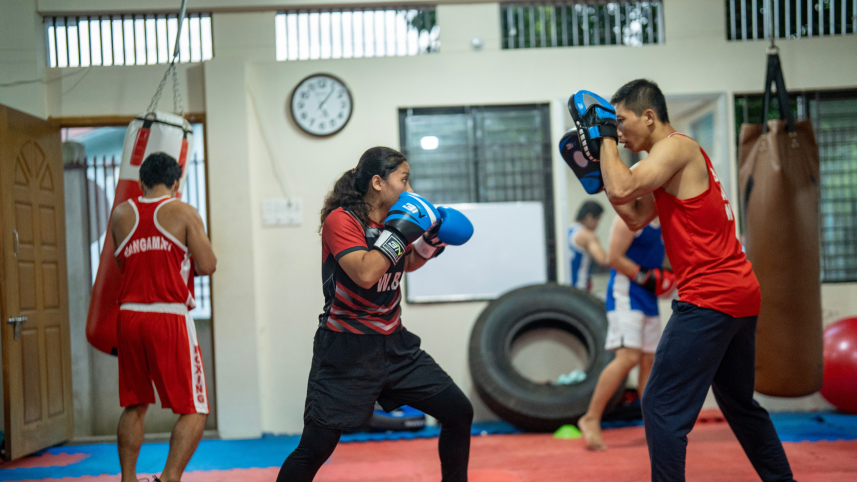
Fahim Zaman, who has been a freelance boxing coach for over 15 years, gives his insight: “Once someone makes up their mind to be a boxer, they need to take the training lifestyle seriously. They need to show up every day; they need to perform their exercise routine diligently, which involves doing bag work, pad sessions, ab workouts, and sparring.”
“Bag work” involves trainees training with a punching bag, and “pad sessions” or “pad work” involve them practising specific punches with the coach. Zaman also stresses the importance of diet discipline and puts emphasis on weight training and running to build strength and stamina.
“When they start out, we teach them the six basic boxing punches — the jab, the lead hook, the rear hook, the lead uppercut, and the rear uppercut,” says Muntaha-Ul-Haque Mumit, a professional boxer and kickboxer who works as a boxing coach for Legacy MMA Gym.
He continues, “We also have them work on their footwork. All of these make the foundations of any boxer, and our training programme is designed to strongly instil these basics in them.”
Mumit also describes at length what an ordinary training session may look like. “We first have them start with four rounds of skipping. Then they do some shadow boxing — the first two rounds without weights and the next two involve one-kilogram dumbbells. This is followed by four rounds of bag work and then pad work or partner drills, where they practise their punches with the partners we pair them up with. Once a week, we hold sparring sessions.”
“When we notice that a fighter has potential, that they are doing well in sparring sessions, that is when we deem them ready to compete,” adds Zaman.
Yet, despite all the training in the world, it is only the fight itself that can truly forge a fighter.
Mahathier Mohammad, an LLB student at London College of Legal Studies (South) and an amateur boxer, shares experiences from his first official fight. “I was very afraid and nervous; for the first few minutes, I was frozen and shaking. I couldn’t land my punches properly, but eventually I gained the confidence and started showing what I had learned. I won that fight by a unanimous decision.”
But for Mahathier, the story of his first fight and victory will always carry with it the bittersweet tint of him rediscovering himself following his mother’s passing. Indeed, for many amateur boxers, the real fight exists outside the ring, and boxing itself is the staunch ally that helps them prevail.
Mahathier tells his story, “I lost interest in everything after my mother died. I quit boxing, disengaged from the other sports I was involved in, and couldn’t even bring myself to study properly. I contemplated taking my own life and gravitated towards self-destructive tendencies. One day, my father told me that I had to be strong, that I had to live on for the sake of my mother’s dream. He told me to balance boxing and my studies at the same time. So, I returned to boxing and trained harder than ever before. I thought about quitting over and over again, but I moved forward regardless. Then, of course, came my first victory. It was an emotional, cathartic moment for me.”
“Contrary to popular belief, combat sports like boxing do not make people violent. Rather, it provides an outlet for repressed emotions and helps them control that side of themselves,” says Mumit.
The others who were spoken to corroborated these views, highlighting how learning boxing and competing at the amateur level have made them calmer and humbler. Aridro discusses how the sport can help in dealing with severe issues such as addiction: “When you love the game, you want to get better at it more than anything else. If you have any addictions, that will certainly cause problems with your training. That in itself will make you want to forego such things.”
 For all latest news, follow The Daily Star's Google News channel.
 Yet, when talking about the amateur boxing scene, there appears to be a sense of pessimism in those engaged with the sport. While the professional boxing scene has seen remarkable development in the past few years, amateur boxing has remained stagnant, or perhaps even regressed.
“The target of amateur boxers should be to get into professional boxing. Only then can they do well. But if their end goal is to pursue national titles at the amateur level, I don’t think they’ll be able to go far,” Mumit cautions.
The young people whom I spoke to all wished to have boxing as part of their futures. Mahathier is of the belief that he can build a career in the legal profession and also continue the sport. Aridro wishes to become a promoter of boxing and help the sport grow and thrive. Sameer plans to continue pursuing boxing alongside his job or business. He says, “I know very well that it's going to be hard. If I fail, that’s alright. But why not go all out before that?”
Nayeem is a student of law and a contributing writer for The Daily Star.
Comments