


Project Hail Mary’s love letter to the wonders of scientific pursuit
In 2011, Andy Weir sent one man to Mars and stranded him there. His instant literary classic, The Martian, was helmed by none other than Ridley Scott four years later for the silver screens.
Andy Weir, a former software engineer and an esteemed duke of the nerd fiefdom, had bestowed upon us in 2021 his magnum opus, Project Hail Mary. With the Ryan Gosling-led film adaptation in theatres at the time of writing, it’s about time that curious readers got a briefing on the thought-provoking science of what made even NASA engineers smile. Astrophysicists like Brian Cox (who consulted on the film) have noted that the overall fidelity to scientific paradigms remains miles ahead of any blockbuster fare.

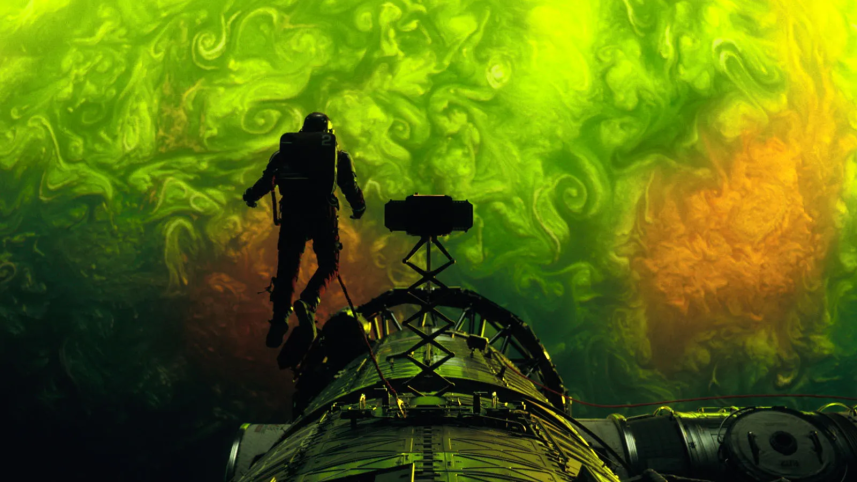
When a mysterious red spectral trail — the "Petrova Line" — appears between the Sun and Venus, humanity discovers it isn't just a cosmic oddity. Spacefaring “mould” called “Astrophages” (literal star-eaters) appear to be eating the sun at its outermost layer – the photosphere. Following the Petrova line, astrochemists discover that Venus is warmer than it should be because its carbon-dioxide-rich atmosphere has made it a prime astrophage breeding ground.
The consequences are existential: a projected 10 percent reduction in solar output, triggering a terminal ice age capable of killing billions within 30 years. A very real possibility should the sun have a very rapid drop in luminosity. But it's not just the sun. Many other nearby stars are subjected to the same fate. All but one system that appears to be immune – Tau Ceti, which the characters are set out to investigate.
Ryland Grace (Gosling), a molecular biology PhD turned middle-school science teacher, wakes up from an induced comatose state in the Tau Ceti star system, 11.9 light-years away. He’s alone on the spaceship, dubbed “Hail Mary,” with two fellow astronauts having died in transit. He can’t remember who he is or why he’s there. As he periodically gains some memories, he learns that he is not to return to earth, as there was only enough fuel enriched by the time they had departed for a one-way trip. Encountering a five-legged rock alien whose planet is also in dismay from the astrophages, they team up with a plot to save their stars.
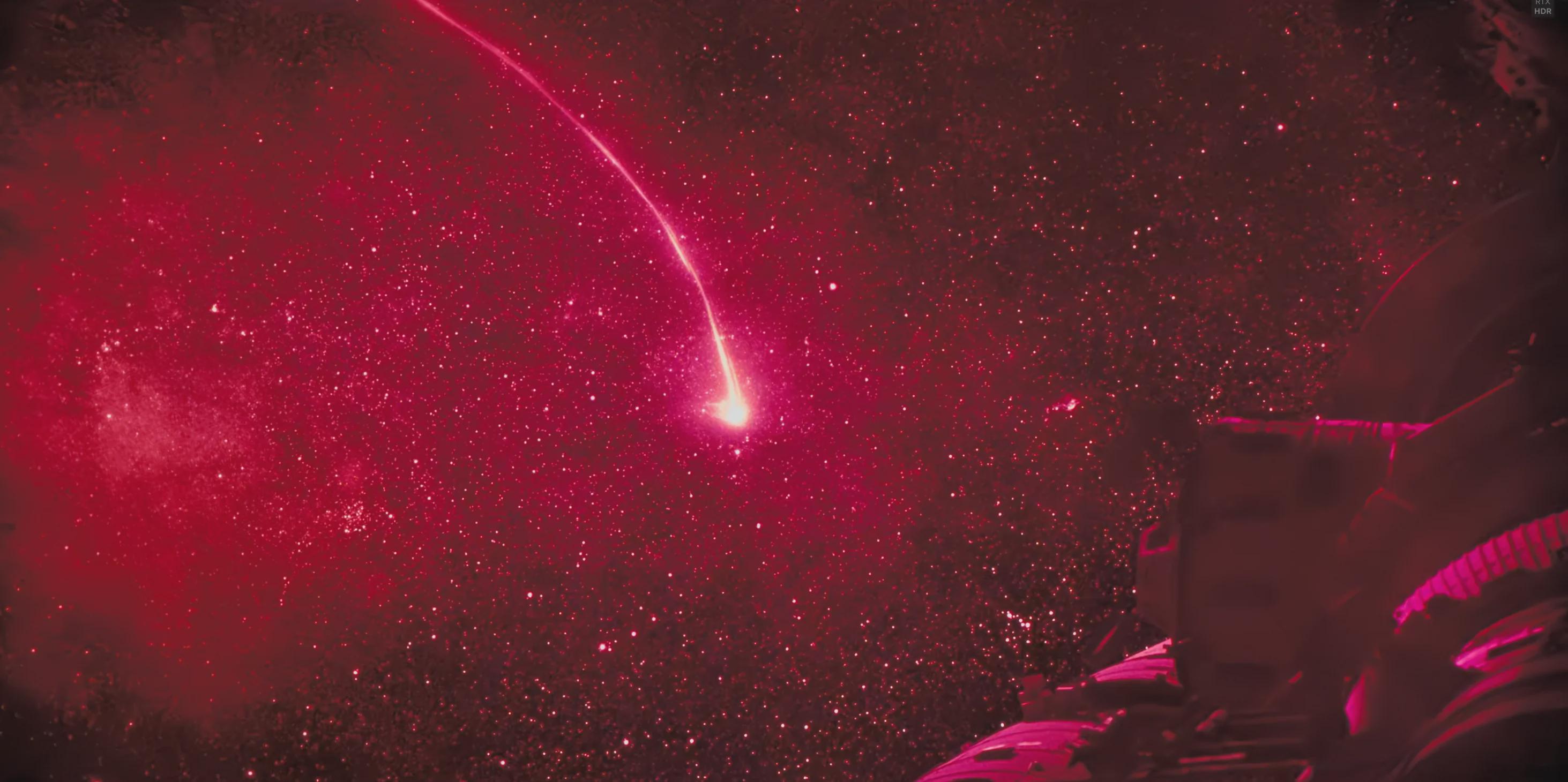
Every good science fiction story gets "one lie", a single break from the known laws of the universe that sets the plot in motion. For Project Hail Mary, that lie is the astrophage’s quantum biology.
These microbes are 10-micrometre-wide, roughly the size of a human red blood cell. Despite their water-based mitochondria and similar DNA, they possess a super-folded origami-like appendage in their cells that interacts with neutrinos — particles that usually pass through entire planets without touching a single atom. By "trapping" these ghost particles, astrophage can store energy and convert it directly into mass and vice versa, according to Einstein’s famous equation E=mc².
In the real world, scientists have yet to utilise neutrinos for energy generation, unless in particle accelerators. While earthly microbes convert mass into energy through the powerhouse of the cell, none are 100 percent efficient thermodynamically – unlike the astrophages. The result is a microbe that is, as described by Weir, gram-for-gram, the most energy-dense fuel source ever conceived — and it is this spent astrophage light, used as thrust, that propels the Hail Mary in what is essentially a photon rocket.
Ion engines, currently being developed by start-ups like Pulsar Fusion in the UK, have similar promising advancements in engineering. But interstellar travel is a numbers game.
Using the Tsiolkovsky relativistic rocket equation – named after the 19th-century Russian aerospace pioneer – and with mirrors to redirect the light exhaust, the ship reaches 92 percent the speed of light using 2,000 metric tonnes of fuel. The closest real-world parallels of this tech are seen in "solar sail" projects like Breakthrough Starshot, which plans to send nano-spacecraft to our nearest star using laser arrays as “wind” for the craft’s sails, reaching 20 percent of the speed of light. At such velocities, time dilation kicks in with full force: while 13 years pass on Earth, only four subjective years pass for Grace.
Interstellar fans, consider yourselves royally appeased.

If the plot is the engine, the heart of Project Hail Mary is an alien rock. Nicknamed Rocky, he may be the finest fictional alien from the 40 Eridani A star system. Rocky is an Eridian: five-legged, roughly spider-shaped, evolved under atmospheric pressure 29 times that of Earth, and in perpetual ammonia-thick darkness at temperatures of 200 degrees Celsius. His circulatory medium is liquid mercury. His skeleton is a pure metallic alloy.
Having never seen proper sunlight, Eridians evolved no eyes — instead, they "see" through echolocation so precise it produces 3D mental images at telescopic distances. Essentially, bats and whales, if they had engineering degrees.
Their first contact, two engineers from opposite ends of the galaxy awkwardly circling each other, is one of the great first-contact sequences in fiction. Rocky is also in search of a solution, investigating Tau Ceti, albeit in a much larger, advanced spaceship. Funnily enough, the concept of relativity is foreign to the aliens.
Their spacecraft hulls, incidentally, are reinforced with Xenonite — a transparent metamaterial of the Eridians, described as crystallised xenon gas, making any made structure effectively indestructible. In reality, xenon is a noble gas that reacts with nothing. Under extreme pressures, though (roughly 1.4 million times Earth's atmosphere), xenon can indeed be forced into metallic or crystalline forms. Materials scientists have noted, with pained admiration, that this is internally consistent. Weir does his homework.
One of the most praised aspects of the story is the communication between Grace and Rocky. Because Eridians have five vocal systems, they speak in musical "chords" rather than words. Grace uses waveform-analysis software and Microsoft Excel to map these songs to human concepts, a process known to linguists as an "elicitation session". They eventually develop a rudimentary translation device.
As the plot unfolds, the pair discover that one of the planets in Tau Ceti abruptly breaks the Petrova line. Analysis reveals their much-needed holy grail. The ultimate fix for the Sun’s infection is what they term "Taumoeba," a predatory microorganism that eats astrophage, rampant in the planet’s atmosphere. However, it’s deduced that the Taumoeba die in the presence of nitrogen, a major component of the atmosphere on Earth and Erid.
 For all latest news, follow The Daily Star's Google News channel.
 Together, Grace and Rocky devise a plan to scoop these Taumoebas using a 10 kilometre xenonite chain, all while keeping up morale in a holodeck-like simulation room (Weir’s nod to Star Trek). The way Weir describes the scooping in the books is sound according to the scientific community. The Europa Clipper mission currently underway will also utilise “the spray” of volcanic plumes from Saturn’s most celebrated moon in years to come – all in the search of biosignatures. An ode to astrobiologists.
Grace then employs directed evolution, a real-world technique pioneered by Nobel laureate Frances Arnold. By gradually exposing Taumoeba to higher concentrations of nitrogen over many generations, Grace selects for the rare mutants that can survive the “toxin”, mirroring contemporary advances into creating microbes that can eat plastic or even survive in radiation zones like Chernobyl.
Without spoiling the ending, they fare well on a high-stakes manoeuvre that ultimately helps them both survive the endeavour and save their planets. With Ryland Grace finding his purpose in a biodome (a personally curated extraterrestrial habitat), the earthlings utilise the Taumoeba to rectify “global-colding”, wherein the equators have also acquired polar snow.
At its core, Project Hail Mary suggests that cooperation for stewardship and pioneering advances for the collective are the ultimate bridge between cultures. Whether it’s relativity, star-eating moulds, or xenon-glass required to keep a rock-alien from exploding, science is the toolkit that allows two lonely nerds from different stars to save the universe together.
As Andy Weir’s tagline for the film suggests, the future is something to not be feared, "just to be figured out".
Shoumik Zubyer is a researcher of the soils of Mars at the Atomic Energy Commission and SERC, and a peripatetic. Find him at: shoumic.zubyer@gmail.com.
Comments