


Lessons from Jane: A mirror for Bangladesh

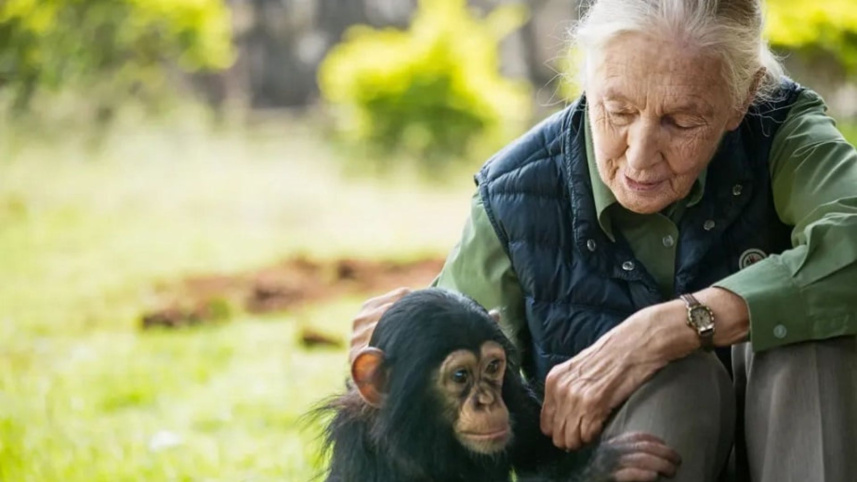
Yesterday on April 3, the world observed “Jane Goodall Day” -- the first since her passing in October last year.
On this day, we do not simply remember a scientist. We confront a question she spent her life asking -- what does it mean to live gently, responsibly, and truthfully on a planet we are rapidly exhausting?

Jane Goodall did not just study chimpanzees; she changed how we see life itself.
By documenting their emotions, relationships, and intelligence, she dismantled the illusion that humans stand apart from the natural world. And in doing so, she handed us a moral responsibility: if we are not separate, then we are accountable.
For Bangladesh, a country standing at the fault lines of climate change, biodiversity loss, and human pressure, that responsibility is no longer abstract; it is immediate.
Lesson one: Conservation begins with coexistence, not control
Jane understood something many conservation policies still fail to grasp -- you cannot protect wildlife without protecting people. Her work eventually expanded beyond research into community-based conservation, recognising that forests disappear when human survival is threatened.
In Bangladesh, this lesson echoes loudly across the Sundarbans, the Chattogram Hill Tracts, and shrinking wetlands. Forest-dependent communities are often treated as threats rather than partners. Yet, without alternative livelihoods, expecting them to prioritise conservation is unrealistic.
If Bangladesh is serious about protecting its ecosystems, it must invest in people living alongside them -- sustainable income, education, and inclusion in decision-making. Conservation cannot be enforced at gunpoint or through eviction. It must be negotiated, built, and shared.
Lesson two: Science must feel -- and speak
Jane broke scientific convention by naming animals instead of numbering them. It was radical and criticised. But it was also transformative -- it made people learn to care.
In Bangladesh, environmental reporting and policy often remain buried in statistics -- hectares lost, species endangered, pollution indices rising. Necessary, yes. But not enough.
Where are the stories of the last fishing cat in a shrinking wetland? The rescued pangolin that never made it? The forest guard who risks his life for a few thousand takas?
Jane taught us that while data informs, stories move. If we want public pressure, policy change, and behavioural shifts, we must humanise -- and animalise -- our narratives.
Lesson three: Small actions scale into movements
From a single young woman observing chimpanzees in Tanzania, Jane built a global movement -- from the Jane Goodall Institute to youth-driven initiatives like Roots&Shoots.
The lesson is deceptively simple: change does not begin at scale. It grows into it.
Bangladesh already has scattered examples -- youth-led clean-up drives, independent animal rescue and wildlife conservation networks, and even grassroots climate activism. But they remain fragmented, underfunded, and often dismissed as symbolic.
What if they were treated as infrastructure instead of side projects?
Institutional support for youth environmental action -- in schools, universities, and local governance -- could transform isolated efforts into a national movement. Not performative, but persistent.
Lesson four: Hope is a strategy, not a sentiment
Perhaps Jane’s most enduring message was hope. Not naive optimism, but a stubborn, informed belief that change is still possible.
She continued travelling, speaking, and advocating well into her later years, urging action even as environmental crises deepened.
For Bangladesh, where climate anxiety is no longer theoretical -- rising seas, disappearing land, vanishing species -- hope can feel indulgent. But without it, action collapses.
 For all latest news, follow The Daily Star's Google News channel.
 Hope, in this context, means refusing fatalism. It means continuing to plant mangroves even as erosion advances. It means enforcing wildlife laws even when violations persist. It means believing that policy, behaviour, and systems can still shift.
Because hope, Jane said, is what enables us to keep going in the face of adversity.
Lesson five: Respect all life -- or lose everything
At the core of Jane’s work was a simple but radical belief -- that every form of life deserves respect.
This is perhaps Bangladesh’s greatest challenge.
From illegal wildlife trade to casual cruelty toward stray animals, from deforestation to unchecked industrial expansion, the pattern is clear: life is often treated as expendable.
But ecosystems do not collapse in isolation. When forests fall, floods rise. When species disappear, balance breaks. When animals suffer, it reflects a broader ethical erosion.
Respecting life is not a moral luxury; it is a basic need for our survival.
Jane Goodall did not leave us with a blueprint. She left us with something far more difficult -- a mirror.
Bangladesh now has to decide what it sees and how to act accordingly.
Comments