


Govt’s bank borrowing exceeds FY26 target by over Tk 47,500cr

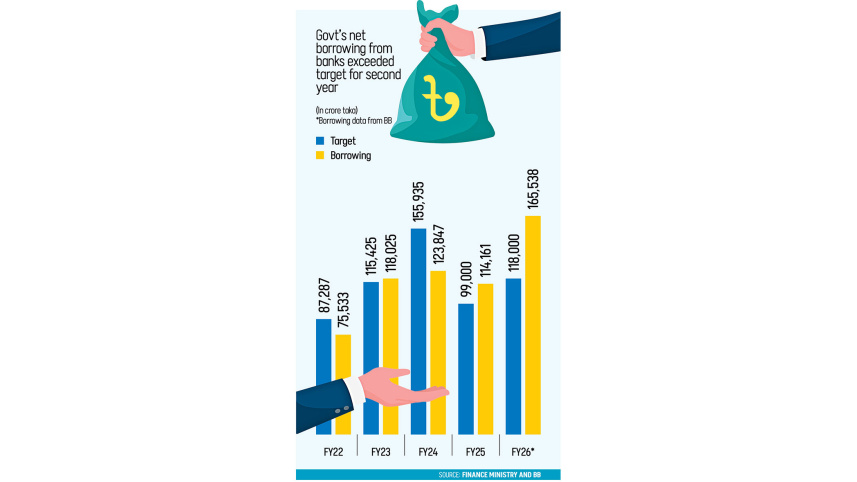
The government’s net borrowing from the banking system stood at Tk 165,538 crore in fiscal year (FY) 2025-26, far exceeding its plan for the year amid falling foreign financing and lower-than-expected revenue collection, according to Bangladesh Bank (BB) data.
At the beginning of FY26, the government planned to borrow Tk 104,000 crore. It later revised its borrowing plan upward to Tk 118,000 crore for the year but ended up borrowing an additional Tk 47,538 crore.

At the end of June 2026, credit to the public sector grew 30 percent, while credit growth to the private sector increased by 4.47 percent, according to BB data.
Two analysts have raised the alarm, warning that increased government borrowing could crowd out loans for the private sector and undermine economic stability and its gradual recovery.
“Persistent government borrowing creates two forms of crowding out,” said Ashikur Rahman, principal economist at the Policy Research Institute (PRI) of Bangladesh.
He said the immediate pressure from high government borrowing from the banking system may appear limited because aggregate liquidity remains comfortable and private credit growth is already weak.
“However, banks have a strong incentive to invest in relatively safe government securities rather than finance productive but riskier private activity. If investment demand recovers, continued government borrowing will place upward pressure on interest rates and restrict credit, particularly for SMEs, working capital and new investment,” he said.
“It will also crowd development priorities out of the budget,” Ashik said, adding that since salaries, subsidies and interest payments are difficult to reduce, development expenditure and the quality of Annual Development Programme implementation will probably bear much of the adjustment.
“Unless revenue mobilisation improves dramatically, the government will again have to exceed its borrowing target, accumulate arrears or compress expenditure.”
The BB, in its monthly report on major economic indicators, said that in FY26 the National Board of Revenue (NBR), which collects roughly 86 percent of total annual revenue, recorded 12 percent year-on-year growth in tax collection, a significant leap from 2.23 percent growth registered the previous year.
Revenue still lagged behind expectations, reaching only 82.60 percent of the government’s target, it added.
FY26 was the 10th year in a row that the NBR missed the government’s revised annual collection target. The tax authority collected Tk 415,500 crore, falling Tk 88,000 crore short of the revised goal for the fiscal year, according to provisional data.
“Consequently, the government progressively relied more on borrowing to finance its deficit. Specifically, deficit financing was primarily sourced from domestic sources, with the banking system accounting for the major share of net domestic borrowing in FY26,” the BB report said.
Towfiqul Islam Khan, additional director, research at the Centre for Policy Dialogue (CPD), said the substantial revenue shortfall is now evident, as is the extent to which bank borrowing overshot the target.
“Together, these outcomes highlight a noteworthy absence of fiscal discipline.”
For the current FY27, the NBR has been given a target of Tk 604,000 crore to finance the Tk 938,000 crore budget. The tax target is 45 percent higher than the actual collection in FY26, and it would be highly challenging for the NBR amid a slowdown in the economy.
Of the deficit estimated at Tk 243,000 crore, the government plans to borrow Tk 127,000 crore from domestic sources, with Tk 112,000 crore coming from the banking sector.
The continued high borrowing from the banking sector, Ashik said, has created a broader concern of “a growing fiscal-monetary contradiction”.
“Bangladesh Bank cannot sustainably reduce inflation and revive productive credit while fiscal policy continues to absorb a disproportionate share of banking resources. The inflationary risk would become greater if the central bank were ultimately required to accommodate this borrowing through additional liquidity,” he warned.
MA Razzaque, chairman of Research and Policy Integration for Development (RAPID), said the government has already stretched expenditure well beyond what its current revenue capacity can comfortably support.
 For all latest news, follow The Daily Star's Google News channel.
 “The pressure could intensify if expected foreign financing falls short, particularly as the FY27 budget appears to assume an ambitious level of external assistance.”
In FY26, net foreign financing decreased by 20 percent year-on-year, according to the BB.
In July, Bangladesh received $180 million in foreign loans, down from the amount received in the same month of the previous year. But it repaid $453 million in principal and interest to foreign creditors.
Razzaque said the government is taking on more and more spending commitments. A new pay scale, the Family Card Programme, support for business activity, help for financially troubled banks, and higher development spending will all require money.
“But revenue is not growing fast enough, there has been little serious effort to cut or rationalise spending, and foreign aid is also likely to fall short. That makes bank borrowing the easy, sometimes seemingly the only, option, but for Bangladesh now it is an option we can increasingly ill afford.”
He said crowding out has so far been masked by exceptionally weak private-sector credit demand. “With businesses borrowing and investing less, heavy government borrowing has not yet created acute competition for bank funds,” he said.
“But as economic activity strengthens and private credit demand recovers, continued high government borrowing could begin to constrain financing available to firms and raise borrowing costs.”
Comments