


Bangladesh trails regional peers in attracting FDI
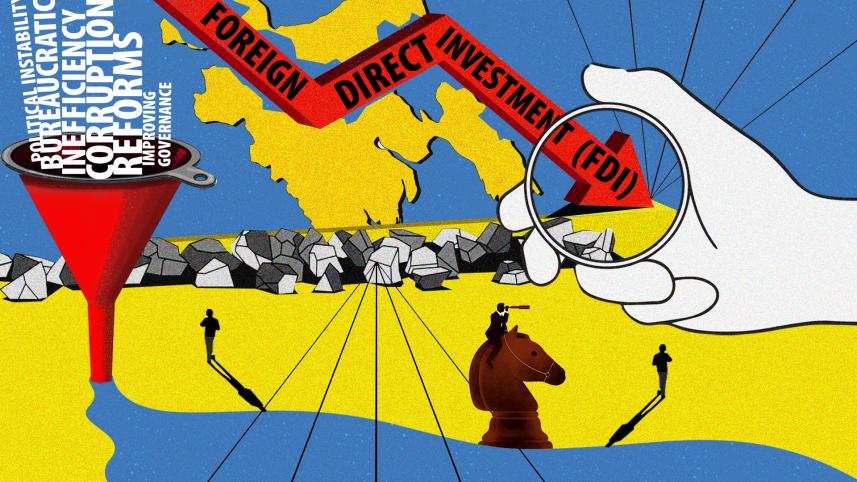
Bangladesh continues to trail its regional competitors in attracting foreign direct investment (FDI), according to a report by the United Nations Conference on Trade and Development (UNCTAD).
The report said that while Bangladesh performs better than the average least developed country (LDC) in absolute FDI inflows, it falls behind when investment is measured against the size of its population, economy and gross fixed capital formation.

On those indicators, it underperforms not only individual comparator countries but also the average for LDCs and for the Association of Southeast Asian Nations (Asean) and the Regional Comprehensive Economic Partnership (RCEP), two blocs it aims to join.
FDI accounts for just 1 percent of the country’s gross fixed capital formation and 0.4 percent of gross domestic product, the report said.
Despite steady economic growth in recent years, Bangladesh has yet to convert its potential into sustained foreign investment inflows, according to the “Investment Policy Review Implementation Report”, launched at the Bangladesh Investment Development Authority (Bida) office yesterday.
Between 2019 and 2024, Bangladesh received an average of $1.5 billion in FDI a year, less than half the level of Cambodia.
The difference becomes even wider when measured against larger regional economies. Vietnam attracted more than $17 billion a year on average over the same period, while Indonesia also drew substantially higher inflows.
In terms of FDI stock, Bangladesh lagged behind Cambodia, Vietnam and Indonesia, as well as the ASEAN and RCEP blocs. It performed better only than the average least developed country in 2024.
The UNCTAD said that inflows have declined over the past six years, although early data for 2025 suggest a tentative rebound.
Investment inflows to the country peaked at more than $1.8 billion in 2019 before entering a downward trend. Since then, inflows have fallen by nearly one-third, dropping below levels recorded during the early phase of the Covid-19 pandemic.
The fall has occurred even as the overall FDI stock has remained broadly stable at around $18 billion since 2021. This suggests that existing investors have retained capital, but new investment has slowed, according to the report.
The report attributed the weakness to macroeconomic instability and operational constraints.
Local currency taka has depreciated by about 36 percent against the US dollar since 2021, while foreign exchange shortages have made it harder for companies to repatriate profits and pay for imports, it said.
“These pressures have been compounded by energy disruptions, particularly fuel import constraints, which have raised production costs and disrupted industrial activity.”
At the same time, inflation has surged to nearly 10 percent and economic growth has slowed from about 8 percent to 4 percent between 2019 and 2024, further dampening investor sentiment.
The report mentioned that political uncertainty around the election cycle and labour unrest in key sectors, especially garments, have added to caution.
Although early indicators for 2025 point to a modest recovery in FDI inflow, the report said that the composition of the rebound raises concern.
The recent uptick has been driven mainly by reinvested earnings and intra-company loans rather than new greenfield projects. In effect, existing investors are expanding their exposure, but few new entrants are arriving, the report said.
The UNCTAD said that while confidence may be stabilising, Bangladesh has yet to regain momentum in attracting fresh foreign capital.
 For all latest news, follow The Daily Star's Google News channel.
 “A national investment policy and a consolidated investment law would help reinforce investor confidence and focus on attracting and leveraging FDI in support of national development objectives through a whole-of-government approach,” the report said.
As a second priority, UNCTAD recommended strengthening investment promotion and facilitation, focusing on sectors identified in its FDI heatmap and adopting targeted measures to support their growth in coordination with other institutions.
“Mitigate the impact of losing preferential LDC status by engaging with key investment and trade partners and by strengthening the capacities of the local private sector.”
Kiyoshi Adachi, a legal officer at UNCTAD, said most recommendations from earlier reviews have only been partially implemented.
He cited outdated legislation, including the Investment Act of 1980, which does not clearly define investor protections or consolidate FDI rules. Entry procedures remain complex and require multiple approvals, while digitalisation efforts are undermined by continued reliance on manual processes.
Challenges such as foreign exchange repatriation, access to land, infrastructure shortages and limited skilled labour mobility continue to weigh on investor confidence, he said.
Ashik Chowdhury, executive chairman of Bida, said Bangladesh needs to accelerate its efforts to attract foreign investment by strengthening competitiveness and aligning more closely with global standards.
Stefan Liller, resident representative of the United Nations Development Programme in Bangladesh, said coherent policies and strong institutional capacity are essential to attract responsible investment that creates jobs and supports inclusive growth.
Among others, Sohana Rouf Chowdhury, managing director of Rangs Motors, M Masrur Reaz, chairman and CEO of Policy Exchange of Bangladesh, Ariful Hoque, former director general of Bida, Md Hafizur Rahman, trade policy and facilitation expert, and Humayun Kabir, executive member of Bida, were present at programme.
Comments