


Bangladesh’s reliance on indirect tax highest among regional peers
Highlights
- Bangladesh relies most on indirect taxes regionally
- Indirect tax share stands at 78.2 percent
- Experts seek urgent reforms to cut inequality
Bangladesh relies on indirect taxes far more heavily than its regional peers, raising fresh questions about the fairness of the country’s tax structure and its impact on ordinary citizens, according to a study presented yesterday.
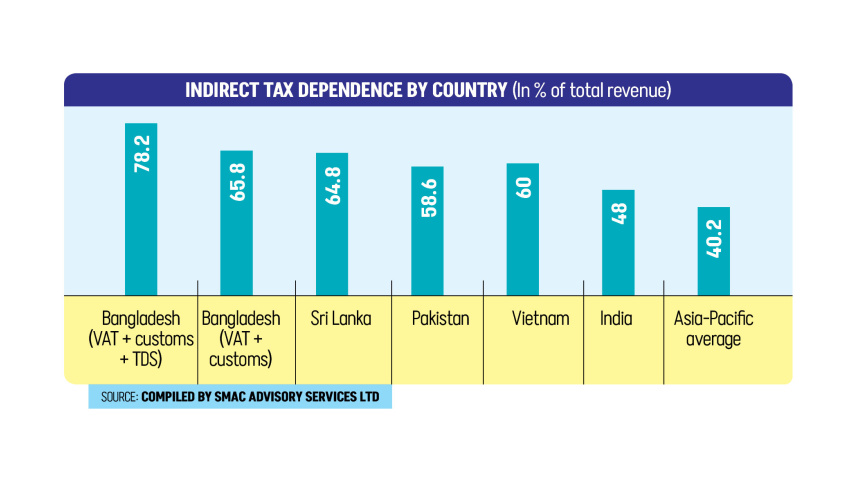
The data, which measures indirect tax dependence as a percentage of total revenue, places Bangladesh at the top of the regional ranking. When VAT, customs duties and supplementary duties are combined, Bangladesh’s indirect tax share reaches 78.2 percent -- a staggering 28 percentage points above the regional average.

Even when calculated using VAT and customs alone, Bangladesh still stands at 65.8 percent, nearly 17 percentage points higher than India’s 48 percent.
Snehasish Barua, managing director of SMAC Advisory Services Limited, presented the comparative study at a roundtable discussion held yesterday in Dhaka on the over-reliance on indirect taxes and their multidimensional impacts on the economy. The event was organised by Voice for Reform, a citizens’ platform in Bangladesh.
By contrast, the Asia-Pacific average sits at just 40.2 percent, according to OECD 2025 data. Vietnam records 60 percent, Pakistan 58.6 percent, and Sri Lanka 64.8 percent -- all below Bangladesh’s figure.
India, often seen as a comparable developing economy, trails Bangladesh significantly, with direct taxes accounting for a far larger share of its revenue base. India’s direct tax share stands at 45 percent, while Bangladesh manages only 21 to 35 percent.
M Masrur Reaz, chairman of Policy Exchange of Bangladesh, said the country’s revenue system is overly dependent on indirect taxation, making it a major structural weakness.
He said indirect taxes are easier to collect but discourage efforts to expand the direct tax base. “As long as this dependence continues, the system will remain regressive, and inequality will persist,” he said.
Reaz added that low tax compliance is driven not only by cultural factors but also by fear of harassment and administrative burdens.
He warned that reliance on customs duties is unsustainable as Bangladesh graduates from least developed country status, noting tariffs still account for 27 to 28 percent of revenue.
“If we had gradually shifted toward direct taxation, we could have used fiscal policy more effectively to address inflationary pressures and rising inequality,” he said.
He said that in the current challenging context, spending Tk 35,000 crore on a new government pay scale would be the wrong decision.
Imran Hassan, secretary general of the Bangladesh Restaurant Owners Association, said current tax assessment methods are ineffective and require full system integration. “All businesses must be brought under the VAT net,” he said, proposing that tax collection be integrated with VAT payments.
He alleged resistance from authorities, arguing that meaningful system reform would reduce opportunities for informal pressure on businesses.
Md Farid Uddin, former member of the National Board of Revenue, said the VAT rate should under no circumstances exceed 10 percent.
The tax reform task force formed during the interim government had also proposed a maximum VAT rate of 10 percent, though several of its other recommendations have since gone unaddressed, he noted.
Rushad Faridi, assistant professor of the Department of Economics at the University of Dhaka, warned that excessive reliance on indirect taxation creates instability in budget execution, as revenues become highly dependent on consumption and overall economic conditions.
“If the economy slows down, fiscal pressure builds up immediately, forcing cuts in essential spending or increased borrowing,” he said, adding that direct taxation provides a more stable fiscal framework.
He also said indirect taxes create a “fiscal illusion,” where people do not fully realise their tax burden, reducing public pressure for government accountability.
Prof M Abu Eusuf, executive director of RAPID, said Bangladesh’s main challenge is not a lack of reform ideas but weak enforcement.
 For all latest news, follow The Daily Star's Google News channel.
 “We all know the problems and solutions. Reform strategies already exist, but without enforcement and a strong commitment, nothing will change,” he said.
Faisal Mahmud, managing editor of The Daily Waadaa, said India’s experience with Goods and Services Tax (GST) and the Unified Payments Interface (UPI) shows how a digitalised economy can strengthen tax administration and expand formalisation.
He urged policymakers to study India’s GST system more closely, saying it offers important lessons for improving Bangladesh’s tax and revenue framework.
AKM Fahim Mashroor, Co-coordinator of Voice for Reform, who moderated the event, proposed setting the standard VAT rate at 7.5 percent while introducing a rate exceeding 25 percent on luxury goods.
Among others, Saeed Ahmed Khan, former head of tax at Unilever Bangladesh, Abdur Rauf, founding president of the VAT Forum, and Doulot Akter Mala, president of the Economic Reporters Forum, also spoke at the event.
Comments