


Economy under strain amid high inflation, weak investment
Despite achieving healthy economic growth over the past decade, Bangladesh’s economy is now showing signs of strain due to persistent inflation and slowing private investment, exposing underlying weaknesses, experts said at an event yesterday.
“Bangladesh faced the Middle East crisis with several existing vulnerabilities, including persistent inflation, weak investment growth and financial sector stress,” said Dhruv Sharma, senior economist at the World Bank.

He made the remark while presenting a keynote speech at the seminar on “Bangladesh Development Update: Special Focus - A Business Environment that Delivers Jobs” jointly organised by Policy Research Institute of Bangladesh (PRI) and the World Bank at the PRI auditorium.
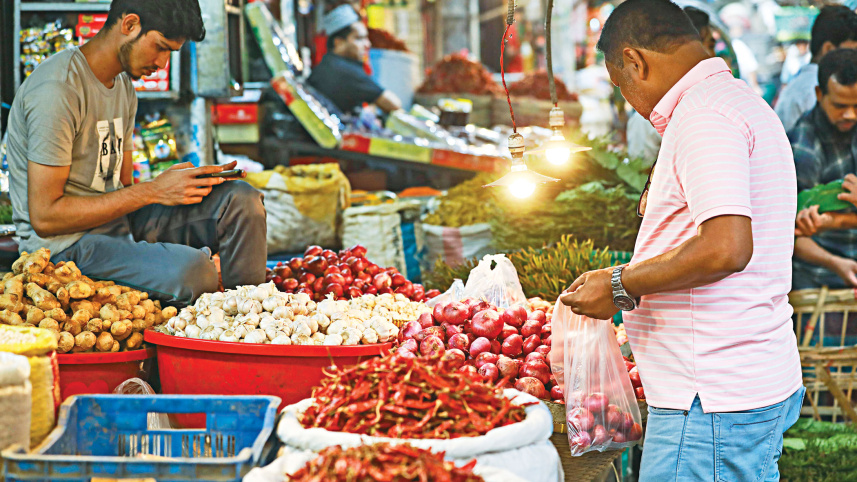
Although Bangladesh Bank has succeeded in bringing inflation down from around 12.5 percent to nearly 9 percent, tighter monetary policy alone cannot fully address the inflationary pressures, which are being fuelled less by excess demand and more by inefficiencies in supply chains, distribution systems and market management, according to Sharma.
World Bank’s Bangladesh-Poverty and Equity Assessment 2025 showed that another 1.4 million people slipped below the poverty line, raising the national poverty rate to 21.4 percent. Sluggish job creation and external shocks, particularly the Middle East conflict, have added to the pressure on households.
He cautioned that prolonged tight monetary conditions are weighing on investment and employment as businesses continue to struggle with high borrowing costs.
Unless wider reforms are made to improve market governance, logistics and the investment climate, hiking interest rates risks further slowing economic growth while failing to substantially ease inflationary pressure, he said.
Bangladesh’s growth model, long driven by cheap labour and protected domestic industries, is no longer delivering sustainable results, said Fahmida Khatun, executive director of the Centre for Policy Dialogue.
She said the country had achieved impressive economic growth over the years, alongside gains in health, education and poverty reduction. But the momentum has weakened since fiscal year 2021-22 as macroeconomic indicators deteriorated under both external shocks and internal vulnerabilities.
She pointed to persistent weaknesses in the banking sector, saying financial institutions were no longer able to adequately support productive private-sector investment with affordable financing.
According to her, many businesses are now focused more on survival than expansion amid regulatory uncertainty, policy unpredictability and bureaucratic delays.
Piecemeal measures would not be enough to restore stability, Fahmida stressed, calling instead for broad institutional reforms in governance, banking, trade policy and labour markets to ensure sustainable and employment-oriented growth.
Foreign investors are increasingly worried about Bangladesh’s unpredictable fiscal and taxation policies, which are hurting long-term investment confidence, said TIM Nurul Kabir, executive director at the Foreign Investors’ Chamber of Commerce and Industry (FICCI).
He said businesses planning investments over 10 years need policy consistency, but sudden changes in taxes and duties are creating uncertainty.
Restoring investor confidence would be a major challenge for the interim government ahead of the budget, he added.
Zaidi Sattar, chairman of the PRI, stressed the need for job-intensive growth, saying employment generation remains central to Bangladesh’s economic and social progress.
Rising youth unemployment posed a serious challenge for policymakers, he said, noting that Bangladesh’s experience over the past three decades showed that growth, employment and poverty reduction moved together.
Ashikur Rahman, principal economist at PRI, warned that Bangladesh’s growth trajectory has weakened since 2019, with slower growth and rising volatility becoming a growing concern.
“The economy’s buffers are now very weak,” he said, stressing that reforms in the financial and revenue sectors were no longer optional.
Rahman cautioned that Bangladesh could face a middle-income trap without urgent reforms and stronger macroeconomic discipline.
 For all latest news, follow The Daily Star's Google News channel.
Comments