


Complex rules erode competitiveness, Muktadir says
Commerce Minister Khandakar Abdul Muktadir yesterday said the government will implement sweeping reforms to ease Bangladesh’s complicated business environment, as high logistics costs, low operational efficiency at ports and lengthy licensing procedures are undermining the country’s industrial competitiveness and export potential.
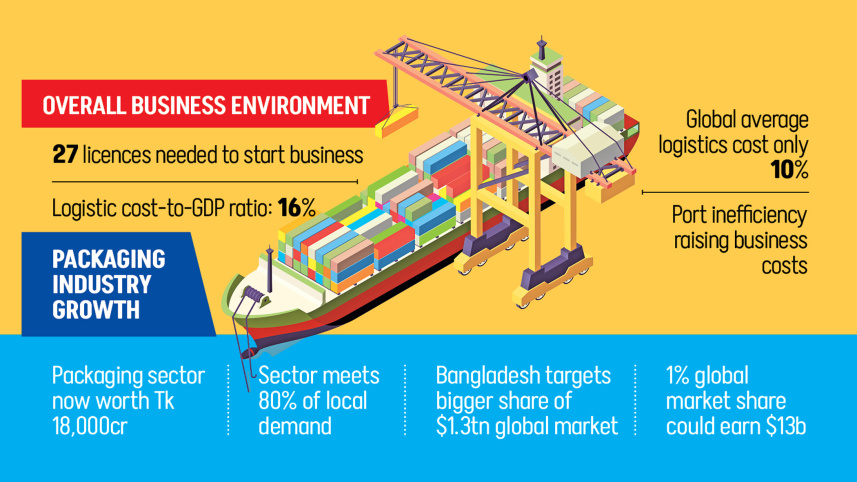
Speaking at the inaugural ceremony of the International Industrial Packaging Expo 2026, he said investors currently need as many as 27 different licences and approvals to start a business in Bangladesh, making the process excessively lengthy and complex.
 For all latest news, follow The Daily Star's Google News channel.
 “We do not have the luxury of stopgap measures,” he said, stressing the urgency of improving competitiveness ahead of Bangladesh’s graduation from the least developed country (LDC) category.
The expo was jointly organised by Exponet Exhibition Private Limited and the Bangladesh Flexible Packaging Industries Association (BFPIA) at the Bangladesh-China Friendship Conference Centre in Sher-e-Bangla Nagar in the capital yesterday.
Muktadir said Bangladesh’s logistics cost-to-GDP ratio currently stands at around 16 percent, compared to the global average of approximately 10 percent. He also pointed out that the lack of operational efficiency at ports ultimately increases business costs.
The government plans to bring more internationally reputed operators into port management and container terminal operations in a bid to improve efficiency and reduce turnaround time, he said.
A Danish company has already begun operating at one of the container terminals, he noted, adding that similar partnerships would be expanded further.
Muktadir also highlighted the heavy fiscal burden created by loss-making state-owned enterprises, many of which occupy vast tracts of underutilised land.
The government intends to bring these industrial assets under private-sector investment within the next two years, he said, so they can generate employment, investment and revenue.
Referring to state-owned sugar mills and factories under the industries, jute and textile ministries, he said many of the facilities were established decades ago under a different economic reality and now require modernisation or repurposing.
The minister argued that idle industrial land could be transformed into hubs for diversified manufacturing activities, creating large-scale employment opportunities.
Turning specifically to the packaging sector, he said the industry’s global market size offers enormous opportunities for Bangladesh.
“The global packaging industry is worth more than a trillion dollars. Bangladesh should not limit its ambitions to a tiny share of the market,” he said.
He urged entrepreneurs to think bigger and expand their global footprint, assuring them of policy support from the government.
Speaking at the event, BFPIA President Safius Sami Alamgir said the sector has evolved from an import-dependent industry into a Tk 18,000 crore market that now meets around 80 percent of domestic demand.
He said the global packaging market is currently worth $1.3 trillion and could reach $1.8 trillion by 2035, presenting a significant opportunity for Bangladesh.
“If Bangladesh can capture even 1 percent of the market, it could generate $13 billion in exports,” he said.
Alamgir described packaging manufacturers as the “invisible backbone” behind major consumer brands and said the sector could replicate the success of the ready-made garment industry through competitive manufacturing.
However, he called for policy reforms, citing double taxation, difficulties in obtaining tax refunds and uneven competition in special economic zones as major obstacles to growth.
Export Promotion Bureau (EPB) Vice Chairman Mohammad Hasan Arif highlighted the packaging industry’s growing role in Bangladesh’s export diversification efforts, pledging institutional support to expand the sector’s global footprint.
Arif said the government had already recognised the industry’s potential by declaring paper and packaging products as the “Product of the Year” for 2026.
He noted that the EPB had earlier organised discussions on the sector’s challenges and opportunities during the Dhaka International Trade Fair, where several policy recommendations emerged.
The EPB now plans to support local exporters in participating in at least one or two international packaging exhibitions in fiscal year 2026-27, he said, assuring exporters of continued institutional backing to strengthen global market access.
Rashedul Haque, managing director of Exponet Exhibition Private Limited, said a total of 140 companies from home and abroad are displaying their products and technologies through 360 stalls at the expo. Of them, 25 companies from China are taking part in the event. The fair will continue until May 9.
Comments