


Ex-owners unlikely to regain SIBL control as merger continues

- BB to reject SIBL former owners' reclamation bid
- Central bank firm on five Islamic banks' merger
- Ministry, BB begin hiring MD for merged bank
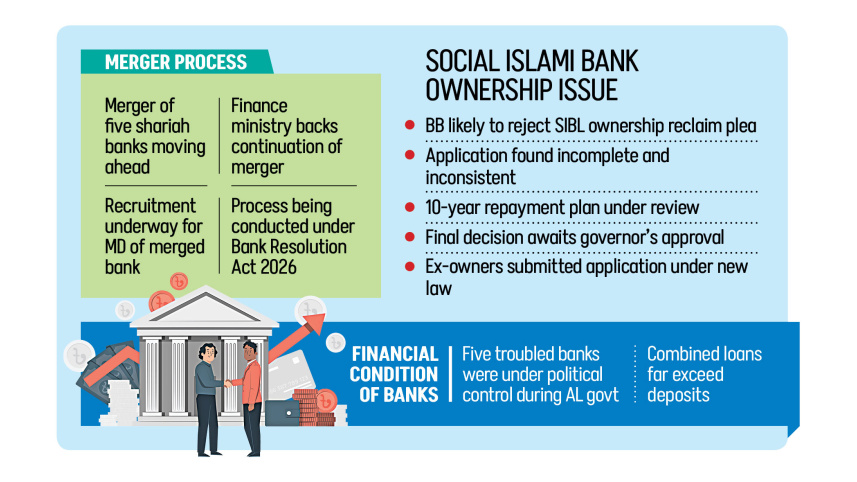
The Bangladesh Bank (BB) has decided in principle to reject a bid by former owners of troubled Social Islami Bank PLC to reclaim control, as the banking regulator moves ahead with the merger of five shariah-based banks, according to top BB officials.
They said the application submitted by former owners of Social Islami Bank PLC (SIBL) to opt out of the merger process is “inconsistent” and “lacks sufficient information”.

Moreover, the applicants had sought 10 years to repay the bank’s dues to the central bank, which is “not acceptable”, said the BB officials on condition of anonymity.
They said the bank resolution department of the BB has therefore decided in principle to reject the application and continue with the merger process under the Bank Resolution Act 2026.
Arief Hossain Khan, executive director and spokesperson for the BB, said the central bank remains firm on the merger plan. “The merger process is ongoing, and media reports claiming that it will not take place are incorrect,” he said.
At a recent meeting of the bank resolution department, BB Governor Md Mostaqur Rahman instructed officials to continue with the merger process of the five troubled lenders.
BB officials also said the Ministry of Finance has agreed to proceed with the process.
As part of the next steps, the ministry and the BB have begun interviewing candidates for the post of managing director of the merged Islamic bank.
On Wednesday, six bankers were interviewed at the BB headquarters in Dhaka. Five more are scheduled for interviews on Sunday this week.
As part of its banking reform initiatives, the interim government approved the Bank Resolution Ordinance 2025. Under it, five crisis-hit lenders -- First Security Islami Bank, Global Islami Bank, Union Bank, Social Islami Bank and EXIM Bank -- were brought under the merger process.
The BB later issued a licence for a new state-owned entity, Sammilito Islami Bank PLC, in November last year, which is expected to become the country’s largest state-owned shariah-based lender.
So far, the government and the central bank have injected Tk 35,000 crore in capital and provided additional liquidity support to stabilise the new bank.
After the Bangladesh Nationalist Party (BNP) came to power following the national election in February, the ordinance was amended and enacted as the Bank Resolution Act 2026. The revised law included provisions allowing former owners to reclaim merged banks under relatively easy terms.
Under the clause, former directors or owners of banks under merger or listed for merger can pay 7.5 percent upfront of the amount injected by the government or the BB to regain control.
The remaining 92.5 percent is to be repaid within two years at 10 percent simple interest.
The provision has drawn criticism from economists and policy experts, who say it risks rewarding those linked to past financial mismanagement rather than ensuring accountability.
Against this backdrop, five sponsor shareholders and former directors of SIBL submitted an application to the BB last month seeking to regain control of the bank.
BB Spokesperson Khan said the application is currently under review but indicated that the demands are unlikely to be accepted.
APPLICANTS SAY APPLICATION MADE UNDER NEW LAW
The applicants are led by Maj (Retd) Md Rezaul Haque, former chairman and sponsor shareholder of SIBL.
 For all latest news, follow The Daily Star's Google News channel.
 Maj (Retd) Haque, who chaired the board until October 30, 2017, was joined by sponsor shareholders Hakim Md Yousuf Harun Bhuiyan, managing director and chief mutawalli of Hamdard Laboratories Waqf, and Sultan Mahmood Chowdhury.
The other applicants are former shareholder director Afia Begum and shareholder Md Zabedul Alam Chowdhury.
Maj (Retd) Haque is currently suffering from age-related health complications and unable to move around properly.
Following the fall of the Awami League-led government in August 2024, the central bank dissolved the board, which had been heavily influenced by controversial conglomerate S Alam Group, and formed a new one that included Maj (Retd) Haque as a director.
However, he was absent from most meetings due to his health condition.
Maksuda Begum, an independent director appointed by the BB after the political changeover, said Maj (Retd) Haque attended meetings occasionally but was unable to stay for long due to illness.
Md Zabedul Alam Chowdhury, a former shareholder and one of the applicants to reclaim the bank, said they had applied in line with regulations.
“We have applied according to the rules. We will fulfil all the conditions. If we get the bank back, we will bring in new investors,” he told The Daily Star.
He added that the bank would operate more effectively if the application were approved.
IRREGULARITIES LED TO THE MERGER
The five banks were brought under the merger process after forensic audits following the political changeover in 2024 found extensive loan irregularities and financial mismanagement.
The lenders faced acute liquidity shortages and were unable to repay depositors, prompting emergency intervention by the interim government.
The banks had been controlled by politically connected groups.
EXIM Bank was previously under Nazrul Islam Mazumder, former chairman of the Bangladesh Association of Banks, while the other four were linked to family members of Mohammed Saiful Alam, chairman of S Alam Group.
Allegations of large-scale irregularities and fund embezzlement during the previous government led to a sharp deterioration in their financial health.
As of September 2024, the combined outstanding loans of those five banks stood at Tk 1,92,787 crore, while total deposits were Tk 1,58,918 crore, according to BB data.
Comments