


Development spending falls to 53-year low
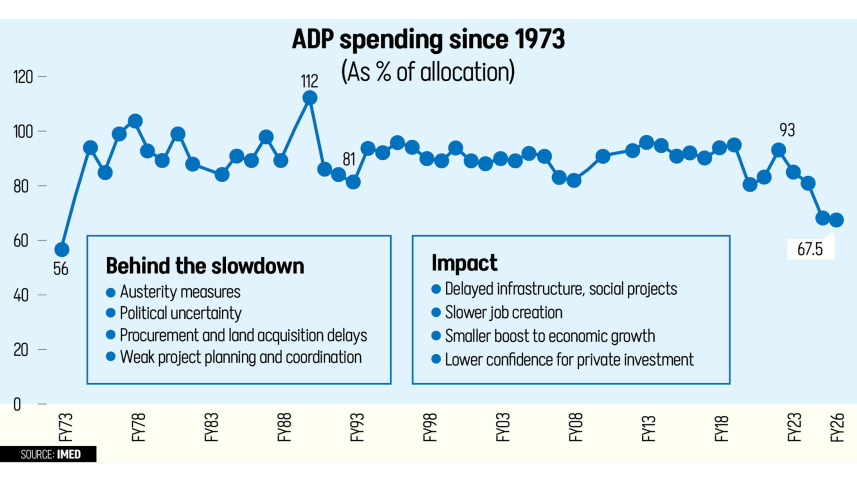
The country’s annual development spending fell to its lowest level in more than five decades in the just-concluded fiscal year, delaying infrastructure and social projects, slowing job creation and reducing the economic boost usually generated by public investment.
Ministries and agencies spent 67.5 percent of the revised Annual Development Programme (ADP) allocation in fiscal year 2025-26, the lowest implementation rate since 1974, according to data published by the Implementation Monitoring and Evaluation Division (IMED) under the planning ministry yesterday.

They spent Tk 141,071 crore against a revised allocation of Tk 208,935 crore.
A senior planning commission official blamed the weak implementation largely on government austerity measures, while the Finance Division as well as economists said political uncertainty, administrative disruption and longstanding weaknesses in project planning, procurement and coordination also held back development spending.
“The lower implementation rate in the last fiscal year was largely the result of government-imposed austerity measures rather than weak project execution,” said the Planning Commission official, requesting anonymity.
“Spending on training, foreign travel, vehicle purchases and some recruitment were suspended for several months. Without those restrictions, ADP implementation would have exceeded 80 percent,” he said.
Among the 15 ministries and divisions that accounted for roughly three-quarters of the revised ADP allocation, the Technical and Madrasah Education Division, the Ministry of Primary and Mass Education, and the Secondary and Higher Education Division recorded the weakest implementation rates, according to IMED data.
The Technical and Madrasah Education Division spent 50.33 percent of its allocation in FY26, while the Ministry of Primary and Mass Education and the Secondary and Higher Education Division spent 60.87 percent and 66.30 percent, respectively.
By contrast, the Energy and Mineral Resources Division recorded one of the highest implementation rates, spending 93.71 percent of its allocation. The Bridges Division and the Road Transport and Highways Division followed with implementation rates of 93.85 percent and 91.18 percent, respectively.
The Local Government Division, which accounts for nearly a fifth of the ADP, implemented 82.04 percent of its revised allocation, according to IMED.
Among all ministries and agencies, the Parliament Secretariat was the weakest performer, spending just 7.5 percent of its allocation. The Economic Relations Division, the Internal Resources Division and the Health Services Division also posted poor implementation rates -- at 13.97 percent, 17.42 percent and 31.15 percent, respectively.
In monetary terms, the FY26 spending was the lowest since fiscal year 2017-18, even though the previous interim government had cut the overall allocation amid numerous domestic and external challenges facing the economy. In FY18, total spending was Tk 148,176 crore, according to official data.
The planning commission official said implementation rates should be assessed alongside actual project costs, noting that many projects are approved with cost estimates that exceed the final contract value.
“Through competitive bidding, contracts are often awarded well below the approved budget,” he said. “So even if financial utilisation appears to be around 80 percent, the physical implementation can be much closer to full completion, because the unspent allocation is simply not required.”
He said implementation would improve in the current fiscal year because most spending restrictions have been lifted. “Compared with the interim government’s tenure, project activities have already picked up. If the austerity measures are not reintroduced, implementation should increase further this year.”
Ashikur Rahman, principal economist at the Policy Research Institute (PRI) of Bangladesh, said the exceptionally low ADP implementation rate in FY26 showed a combination of prolonged political uncertainty, external economic shocks and entrenched bureaucratic inertia.
“The problem appears particularly acute in ministries suffering from weak leadership, poor project management, and slow decision-making. Frequent administrative changes, delays in procurement and project approvals, and uncertainty over policy priorities have further weakened implementation capacity,” he added.
In its latest Medium-Term Macroeconomic Policy Statement, the Finance Division said insufficient project readiness before approval, delays in procurement and land acquisition, weak coordination between executing and implementing agencies, cost revisions, design changes and cash planning constraints all contributed to the slowdown.
It also said tighter fiscal conditions had led the government to scrutinise low-priority projects more closely.
The Finance Division said improving implementation would require a stronger project gate system that allows only mature projects into the ADP, alongside realistic annual work plans, earlier procurement, stronger contract management and closer monitoring of large and strategically important projects.
 For all latest news, follow The Daily Star's Google News channel.
 Selim Raihan, executive director of South Asian Network on Economic Modeling (Sanem), said the weak implementation exposes the fragility of the country’s public investment management system.
“While the interim government operated under extraordinary constraints including law-and-order challenges, political uncertainty, administrative disruptions, and the need to reassess ongoing projects, these circumstances also revealed longstanding structural weaknesses in project planning, procurement, coordination, and implementation,” said Selim, also a professor of economics at Dhaka University.
“The resulting delays have postponed critical infrastructure and social investments, constrained employment generation, weakened private-sector confidence, and reduced the growth-enhancing impact of public expenditure,” he said.
Selim said the government that took office after the February elections inherited a large implementation backlog with only a few months left in the fiscal year.
But restoring momentum would require administrative reforms, stronger coordination among agencies, faster procurement and project approvals, and closer monitoring to ensure development spending translated into tangible economic and social outcomes, he commented.
“The experience of FY2025-26 highlights that increasing budgetary allocations alone is insufficient; without sustained improvements in institutional capacity, governance, and accountability, our development ambitions will remain difficult to achieve,” he added.
Comments