


Eid cattle sales rise in north, mid-sized cows lead

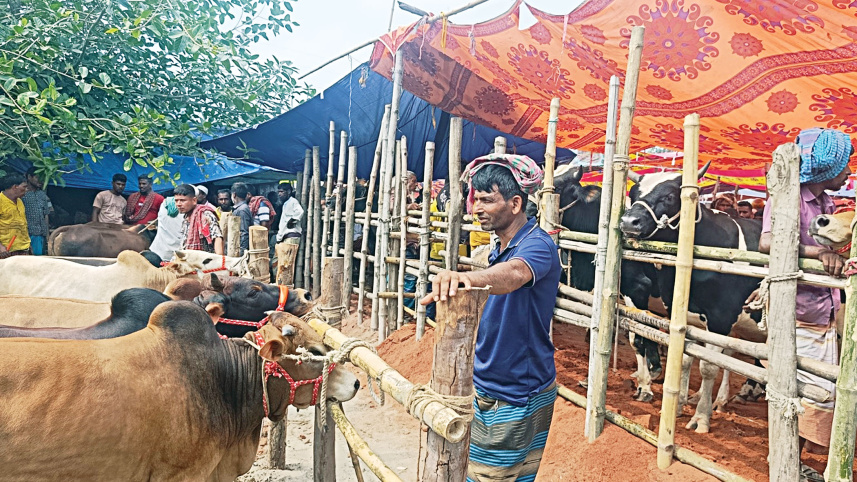
Sacrificial animal sales are running ahead of last year’s pace in Pabna and Sirajganj, with medium-sized cows, weighing three to six maunds, clearing fastest.
Despite strong volumes, traders say overhead costs are squeezing returns on large cattle. They also fear that a late surge of illegal Indian imports could crash local prices overnight.

The Department of Livestock Services (DLS) says the country is well-stocked. Demand is estimated at 1.01 crore animals against a supply of 1.23 crore, leaving a surplus of roughly 22 lakh. The surplus was 20.68 lakh in 2025 and 22.77 lakh in 2024.
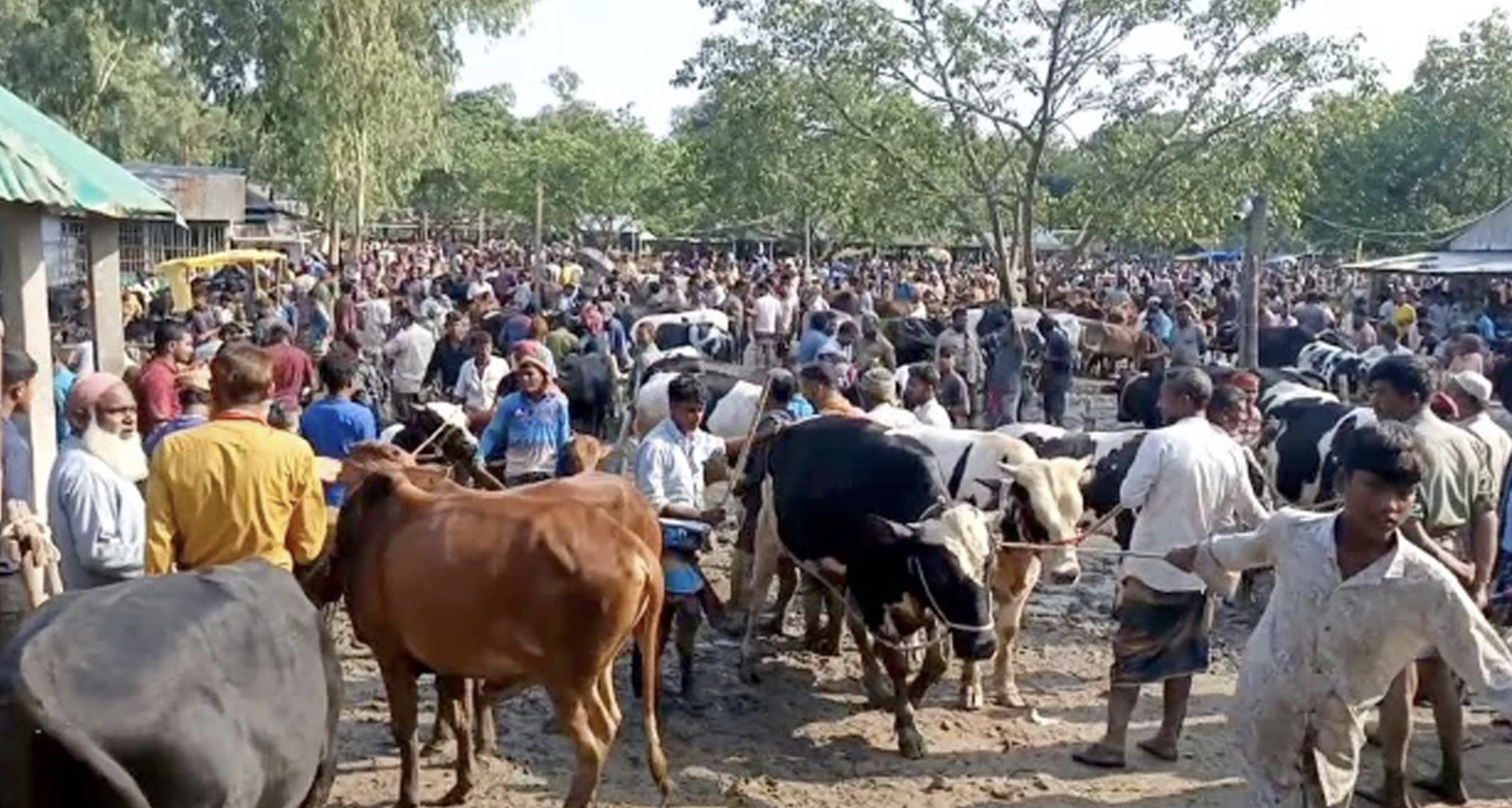
Eid-ul-Azha accounts for nearly 40 percent of Bangladesh’s annual animal slaughter. Cows and buffaloes account for 56.95 lakh of the total animals this year.
SALES UP BUT RETURNS UNEVEN
Sales volumes are up, but returns are uneven depending on animal size and trader scale.
Md Saiful Alom, a Faridpur upazila trader and president of the Pabna District Cattle Farmers’ Association, told The Daily Star that he has already sold 22 of the 23 cows he prepared for this season and kept one for himself.
“Last year, I brought 20 cows to the Eid market. I sold 17 before Eid and the rest to butchers afterwards,” he added.
His four-to-five maund cows fetched Tk 1.2 lakh to Tk 1.5 lakh each. He said selling large animals is a different calculation, as high maintenance costs mean farmers often accept lower margins just to recover their investment.
Md Sadek Ali Pramanik, a trader from Bhangura upazila who buys cattle from villages and sells across markets in Pabna, Sirajganj, and Rajshahi, has booked 200 cows this season and sold more than 100 in the past 10 days.
“The flow of cattle sales is much better than previous years. A trader can easily sell five to 10 cows per haat,” he said. “But although we make good profit on some animals and take a loss on others, the average comes to about Tk 2,000 to Tk 3,000 per cow.”
Another trader, Abdur Rahim, said he has already sold 23 cows so far this Eid, compared to 50 cows in the month before last year’s Eid. “This year, I expect that number to double.”
Meanwhile, small farmers raising heavy cattle report the sharpest squeeze. Raju Ahmed, resident of Ramkharua village in Shahzadpur upazila of Sirajganj, spent four years and over Tk 2.5 lakh raising an 11-maund cow, expecting to sell it for at least Tk 3 lakh.
“I had to sell it for Tk 2.6 lakh,” he said, adding that there were not enough buyers for large animals. “But, if I don’t sell during Eid, it is nearly impossible to move an 11-maund cow at any other time, so I did not wait and sold without getting my price.”
The second cow, weighing six maunds, sold for Tk 1.5 lakh and was profitable, he added.
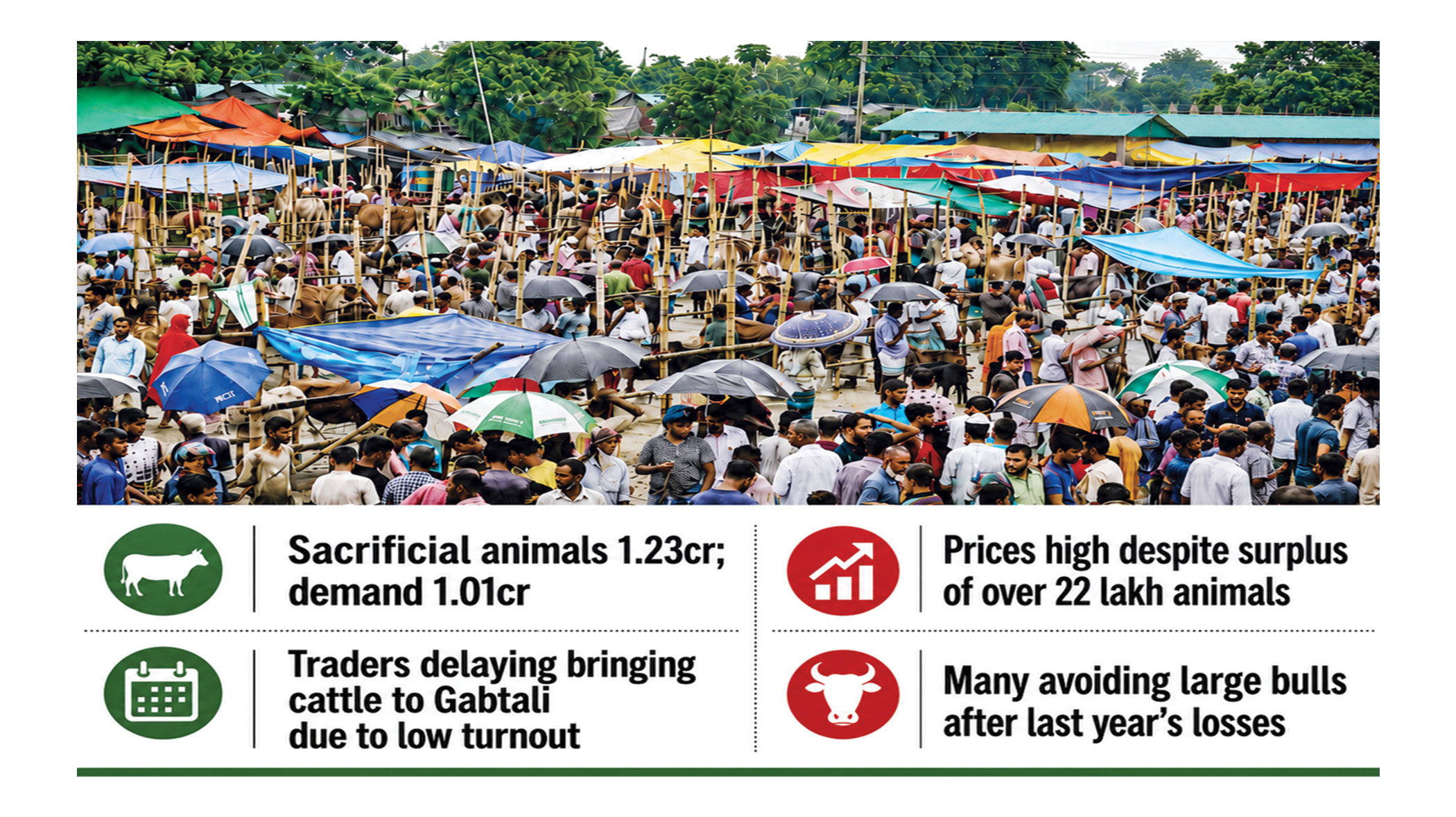
Traders say cows in the three-to-five maund range are fetching around Tk 30,000 per maund. Animals above six maunds are drawing around Tk 24,000 to Tk 28,000, a discount they attribute to buyers stretching budgets rather than seeking prestige.
Buyers confirm the pressure. Zafar Sadek, a retired college teacher, said he paid Tk 90,000 for a cow he estimates will yield about three maunds of meat. “This is a high price for me.”
Rafikul Islam, another teacher, said he had visited two haats without finding a cow within his Tk 1.40 lakh budget and expects to try again before Eid.
 For all latest news, follow The Daily Star's Google News channel.
 FEAR FOR INDIAN COW INFLUX
The market’s biggest variable remains what happens at the border in the final days before Eid.
The concerns come as the newly elected BJP government in West Bengal recently enforced strict cattle slaughter rules, including mandatory fitness certificates. Animals under 14 years or not permanently incapacitated do not qualify.
The restrictions have disrupted cattle trade there, a situation that traders here say could push Indian sellers to seek buyers across the border.
Riazul Haque Baperi, a seasoned cattle trader in Pabna, said, “We are hearing that cattle sales ahead of the sacrificial festival have slowed in India.”
“If Indian cattle enter the local market, prices will fall sharply and it will be damaging for traders and farmers,” he said.
Livestock officials said that border security forces have been put on high alert to block illegal cattle entry in the country.
“For the sake of our local traders and farmers, we are monitoring the situation rigorously,” said Shakawayet Hossain, deputy director of the DLS export unit.



Comments