


Fitch’s negative outlook and how we can navigate the storm ahead

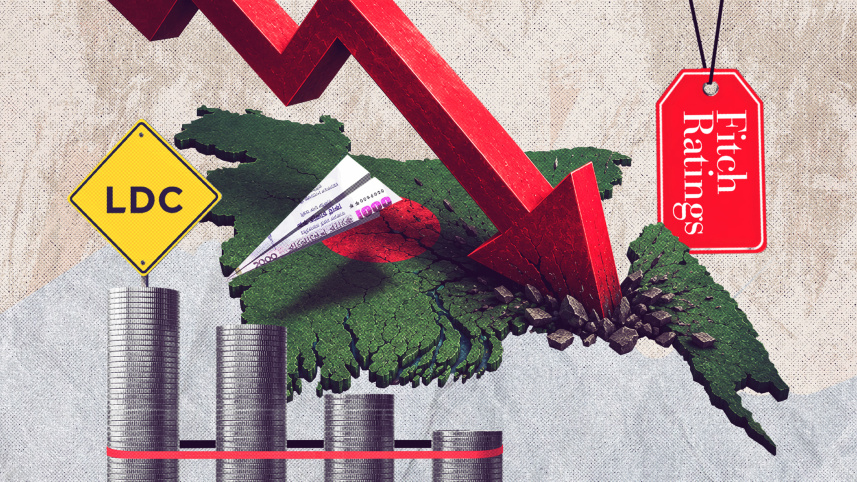
Recently, Fitch Ratings observed that Bangladesh’s economic risks have increased, prompting a downgrade of the country’s sovereign outlook from “stable” to “negative.” It has kept the country’s overall international credit rating unchanged at B+, indicating that it remains capable of repaying its foreign debts. However, the rating remains relatively low, indicating that Bangladesh remains economically vulnerable to shocks and financial pressures. When the country is facing a number of economic challenges while it awaits LDC graduation, Fitch’s assessment has sent an important signal to markets, investors, development partners, and policymakers that its macroeconomic vulnerabilities are increasingly difficult to ignore.
Fitch specifically highlighted the risks posed by the escalating conflict in the Middle East, particularly the country’s heavy dependency on the region for both energy imports and remittance inflows. This dual dependency creates dangerous exposure. Prolonged geopolitical instability in the Gulf region can simultaneously affect remittance earnings, energy prices, inflation, the exchange rate, and the country’s balance of payments position. Bangladesh experienced a similar vulnerability during the global energy shock of 2022-23, when forex reserves declined sharply, import controls were imposed, and the taka came under significant pressure. Fitch’s forecast suggests that such risks are re-emerging.

Fitch also noted Bangladesh’s relatively weak external liquidity position, which is equivalent to approximately four months of external payments. While this level is not critically low by international standards, it remains modest for an economy of Bangladesh’s size and import dependency. Moreover, imports are still restricted and private investment is stagnant. So, these reserves remain vulnerable to higher energy and other import bills, capital outflows, weaker export growth, and slower external finance inflows.
Fitch noted limited progress in reforms across public finance, governance, financial sector regulation, and institutional capacity. This observation is particularly significant as Bangladesh’s current challenges are not merely cyclical but predominantly structural. Revenue mobilisation remains one of the weakest macroeconomic indicators in the country. Weak tax administration, extensive exemptions, low compliance, and a narrow tax base continue to undermine fiscal capacity. As a result, the government struggles to finance development expenditure, social protection, and infrastructure without increasing borrowing.
At the same time, debt-servicing pressures are mounting. Although the country’s public debt level remains moderate at around 38 percent of GDP, the quality of fiscal management is becoming a greater concern. Low revenue means even moderate debt levels can become difficult to manage over time.
The state of the country’s banking sector also remains a major concern. Fitch warned that vulnerabilities remain elevated, especially among state-owned banks, and cautioned that non-performing loans could increase significantly once regulatory forbearance measures are withdrawn. The banking sector has long suffered from weak governance, politically influenced lending, poor recovery mechanisms, inadequate supervision, and capital shortfalls in several institutions. These weaknesses undermine investor confidence and constrain productive private sector investment.
Inflation constitutes another major challenge. Fitch expects inflation to remain around nine percent in FY2027, driven partly by shortages of essential commodities and possible increases in fuel prices. Persistently high inflation not only reduces purchasing power and increases poverty pressures but also weakens macroeconomic credibility. High inflation alongside slowing growth creates a particularly difficult policy environment because the authorities must simultaneously support growth and maintain stability.
Fitch forecasts Bangladesh’s GDP growth at 3.7 percent in FY2026 and 3.5 percent in FY2027. These projections are significantly lower than the country’s historical growth trajectory and well below the levels required to generate sufficient employment and sustain poverty reduction. Fitch specifically highlighted weakening RMG exports due to redirected global orders, reciprocal tariffs, softer demand, and rising domestic production costs.
How does the Fitch Ratings for Bangladesh compare with regional peers? India retains an investment-grade BBB- rating with a stable outlook from Fitch, supported by strong growth prospects, infrastructure investment, and resilient capital inflows, despite public debt exceeding 55 percent of GDP. Vietnam also has a stronger credit profile than Bangladesh, underpinned by diversified exports, sustained foreign investment, and deeper integration into global supply chains.
The task before the new government
Barely three months into office, the new government is already facing inherited structural weaknesses alongside growing external economic pressures. In this context, Fitch’s negative outlook carries significant implications and highlights the urgent need for credible reforms, strong policy commitment, and decisive measures to restore confidence and strengthen economic resilience. Sovereign ratings affect borrowing costs, investor confidence, access to external financing, and perceptions of economic stability. A deterioration in ratings can increase the cost of international borrowing for both the government and the private sector. It can also discourage foreign investment at a time when the country urgently needs to diversify investment ahead of LDC graduation.
Addressing these challenges requires more than just immediate crisis response. Bangladesh requires a clear medium-term reform plan to rebuild trust, enhance resilience, and boost institutional credibility. First, macroeconomic stabilisation must remain the immediate priority. Inflation control should receive central attention through prudent monetary policy, improved supply chain management, and careful energy pricing adjustments. Inflation cannot be allowed to become structurally entrenched.
Second, reforms in revenue mobilisation are imperative. Bangladesh cannot fulfil its development ambitions given its position among the lowest-tax countries globally. The government is required to expand the tax base, curtail exemptions, digitise tax administration procedures, enhance compliance efforts, and fortify institutional capacity within the revenue authorities. In the absence of enhanced domestic resource mobilisation, fiscal pressures are expected to persist and escalate.
Third, the banking sector needs comprehensive structural reform. This includes asset quality reviews, stricter loan classification standards, enhanced regulatory independence, better governance of state-owned banks, and credible resolution mechanisms to restore confidence. Regulatory forbearance cannot continue indefinitely.
Fourth, Bangladesh needs to accelerate export diversification and enhance competitiveness before graduating from the LDC status. Relying heavily on RMG exports makes the economy susceptible to external demand shocks. To attract new industries and maintain export growth, key areas such as logistics, energy reliability, trade facilitation, skills development, and investment climate must be improved.
Fifth, energy security should be a central macroeconomic priority. The country’s heavy reliance on imported fossil fuels has led to the ongoing external vulnerabilities. Increasing investment in domestic renewables, regional power links, energy efficiency, and diverse fuel sources can help minimise exposure to global shocks in the long run.
Finally, the credibility of policies and strength of institutional governance are critically important. Investors and rating agencies consider not only economic indicators but also factors such as policy consistency, reform progress, transparency, and institutional effectiveness. Repeated policy reversals, postponed reforms, and poor governance undermine confidence.
Fitch’s negative outlook should be viewed with caution, not alarm or complacency. Bangladesh maintains key strengths, including moderate debt, a resilient remittance sector, entrepreneurial vigour, and a dynamic export industry. Nevertheless, the scope for policy mistakes is decreasing. The country is entering a more challenging development stage where resilience, institutional strength, and reform credibility will be crucial.
Dr Fahmida Khatun is an economist and executive director at the Centre for Policy Dialogue (CPD).
Views expressed in this article are the author’s own.
Views expressed in this article are the author's own.
 For all latest news, follow The Daily Star's Google News channel.
 Follow The Daily Star Opinion on Facebook for the latest opinions, commentaries, and analyses by experts and professionals. To contribute your article or letter to The Daily Star Opinion, see our guidelines for submission.
Comments