


Red tape hobbles Japanese investment in Bangladesh

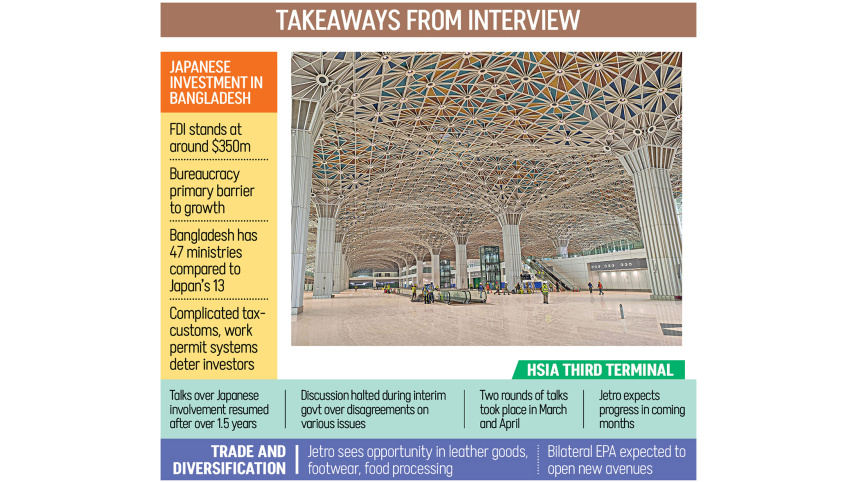
Despite decades of development ties, Japanese investment in Bangladesh has yet to match the scale seen in Vietnam or other peer economies. Official figures put direct Japanese investment in Bangladesh at around $350 million, compared to $79 billion in Vietnam.
The gap is less about a lack of interest and more about bureaucratic hurdles, policy inconsistencies and a shortage of mid-level managerial talent, according to Akiko Okumura, executive vice-president of the Japan External Trade Organization (Jetro).
 For all latest news, follow The Daily Star's Google News channel.
 Speaking to The Daily Star in an interview, she said the core challenge lies in Bangladesh’s business environment. “It needs improvement -- especially in tax systems, customs clearance and work permits.”
These issues, she explained, consistently feature in inquiries received by Jetro from both existing and prospective investors.
Her colleague Kazuiki Kataoka, country representative of Jetro’s Dhaka office, echoed the concern, adding that investors also face difficulties repatriating profits. “Many of these problems are related to bureaucracy.”
While logistics and energy shortages also persist, administrative inefficiencies and regulatory unpredictability weigh more heavily on investment decisions, the officials suggested.
They pointed to the complexity of Bangladesh’s administrative structure -- with 47 ministries compared to Japan’s 13 -- as a source of inefficiency.

“This creates a lot of red tape,” said Okumura. “Simplifying the government structure could significantly improve the business environment.”
Rather than chasing new investors, Jetro recommends that Bangladesh prioritise resolving the concerns of companies already operating in the country.
“If existing problems are solved, new investors will automatically become interested,” Kataoka said. “The first step is to focus on the existing Japanese companies.”
This approach, the Jetro official added, would strengthen Bangladesh’s reputation as a reliable investment destination.
Okumura also noted that official figures do not capture the full picture, as many multinational Japanese firms channel investments into Bangladesh through third countries such as Singapore or Switzerland.
Beyond policy, human capital poses a challenge, according to the Jetro officials.
“Bangladesh does not lack skilled workers,” Okumura said. “But there is a shortage of middle managers.”
This gap limits companies’ ability to scale, as mid-level managers play a critical role in bridging operational and strategic functions. Addressing it will require sustained investment in training and leadership development, she added.
She said Jetro sees a positive signal in Bangladesh’s current political trajectory. “With the new government in place and elections not due for another five years, there is an opportunity to ensure political and social stability. This allows companies to plan long-term strategies.”
Such stability, Okumura believes, could serve as a catalyst for increased foreign investment, provided it is accompanied by meaningful reforms. Among the most pressing expectations from the government is institutional reform.
The Jetro officials welcomed recent moves toward ministerial consolidation but emphasised the need for deeper reform.
Meanwhile, Okumura said talks over Japanese involvement in operating the third terminal at Hazrat Shahjalal International Airport have resumed after nearly one and a half years.
Jetro views the development as a positive signal for bilateral cooperation. Talks were halted during the interim government period due to disagreements on service charges, operational control and revenue-sharing issues.
Following the formation of the new government, two rounds of discussions have taken place — one in March and another in April.
“We are hopeful. The fact that negotiations have restarted indicates a willingness to move forward,” Okumura said, adding that she expects progress to emerge in the coming months.
On trade, Bangladesh’s exports to Japan remain heavily concentrated in ready-made garments (RMG), accounting for roughly 80 percent of shipments.
Ando Yuji, Jetro’s senior director for global strategy in Southwest Asia, sees scope to diversify, but said it will require a shift in industrial policy.
“Bangladesh has built its competitiveness on abundant and low-cost labour,” he said. “To diversify, it needs to gradually move towards more capital-intensive industries.”
At the same time, labour-intensive sectors such as leather goods, footwear, home appliances and food processing could offer immediate opportunities, leveraging the country’s existing strengths, he added.
The recently signed Economic Partnership Agreement (EPA) between Bangladesh and Japan is expected to open new avenues for trade and investment, the Jetro officials noted.
While they refrained from detailing specific benefits, they indicated that the agreement would support broader economic cooperation and help address some of the structural issues highlighted by investors.
Comments