


Soybean can cut import dependence, bridge protein gap
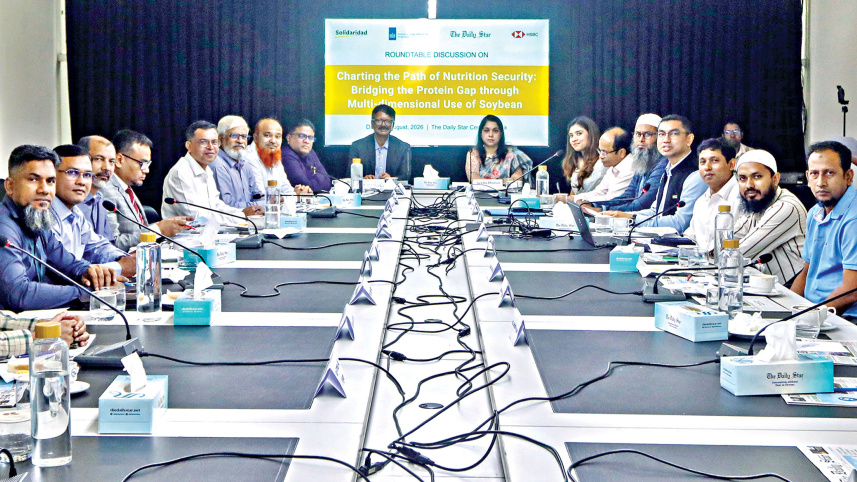
The country can reduce its heavy reliance on imported edible oil and animal feed by expanding soybean cultivation and strengthening the domestic value chain, speakers said at a roundtable yesterday.
The country imports 93 percent of its edible oil, spending around $2.5 billion annually, while 24-28 lakh tonnes of soybean and soybean meal are imported yearly for the feed industry.

Local production meets only 7-8 percent of national soybean demand, said Mohammad Moziball Hoque, head of supply chain and private sector engagement at Solidaridad Network Asia, presenting the keynote.
The event, “Charting the Path of Nutrition Security: Bridging the Protein Gap through Multidimensional Use of Soybean,” was jointly organised by Solidaridad Network Asia and The Daily Star, with support from the Netherlands’ Ministry of Foreign Affairs and HSBC Bangladesh. It was moderated by Tanjim Ferdous, head of strategic partnerships at The Daily Star.
“We used to spend more than Tk 20,000 to cultivate a plot because of labour and other farming costs. With the seeder machines, we have been able to reduce those costs significantly,” said Rizuanur Rahman, a soybean farmer from Noakhali
A REALISTIC TARGET, NOT SELF-SUFFICIENCY
Prof Jahedur Rahman, pro-vice chancellor of Gazipur Agricultural University, said soybean should be seen as both a food and feed source, given its more than 40 percent protein content.
“We need quality seeds, mechanisation and greater farmer awareness,” he said, calling for stronger public-private collaboration.
Prof Abdul Karim of International University of Business Agriculture and Technology said Bangladesh’s soybean requirement could reach 1 crore tonnes by 2030.
“A target of meeting at least 25 percent of our requirement from domestic production is realistic,” he said, pointing to the southern coastal belt and newly emerging land as key growth areas.
He said Bangladesh Agricultural Development Corporation (BADC) alone cannot meet seed demand and called for private entrepreneurs to commercially produce and supply quality seed, alongside buyback guarantee models linking academia, industry and farmers.
Osman Haruni, senior policy advisor at the Netherlands embassy, echoed the caution against chasing full self-sufficiency.
“Bangladesh does not have the comparative advantage that Brazil or the United States has. What we can do is identify the areas where soybean makes economic sense and invest there,” he said, adding that soybean should complement rather than replace rice by moving into fallow and marginal land.
He said the government should act as a facilitator by supporting seed, processing, storage and financing mechanisms.
BUILDING THE MARKET FIRST
Mohammed Harun Or Rashid, principal scientific officer at Bangladesh Agricultural Research Institute (BARI), said Bangladesh must build a stronger domestic market before scaling up production.
“About 90 percent of our soybean is produced in Lakshmipur, while only a handful of companies are the major buyers,” he said, adding that national yields, at 1.85 tonnes per hectare, still trail the global average of over 2.5 tonnes.
He noted the country already has salt-tolerant, short-duration varieties and cited soy milk as an underused avenue for boosting both production and consumption.
QUALITY AND POST-HARVEST CHALLENGES
Fasiul Alam, head of business at Nourish Feed, said locally developed varieties from Gazipur Agricultural University, Bangladesh Institute of Nuclear Agriculture (BINA) and BARI average around 38 percent protein, higher than the 32-34 percent found in imports.
 For all latest news, follow The Daily Star's Google News channel.
 But he flagged post-harvest risks: early rainfall this year left 4-15 percent of locally sourced seed with fungal infections.
“If we can bring the moisture content of harvested seed down to around 10 percent, the risk of fungal infection can be virtually eliminated,” he said, suggesting community-level dryers and stronger monitoring against variety mixing.
INDUSTRY DEMAND IS THERE
Enamul Karim of CP Bangladesh Co Ltd said soybean meal makes up 25-30 percent of feed ingredients industry-wide.
“We are ready to take the entire production if we can get the required quality,” he said, noting CP can offer advance payments and fixed prices to farmers.
The company recently sourced around 8,000 tonnes from Muladi in Barishal and is looking to expand to other districts.
FARMER EXPERIENCE AND FINANCING
Rizuanur Rahman, a soybean farmer from Noakhali, said mechanisation has cut costs sharply.
“We used to spend more than Tk 20,000 to cultivate a plot because of labour and other farming costs. With the seeder machines, we have been able to reduce those costs significantly,” he said, adding that training in biological pest control has also reduced chemical pesticide use.
Syeda Afzalun Nessa, head of corporate sustainability at HSBC Bangladesh, said the bank has backed climate-smart agriculture in vulnerable areas for five years as part of its CSR efforts.
“We are still at an early stage, but there is a lot of potential,” she said.
POLICY AND INFRASTRUCTURE GAPS
Obadur Rahman of the Department of Agricultural Extension (DAE) said Bangladesh needs to strengthen the soybean seed system and focus production in suitable coastal areas.
“BADC needs to take greater responsibility for soybean seed production, preservation and marketing. At present, its contribution to these areas is very limited, and this needs to change,” he said.
He said expanding soybean cultivation nationwide would be difficult because of competition for land with rice and other crops.
“Given our land scarcity and high cropping intensity, we cannot realistically cultivate soybean across the country. The coastal belt, particularly the climate-vulnerable areas, is the most suitable region for expanding soybean cultivation,” Rahman said.
Selim Reza Hasan, country manager of Solidaridad Network Asia, said scaling up requires a strong policy framework for stress-tolerant seeds, better access to finance, and stronger farmer-buyer linkages.
“The market is the driver of change for sustainability,” he said, calling for investment in the market system to build food security for both producers and consumers.
Reza Mohammad Emon, principal scientific officer of BINA; Md Forkan Ali Bhuiyan, CEO of Fozia Foods; and Md Omidul Hasan, managing director of Janata Engineering, also spoke at the event.
Comments