


Steel makers warn against further power price hike
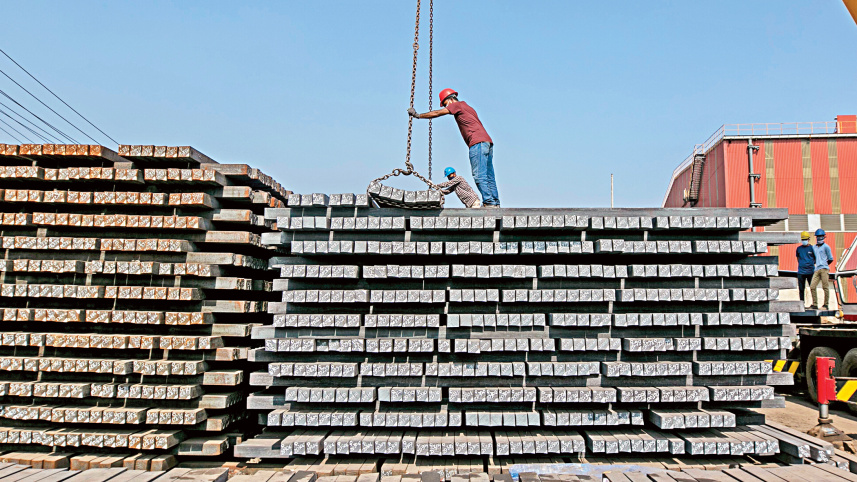
Bangladesh’s steel manufacturers yesterday urged the government not to raise electricity tariffs further, saying higher energy costs could deepen the sector’s crisis by triggering production cuts, financial losses and possible factory closures.
At a press briefing organised by the Bangladesh Steel Manufacturers Association (BSMA) at the Economic Reporters’ Forum in Dhaka, industry leaders said the sector was already under pressure from rising utility prices, weak demand, high borrowing costs and low utilisation of installed capacity.

“If electricity prices are increased again, production costs will rise sharply, and many factories may be forced to reduce output. Some could even face partial or complete shutdown,” said Mohammad Jahangir Alam, president of BSMA.
The association said industrial electricity tariffs have risen around 30 percent in recent years, while gas prices for some industries climbed nearly 300 percent, hurting the competitiveness of one of the country’s largest manufacturing sectors.
As part of the ongoing electricity tariff review, the Bangladesh Power Development Board submitted a proposal to the Bangladesh Energy Regulatory Commission seeking higher bulk electricity purchase rates.
BSMA said the proposed tariff hike comes at a time when steel makers are still dealing with the fallout from the Covid-19 pandemic, global supply chain disruptions, the Russia-Ukraine war, exchange rate volatility and geopolitical uncertainty in the Middle East.
The association also criticised demand charges, additional VAT and power factor penalties imposed on industrial consumers, saying those charges effectively act as indirect tariff increases.
According to BSMA, most large steel mills receive electricity through high-voltage connections ranging from 33kV to 230kV, where transmission and distribution losses remain low. Despite this, industries continue to bear additional charges.
It also questioned the power sector’s capacity payment system, claiming that more than Tk 50,000 crore is paid annually in capacity charges even as industries struggle with rising energy bills and inadequate gas supply.
BSMA urged the government to keep electricity prices unchanged for the steel sector, reduce demand charges and VAT, review power factor surcharges and introduce special tariff facilities for high-voltage industrial consumers.
Responding to reporters, BSMA President Jahangir Alam said many mills were operating at a loss amid sluggish construction demand, rising financing costs and increasing production expenses.
He said an additional Tk 2,000 in production costs per tonne would be difficult for the construction sector to absorb and could further slow real estate and infrastructure activities.
“Many factories were built with significantly higher production expectations, but now they are operating at only around 40 percent capacity,” he said.
BSMA Secretary General Suman Chowdhury said electricity accounts for nearly 30 percent of steel production costs, making the industry highly vulnerable to tariff hikes.
According to BSMA, annual steel demand in Bangladesh has fallen to around 40-50 lakh tonnes against the installed production capacity of nearly 1.2 crore tonnes.
Among others, Salam Group Chairman Md Rezaul Karim and BSMA Vice-President Sk Masadul Alam Masud, who is also managing director of Shahriar Steel Mills Ltd, addressed the briefing.
 For all latest news, follow The Daily Star's Google News channel.


Comments