


Storytelling, an art to inspire employees
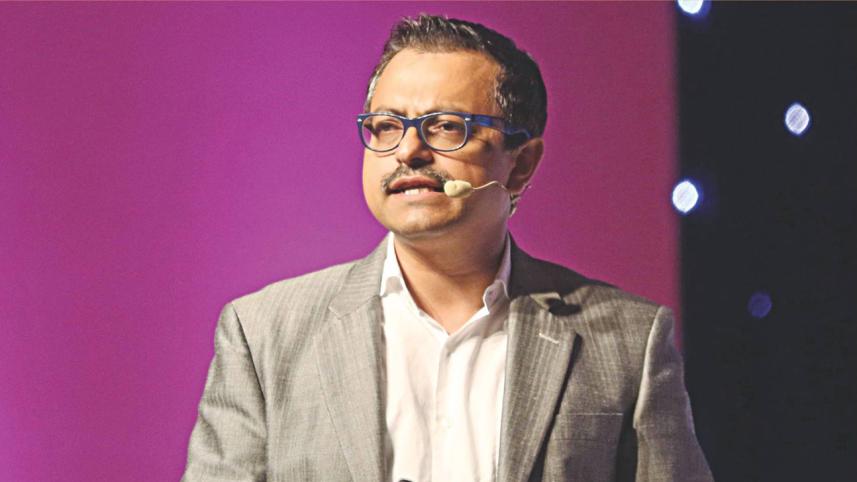
STORYTELLING is an essential leadership skill. It allows leaders to communicate, build engagement and drive changes in an organisation, said Indranil Chakraborty, founder of StoryWorks, a communications consulting firm based in India.
"We believe in increasing effective communication within an organisation through stories to inspire enduring changes," he said in a recent interview with The Daily Star.
 For all latest news, follow The Daily Star's Google News channel.
 The veteran corporate personality had also worked with Unilever as its global brand director, at Tata Teleservices as vice president for sales and marketing, and at Mahindra Holidays and Resorts India as chief marketing officer.
Chakraborty has recently come to Dhaka to attend the Communication Summit 2015 organised by Bangladesh Brand Forum as a distinguished speaker.
"The problem is, when we share facts, the facts are difficult to remember and recollect. When we use the story telling technique, we go back to the most fundamental way for us to connect," he said.
Humans are good at special understanding because they have not evolved as bullet-point readers, but as hunter-gatherers, said Chakraborty.
One can remember an event when it has an emotion attached to it, he said. "What a story does is that it links things powerfully because it touches the very core of a human being."
Chakraborty believes that a leader can facilitate storytelling as a mantra of engaging and inspiring a team. "People remember a leader's behaviour, rather than his speech at a town-hall meeting."
Embedding stories can add value to business, he said. At his last corporate assignment, his organisation brought a new vision called "making every moment magical" where "no room for ordinary" was one of the core values.
What he did was collect stories from employees with values that matched the core values. These stories were then made popular through the internal magazine, intranet and other internal small groups, thus, making the core value understandable by all.
Business storytelling is not about writing big stories; it is about taking small experiences and incidents and narrating them to make a point, he said. "It is not about writing fairytales, but about small anecdotes."
Chakraborty said anecdotes streamed with data can change the scenario in terms of decision making.
He gave an example where the ability to take a decision in a meeting dramatically increases if someone describes the sufferings of the families of employees who died in factory accidents for a lack of safety measures, rather than just analytical data in percentages.
Chakraborty suggested Bangladeshi companies turn business case studies to success stories.
Powerful stories on why something promised or planned by the management should not be believed are called anti-stories, he said.
To neutralise them, the first step is to acknowledge the anti-story and then put a more powerful story in its place.
Effective storytelling needs authenticity, according to Chakraborty. "We are 22 times more likely to remember a story than disconnected facts."
The interviewer is strategic project planner for business development at The Daily Star and can be reached at roy.tds@outlook.com.
Comments