


FSRU glitch cuts gas supply to national grid by 17%
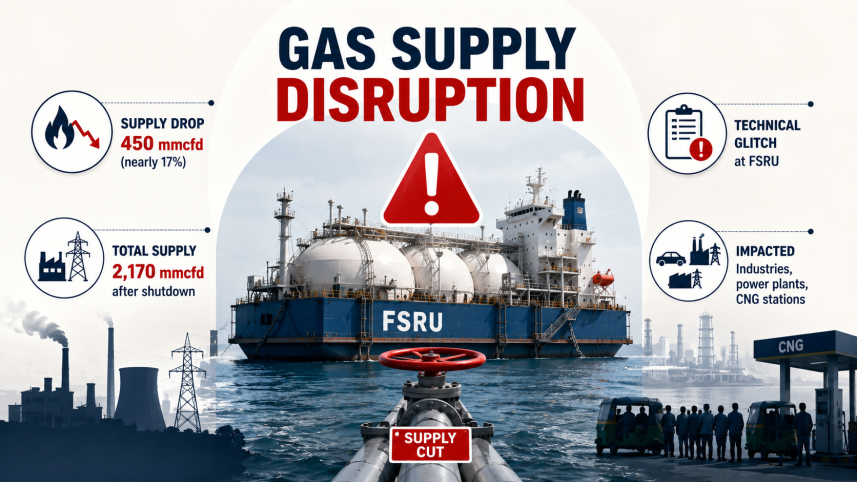
A technical glitch at one of the country's floating LNG terminals has cut gas supply to the national grid by around 450 million cubic feet per day (mmcfd), or nearly 17 percent, worsening an already acute supply crunch across the country.
According to Petrobangla data, total gas supply stood at around 2,620 mmcfd against a demand of nearly 3,800 mmcfd before the glitches were found on Tuesday.

Following the shutdown of the affected floating storage and regasification unit (FSRU), supply has dropped to 2,170 mmcfd.
The disruption has affected industries, power plants, and CNG (compressed natural gas) filling stations in different parts of the country.
In some areas, including Dhaka and its surrounding areas, lower gas pressure has prevented CNG stations from receiving adequate supplies, resulting in long queues and public suffering.
The government said the technical problem at the FSRU was being addressed by relevant agencies and technical experts.
It did not, however, specify when the terminal would resume normal supply.
At a briefing at the Secretariat today, Monir Hossain Chowdhury, a joint secretary of the Energy Division, said the immediate gas supply disruption was linked to the FSRU malfunction rather than the Middle East conflict.
He said there was no crisis in fuel supply and accused some people of spreading "fake news" in this regard.
He said the country currently has around 344,000 tonnes of diesel in stock, while another 180,000 tonnes are expected to arrive by July 31.
The stock, he said, would be enough to meet the country's demand for around 48 days.
Moreover, another 240,000 tonnes of diesel are scheduled to arrive in August, the joint secretary said.
Bangladesh's dependence on the Middle East for fuel imports is limited, with crude oil being the main area of dependence.
"We used to bring fuel through the Red Sea, but we have found alternative routes," he said, adding that there was no immediate risk of a fuel supply crisis.
 For all latest news, follow The Daily Star's Google News channel.
Comments