


Ten banks account for 72% of total bad loans

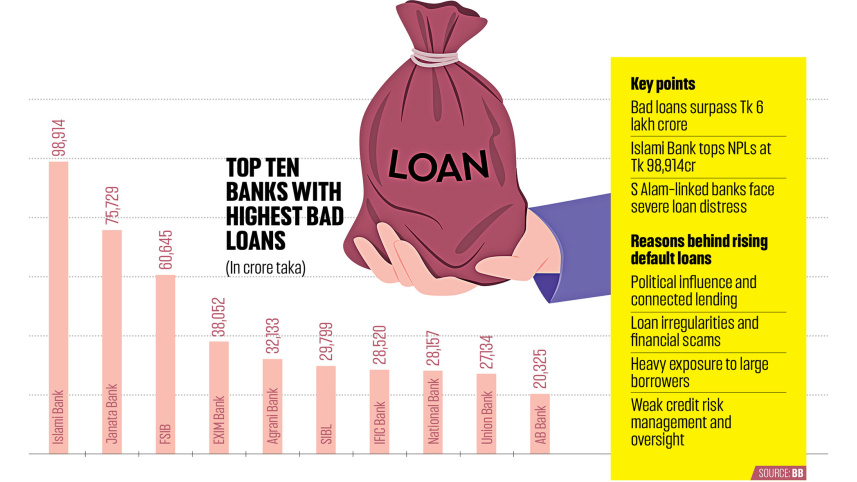
Ten banks accounted for more than 72 percent of the banking sector’s total non-performing loans, according to the central bank, showing that the country’s 61 commercial lenders are not equally responsible for the sector’s financial distress.
As of June this year, bad loans in the banking sector stood at a whopping Tk 6,06,555 crore, according to the latest data from the Bangladesh Bank (BB). Of this, the 10 distressed lenders held Tk 4,39,527 crore in NPLs.

The lenders are Islami Bank Bangladesh, Janata Bank, Agrani Bank, IFIC Bank, National Bank, AB Bank, First Security Islami Bank, EXIM Bank, Social Islami Bank and Union Bank.
In terms of volume, Islami Bank Bangladesh has the highest level of bad loans in the banking sector. Until June this year, its NPLs stood at around Tk 98,914 crore, or 52.15 percent of its disbursed loans.
The bank was taken over by S Alam Group in 2017. The controversial conglomerate later extended around 80 percent of the bank’s total loans to its own companies and associated firms, violating banking rules and regulations.
After the fall of the Awami League government in August 2024 in an uprising, the bank was freed from the group’s control and is now operating under the supervision of the BB.
At the end of December last year, Islami Bank’s bad loans stood at Tk 92,115 crore, or 49 percent of its disbursed loans. In the six months to June, its bad loans increased by Tk 6,799 crore, according to BB data.
Contacted, Md Altaf Hossain, acting managing director of Islami Bank, said that a large share of its defaulted loans is linked to the S Alam Group, with recovery remaining minimal.
He said that the bank is trying to recover loans from other borrowers, but progress has been limited.
“We are trying to recover the loans through cash payments and rescheduling. When we find no other way, we ultimately resort to filing cases against the customers,” Altaf told The Daily Star.
The acting managing director said the bank regularised Tk 5,885 crore this year through rescheduling, while it recovered Tk 749 crore from classified loans.
Scam-hit Janata Bank ranked second in terms of bad loan volume. Its NPLs stood at Tk 75,729 crore, or 75 percent of its disbursed loans.
Seeking anonymity, Janata Bank officials told The Daily Star that a major portion of the bank’s bad loans is concentrated among a small number of powerful business groups.
They said that about 80 percent of its bad loans are stuck with its top 20 defaulters, including Beximco, S Alam and AnonTex.
Beximco Group alone accounted for about Tk 25,000 crore of the bank’s exposure. Other major defaulters include Crescent Group and Thermex Group.
Agrani Bank, another state-run lender, also struggles with a heavy NPL burden. Its NPLs stood at Tk 32,133 crore, or 43.98 percent of its disbursed loans, show BB data.
At EXIM Bank, bad loans stood at Tk 38,052.53 crore, nearly 71 percent of its total disbursed loans, according to central bank data.
The bank was largely influenced by Nazrul Islam Mazumder, chairman of Nassa Group and former chairman of the Bangladesh Association of Banks (BAB). Lending irregularities and weak corporate governance have pushed the lender towards a merger with four other troubled banks.
Among lenders linked to the S Alam Group, First Security Islami Bank reported NPLs of Tk 60,645 crore, or 97 percent of its total disbursed loans.
Social Islami Bank’s bad loans stood at Tk 29,799 crore, or 78 percent of its disbursed loans, while Union Bank’s NPLs stood at Tk 27,134 crore, or 96 percent of its disbursed loans.
 For all latest news, follow The Daily Star's Google News channel.
 The boards of the two lenders were also largely dominated by the S Alam Group.
AB Bank’s NPLs stood at Tk 20,325 crore, or 56.04 percent, while National Bank reported Tk 28,276 crore, or 65.46 percent, according to BB data.
Bad loans at IFIC Bank stood at Tk 28,520 crore, or 63.38 percent of its disbursed loans. The bank was dominated by Salman F Rahman, vice-chairman of Beximco Group and an influential adviser to ousted prime minister Sheikh Hasina.
Md Ezazul Islam, director general of the Bangladesh Institute of Bank Management (BIBM), said the country’s NPL situation shows that the problem is concentrated in a handful of Islamic and state-owned banks.
“The main reason for the rise in NPLs is that loans have become concentrated among a small number of corporate borrowers. The banking sector needs to move away from this excessive loan concentration,” he told The Daily Star.
Ezazul, a former official of the central bank, said that around 10 percentage points of the banking sector’s NPL ratio, which has now reached 30 percent, can be attributed to economic factors, while the remaining 20 percentage points are the result of willful default, irregularities and corruption.
Comments