


Solar power shields farmers from energy crisis


Times are bad for Bangladesh's farmers. Right when they needed a steady diesel supply to irrigate vast swathes of cropland -- Boro paddies, seasonal vegetables, maize -- the world entered what the head of the International Energy Agency called “the biggest energy security threat in history.”
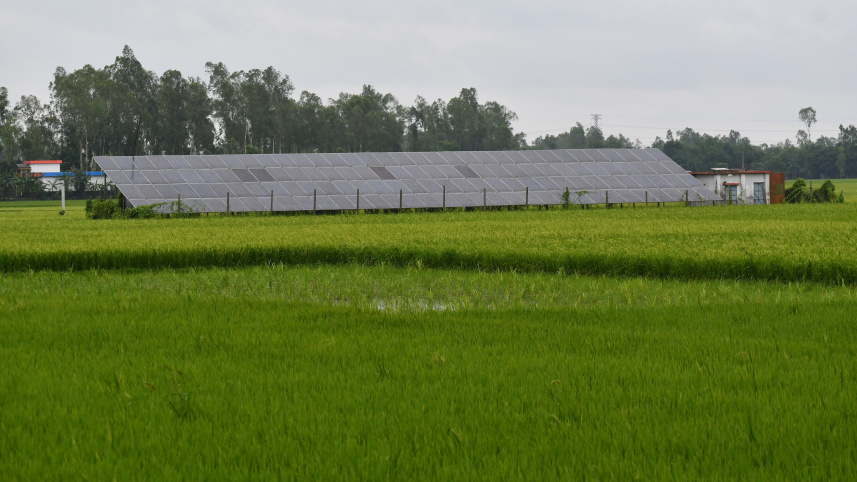
The fuel is in short supply. The government has just hiked its price by 15 percent. Many farmers are now fearing losses of both crops and investment. But not Afzal Hossain from Fulpukuria village in Gobindaganj of Gaibandha, who cultivated Boro paddy on six bighas this season and gets his water from a solar-powered pump.

“I am not really worried about irrigation,” he said.
“My neighbours who rely on diesel or electric pumps are suffering due to the fuel crisis and load-shedding.”
Bangladesh requires over 40 lakh tonnes of diesel a year, with a large chunk of it going towards the running of more than 12 lakh irrigation pumps, according to data from the Asian Development Bank (ADB) and government agencies. Besides, there are more than 430,000 electric pumps that provide minor irrigation.
According to the Department of Agricultural Extension (DAE), the country currently has 754 diesel-powered deep tube wells, 1,039,337 shallow tube wells, and 184,384 low-lift pumps in operation.
While this reliance could be a devastating blow for many farmers, those using solar-powered pumps are enjoying immunity from the whole crisis.
In Rangpur Division, across five districts, 509,095 hectares of Boro paddy have been planted this year. Around 35 percent to 40 percent of cultivable land in the region depends entirely on diesel-powered shallow machines. The recent price hike has pushed service providers to raise charges for irrigation, harvesting, and maize threshing.
According to Hussain Mohammad Altaf, executive engineer at Rangpur office of the Bangladesh Agricultural Development Corporation (BADC), 596 solar-powered irrigation machines were active during the last irrigation season in the division.
“If each generates an average of 10 kilowatts, total output comes to 5.9 megawatts, enough to run 80,000 to 85,000 fans daily,” he said. Over a four-month irrigation season, those machines save approximately 75 lakh litres of diesel.
In Lalmonirhat, Atiar Rahman manages a solar-powered deep tube-well run by the BADC at Doani village of Hatibandha upazila, supplying water to around 15 bighas of maize and vegetable land.
“Even if diesel is unavailable or its price rises, farmers no longer have to worry,” he said, “because this irrigation machine runs on solar power.”
He added that the panels sit idle for eight months after the irrigation season ends, and that connecting surplus electricity to the national grid through net metering could benefit farmers, institutions, and the government alike.
Further into the char lands of Kurigram, farmer Meher Jamal of Char Paschim Bajra at Ulipur upazila said vast areas surrounded by the Teesta River once sat uncultivated because irrigation was out, but it meant increased costs and labour.
“For the last few years, many char lands are now being cultivated regularly because of irrigation facilities through solar power,” he said. “Land that once remained unused is now producing crops.”
Sudhan Chandra Sen, a farmer from Madhupur village at Kaunia upazila of Rangpur, said the difference is simple.
“There is no worry about fuel. Electricity comes from solar power, and we get water. Crops are better, and costs are lower.”
He noted that while electricity is less reliable, as it often comes and goes, delaying irrigation, solar power is sustainable and consistent.
“Water is always available.”
 For all latest news, follow The Daily Star's Google News channel.
 In Bogura, Abdul Hamid from Kachua village at Shibganj upazila cultivated Boro on five and a half bighas. He said solar-powered pumps have reduced both his costs and stress.
“I planted Boro paddy after harvesting potatoes. So far, I haven’t had to worry about irrigation or the cost. I can pay the irrigation fees after harvesting the crop.”
Abu Hasan, another farmer from the same village, said crops under solar pumps yield better because the water supply is uninterrupted.
“I face no water shortages. I have to pay Tk 1,500 per bigha for irrigation after the harvest.”
Beyond individual farms and government initiatives, private operators have built businesses around solar irrigation. Abu Jafar Sujan, regional manager of Salek Solar Power Limited, said his company runs 122 solar pumps across Bogura, Gaibandha, Meherpur, and Panchagarh districts.
“Each pump has a lifting capacity of 5 to 20 horsepower. Smaller pumps cover 30 to 40 bighas, while the larger ones irrigate up to 120 bighas of Boro land, he added.
Abu Bakkar Siddique, who looks after a 20-horsepower irrigation pump owned by Salek Solar in Kachua, said 100 bighas of Boro land were irrigated under this pump this year.
Nationally, the state-run renewable project financer Infrastructure Development Company Limited (Idcol) has funded the installation of approximately 1,523 solar pumps through six companies, covering around 15,000 hectares.
“There are 152 such pumps in Bogura, Sirajganj, Gaibandha, and Naogaon. However, some remain inactive due to various complexities and a lack of technical spare parts,” an official of the organisation said on condition of anonymity.
“We plan to install 10,000 solar pumps across the country by 2030.”
The ADB, in a December 2023 report on scaling up solar irrigation pumps in Bangladesh, said irrigation costs in Bangladesh account for 43 percent of total agricultural costs.
It estimated that replacing diesel pumps with solar could displace consumption of 10 lakh tonnes of diesel annually, avoiding 30 lakh tonnes of carbon dioxide equivalent each year.
But installation has slowed sharply. After peaking at 12.88 MWp in 2019, new installations had fallen to just 4.65 kWp by 2025, according to the state-owned Sustainable and Renewable Energy Development Authority (Sreda), responsible for increasing renewable energy production.
Rangpur BADC’s Altaf confirmed that no new solar irrigation projects have been launched in Rangpur division since 2022, and some existing pumps remain inactive due to technical problems and missing spare parts.
Mizanur Rahman, chief engineer (operation) of Northern Electricity Supply Company PLC (Nesco) in Rangpur, believes that if diesel-dependent irrigation can be quickly transformed into solar-powered irrigation, it would save foreign currency and reduce carbon emissions.
For climate-vulnerable Bangladesh, this could be an effective path toward sustainable agriculture, he added.
“Most solar-powered irrigation machines are located in areas under the Rural Electrification Board. Therefore, implementation would be possible if the relevant authorities take initiatives to introduce net metering at those installations.”
Rights activists noted that solar projects are highly important for increasing agricultural production, ensuring food security, and modernising agriculture.
“Government and private initiatives should further expand solar-powered irrigation projects to improve the fortunes of marginal farmers,” said Shafiqul Islam, president of the Lalmonirhat district unit of Nodi Bachao Teesta Bachao Sangram Parishad.
Comments