


Tufan Chakma on his Erasmus Mundus Joint Master’s in Animation journey
Tufan Chakma, an Indigenous visual artist from the Chittagong Hill Tracts (CHT), Bangladesh, recently completed the fully funded Erasmus Mundus Joint Master’s Degree (EMJMD) in Animation, Re:Anima. A Bachelor of Fine Arts (BFA) graduate from Jahangirnagar University (JU) and founder of the widely followed Facebook page “Tufan’s Artbin”, Tufan works with painting, illustration, and animation, using visual storytelling to highlight the identity, history, culture, and social realities of indigenous communities in the CHT.
Campus sat down with Tufan to get a closer look at his journey.

Campus (C): How did you discover Re:Anima and determine that it was the right programme for you?
Tufan Chakma (T): After completing my BFA from JU in 2023, which took seven years instead of four, I was hesitant to spend another three to four years on a master’s degree there, but I also didn’t want to quit studying. Ultimately, I decided to enrol at JU, so I wouldn’t lose a year while looking for an alternative—which had to be a fully funded scholarship, since neither my family nor I could afford the expenses of studying abroad or at a private university.
The first thing that came to my mind was the Erasmus Mundus scholarship, which I’d first learnt about in the fourth year of my bachelor’s. I had very little knowledge of its requirements, so I started by watching YouTube videos and reviewing the official catalogue. I was very sad to find no painting-related programme, as I wanted to continue my master’s in painting.
One day, I found the programme called Re:Anima. But I wasn’t taught animation academically or professionally. However, as a visual artist, I had been practising animation irregularly since 2019 to tell my stories and reach a wider audience. My only experience with animation was watching Studio Ghibli movies and making some animated videos following YouTube tutorials.
Nevertheless, the course was the only programme that interested me. When I realised animation could bring to life the stories in my head and portray the unseen and unheard history, trauma, loss, and existential crisis of indigenous peoples, I was convinced to apply.
I dug deeper into the requirements, without worrying whether the scholarship committee would select me or not due to my limited animation knowledge. I just felt a connection with animation and started preparing, including the IELTS exam and writing my statement of purpose (SOP).
C: Re:Anima looks for applicants with advanced animation skills, but you had only some self-taught experience in animation. How did you address that in your application?
T: My self-taught animations were created to represent the CHT and address its under-representation and misrepresentation in mainstream media, not for academic purposes. However, Re:Anima required the submission of a four-minute animation showreel to prove sufficient general knowledge. Since I didn’t have one, I decided to use my illustrations and paintings, combined with a few animation clips – as illustration connects to animation through storytelling, character design, and concept art. I hesitated over whether it would be accepted but kept shaping it regardless.
Around then, I learnt from seniors at JU about Mreethmandir Gunjan Kumar Roy, who was studying Re:Anima in the 2023–2025 session. Once I connected with him on social media, his feedback helped improve the showreel and gave me confidence to apply with what I had.
What I realised is that they don’t just look for advanced animation skills—they look for people with passion for animation, experience in a related field, and the ability to bring change, diversity, and new ideas.
C: For your portfolio, how did you decide what to include?
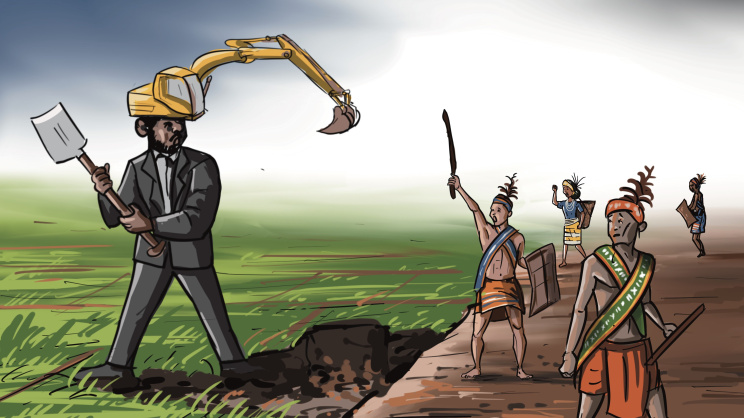
T: I included work that showed what I actually do, why I do it, and what I wanted to do in the future if selected, which, I now realise, mattered most, even though it was unconscious at the time.
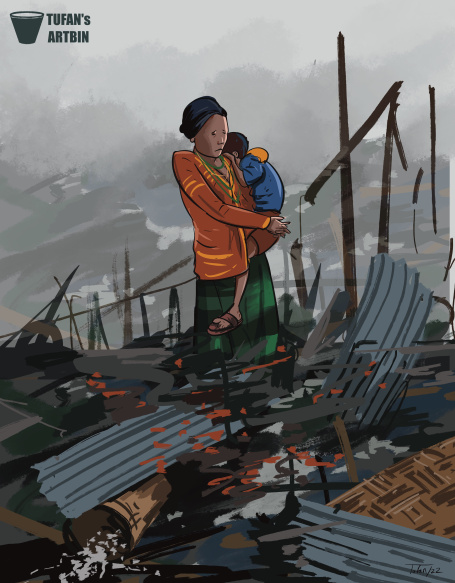
I was clear about what I wanted to achieve through this programme. As someone from an indigenous community in the CHT, all my work is based on the rights, struggles, and existential crises we face as under-represented peoples in Bangladesh. Even before knowing about Re:Anima, I had been telling stories from the CHT through my art and wanted to carry those stories into a bigger canvas like an animation film, since the CHT has no notable animation filmmakers to represent stories kept in the dark for so long. So, I chose the pieces that best represented those stories, along with my achievements as an artist.
C: Limited to just 1,000 characters for the motivation letter, how did you present yourself to the selection committee?
 For all latest news, follow The Daily Star's Google News channel.
 T: For Re:Anima, we had to submit a letter of motivation, expectations concerning knowledge to acquire, and a project proposal, each limited to 1000 characters.
I tried to represent the true me—how I started my artistic journey, what motivated me to create art and animation, what I wanted to learn through the programme and why, and the project proposal for my final short film. I believe this is what led the committee to see me as a passionate storyteller—pursuing the degree to represent the CHT creatively.
Firstly, I wrote everything I wanted to include, then shortened it as much as I could. Then, I asked my senior from JU, Dinalo Chakma, to review my writing and give feedback, which helped me shape my words. This is something every candidate should do: never hesitate to reach out to someone experienced who can provide proper guidelines.
C: What project idea did you propose, and how much did it change during the master’s programme?
T: It was tough to decide what to include in this section without proper knowledge of animation filmmaking at the time, but I was motivated to make something no one had made yet—something sustainable about the indigenous peoples of CHT that could be used as a visual example in the future.
There are many untold stories of the CHT that need to be heard and seen. The Kaptai Dam tragedy is one of them, especially in terms of visual documentation; we have no archive with enough visual data on this historical tragedy.
But once the programme started, the story of my final project kept transforming, which is common in filmmaking. So, the film I eventually made is not just about the Kaptai Dam tragedy, but more than that—to discover the full film, audiences will have to wait at least a year. I’m excited to show it to the world and feel very fortunate for this opportunity.
C: How did you decide whom to approach for recommendation letters?
T: Before applying, I had very little knowledge about this and was confused about who and how to ask. My requirement was two or three letters, so I collected three. I wanted people who knew me well, either through teaching or working with me. Since it was an academic application, at least one recommender had to be from JU. I asked two respected teachers from the Fine Art Department, who were supportive and wrote the best letters—which is one of the key documents for any fully funded scholarship. I got another from an organisation I had worked with, which I believe also played a great role.
I spoke to each of them personally, shared my desire to pursue the scholarship, and once they agreed, shared the programme website so they could connect it to my personality, education, and experience.
C: What advice would you give to students with unconventional dreams who are unsure about their career path?
T: Firstly, don’t doubt yourself. Don’t question whether you’re capable of applying for a scholarship. If you want an unforgettable journey full of learning, sharing, and growing, believe in yourself and start working on it. Don’t wait to feel ready; start your journey today.
Secondly, try to be honest, true, and the most authentic version of yourself—someone interested in learning, sharing ideas, bringing diversity, and being creatively different from others. The more genuine you are, the stronger a candidate you become.
Thirdly, the Erasmus Mundus scholarship journey is a chance to transform yourself academically, personally, and professionally and a lifetime opportunity to study at top universities across Europe, explore multicultural societies, and build international connections.
Finally, reserve at least two to three months before applying to prepare for the IELTS exam, research the programme thoroughly, and get to know the universities it’s affiliated with. Your SOP and recommendation letters should reflect that you know the programme, the connection between your previous studies and this one, how your work experience ties in, and how you intend to contribute—not just study it. The committee needs to see that you’re not simply someone who wants a scholarship but someone worth investing in.
Although there’s no universal scoring method across Erasmus Mundus Master’s programmes, remember—it’s not all about your CV, CGPA, motivation letter, or IELTS score—it’s about presenting who you are; what you do and why; the reason why you’re applying for that particular programme; what you’ve already accomplished; and what you intend to do afterwards. Try to submit the best and most unique version of yourself in every way possible.
Education / A Bangladeshi photojournalist's Chevening journey
Interviews / Dr Arifin Sandhi on building Bangladesh's environmental future
Interviews / IDP's Razib Mahbubul on making smarter study-abroad decisions

Interviews / From Diana Award to Forbes 30 Under 30: Nafira's social impact journey
Interviews / How Team Six Seven made Bangladesh proud in Hong Kong
Interviews / Dr Hamidul Huq on sustainable development and eight years of ICSD

Interviews / Words of wisdom for aspiring boxers
IUB valedictorian Sajid on self-belief and success
How Bangladeshi universities can adapt to a changing world
