


Abul Mansur Ahmad's ideals still relevant
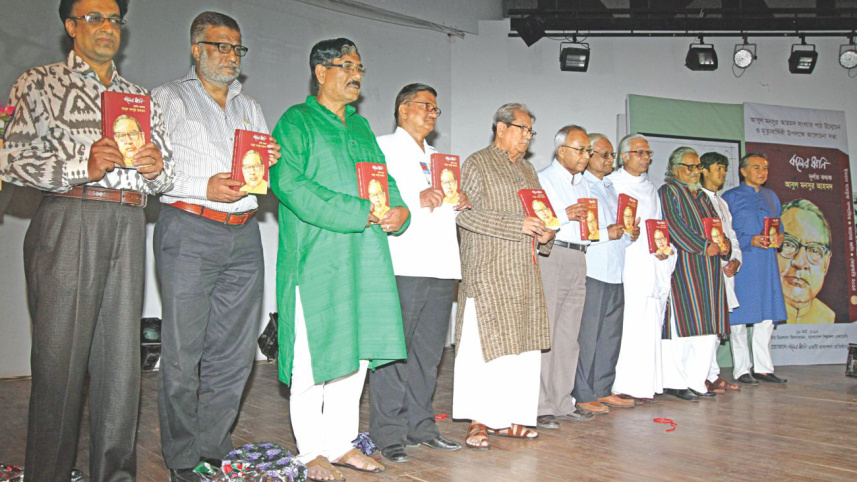
It is pertinent even today to follow the ideals of noted satirist and politician Abul Mansur Ahmad for people's social and economic emancipation, eminent intellectuals told a discussion yesterday.
He is still relevant politically and socially, said Golam Kuddus, president of Sammilito Sangskritik Jote.
 For all latest news, follow The Daily Star's Google News channel.
 The political consciousness of Abul Mansur Ahmad was for a language-based nation state, and it evolved around literature, politics and economy of then East Pakistan, which is now Bangladesh, said poet Asad Chowdhury.
"His ideals and thoughts can still pave the way for people's emancipation," he said.
Kaler Dhoni, a literary magazine and publishing house, organised the discussion at Bangladesh Shilpakala Academy, marking the 36th death anniversary of Abul Mansur Ahmad, a renowned litterateur, journalist and politician of the sub-continent.
A special issue of Kaler Dhoni titled "Durlov Kathak", a collection of 73 articles featuring Abul Mansur Ahmad and published in this year's Amar Ekushey book fair, was unveiled at the programme.
Abul Mansur Ahmad wrote constantly and used his works, particularly the satires, against religious orthodoxy, prejudices and communalism, said Prof Abul Kashem Fazlul Haque of Dhaka University. "He had an incomparable intellectual honesty."
Abul Mansur Ahmad had two distinct literary traits -- vigorousness and political-mindedness -- like poet Kazi Nazrul Islam and novelist Mir Mosharraf Hossain, said Professor Emeritus Serajul Islam Choudhury.
He was against imperialism for emancipation of the peasantry, he said, and like Nazrul and Jibanananda Das he did not believe in imitating imperialism as a way of modernism, as it is today.
Professor Emeritus Anisuzzaman, who presided over the discussion, said, "He had a sense of a unique identity for Muslim Bangalees but was never a sectarian."
Abul Mansur Ahmad's satires Aina and Food Conference, and autobiographical writings Amar Dekha Rajnitir Panchash Bachar (50 years of politics as I saw it) and Atma Katha (about myself) were epoch-making works, he added.
Columnist Prof Salimullah Khan said Abul Mansur Ahmad had not been properly recognised as a litterateur.
Emran Mahfuz, editor of Kaler Dhoni, said he had to struggle for around two years to get together the 73 articles by eminent scholars to publish the compilation on the works and life of Abul Mansur Ahmad.
Mahfuz Anam, the youngest son of Abul Mansur Ahmad and editor and publisher of The Daily Star, on behalf of the family, thanked the speakers, and Kaler Dhoni for publishing Durlov Kathak.
Later, a drama, "Gulliverer Safar", based on Abul Mansur Ahmad's story "Gulliverer Safarnama", was staged by Vision Theatre.
One of the greatest satirists of Bangla literature, Abul Mansur Ahmad was a renowned politician, lawyer and a very powerful journalist. He worked for Krishak, Nabajug and was editor of the daily Ittehad published from Kolkata in 1946 in undivided Bengal. He was a pioneer in modern and progressive journalism.
A very successful politician, Abul Mansur Ahmad was the provincial education minister in the United Front Cabinet under Sher-e-Bangla AK Fazlul Huq and the central commerce and industries minister of the Awami League government of Prime Minister Hossain Shaheed Suhrawardy in 1957. He was known for his strong stand for regional autonomy of East Pakistan.
Abul Mansur Ahmad always propagated secularism in a manner unparalleled in the forties, fifties and sixties.
He was the author of the famous Ekush Dafa (21 points programme) election manifesto of Jukta Front (a grand coalition of the three giants of our politics, Sher-e-Bangla AK Fazlul Huq, Moulana Bhashani and Hossain Shaheed Suhrawardy) in the 1954 election. For his political activities, he suffered jail terms on several occasions during Gen Ayub Khan's martial law in the late fifties and early sixties.
Comments