


The economy of premium education and parental anxiety

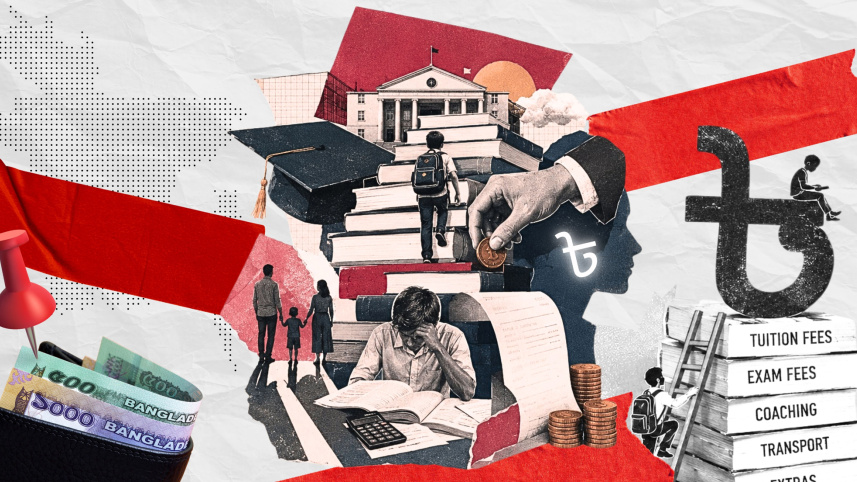
A recent post by a colleague who had to pay Tk 2.5 lakh as an admission fee for his child at a reputed English medium school made me reflect on an anomaly that we have gotten used to. The financial strain faced by parents of English medium schools is nothing new. It became critical during the Covid pandemic when we had several pleas and protests lodged by parents. There has been a High Court ruling to stop the malpractices and exuberant charges. Then again, just like everything else, we have transitioned to a new normal with the issue of tuition fees shelved out of sight.
My colleague thought aloud to rationalise the annual amount that was charged in addition to the monthly tuition fees. It does not include books, uniform, lunch, stationeries and accessories, or transport. Tk 2.5 lakh was charged to facilitate the sacred ritual of entering school. As a young parent who will have to worry about sending two more kids to school, he pondered: what exactly happens at admission? Does the school provide the child with a start-up grant? A small equity portfolio? A tea garden in Sreemangal? Is the child being quietly converted into an offshore educational asset?

To be fair, quality schooling costs money. Qualified teachers need to be continuously trained and upscaled. They deserve decent pay. Then the learning ecosystem—involving laboratories, libraries, security, playgrounds, co-curricular activities, technology, and landscaping—requires heavy investment. The government is happy to milk the schools for taxes, not thinking how they impact the guardians. Good schools are good sources of revenue. And parents will sweat blood to make sure their children get the best possible education. Who in their right mind and affordability would send their children to “free” or “cheap” schools when cheap means careless and no quality? But there has to be a line between “quality education” and “premium gated housing project with homework.” My colleague is cross because that line is continuously being crossed.
The monthly fee in many elite schools is set in the range of Tk 20,000-30,000, which means parents pay around Tk 3 lakh or more a year before the yoke of re-admission clamps down. The irony becomes sharper when we compare these charges with higher education. Getting a child into certain schools may cost several times more than entering some of the country’s premier private universities. Apparently, learning the alphabet has become more exclusive than graduating with an undergraduate degree.
The situation doesn’t end there. Once school kids reach their academic finishing line, the ferryman demands more coins. The international examination economy starts. For instance, a student sitting for seven O Level subjects may easily face exam registration costs in the range of Tk 1.7-2.2 lakh before coaching, school mock exams, guidebooks, transport, and the cost of parental blood pressure medication. If the child takes A Level later, the meter restarts. If a subject is repeated, the meter shows no mercy. Of course, it is the franchise that administers the exams. Where does the money come from? The household budgets, postponed vacations, broken fixed deposits, and compromised comfort of parents all contributed to this situation. They come from parents who quietly stopped buying things for themselves because “the child’s future” is non-negotiable.
That phrase, “the child’s future,” thus becomes a commodity. “Premium” education has mastered the commodification of parental concerns. It sells not only curriculum but also class mobility, social capital, accent, global aspiration, and imagined flight to the first world. And there are too many aspirant clients. “If you don’t like it, take your kids to some other [cheap] schools” is a haughty catchphrase of hobnobbing school principals. Guardians fear the reproach. They fear that if they resist, their children will be ostracised in school. Parents complain in the underground domain of chat groups or rant on social media. Then they make sure to pay before the deadline to avoid late fees. They know the game is unfair, but they are also aware that their children are participating in the game.
The General Educational Development (GED), in theory, could have offered a cheaper alternative for some students as a terminal secondary credential. It is flexible, shorter, and accepted by many foreign universities. But in 2018, the University Grants Commission ((UGC) decided that a short GED route could not be treated as equivalent to the two-year HSC or A Level course. Yet, my experience tells me GED students sometimes outperform full-course students. As a result, parents who might have considered GED are pushed back towards the two-year courses; they become less of an academic choice and more of a structural compulsion. This is how the opportunity cost multiplies.
Concerned citizens have tried the High Court route to discipline the fee culture. The High Court even imposed a ban on re-admission fees when students advance within the same institution. The engine that runs these schools has protective shields against criticism and court orders alike.
Demonising elite academic institutions or English medium schools is not the objective of my reflection. Some of these schools have brought laurels for the country in all sectors. Many schools work sincerely. The British Council and other international boards provide standardised assessment, global recognition, and administrative reliability.
But the grievance highlights another reality: why is our national education ecosystem so dependent on expensive private schooling and foreign examination pipelines that middle-class parents must mortgage their peace of mind for their children’s academic progression? Education should cost, but it should not extort. A school is not a luxury condominium. A child is not a captive consumer. And a parent’s anxiety should not be the most profitable commodity in town.
Dr Shamsad Mortuza is vice-chancellor at the University of Liberal Arts Bangladesh (ULAB).
Views expressed in this article are the author's own.
Follow The Daily Star Opinion on Facebook for the latest opinions, commentaries, and analyses by experts and professionals. To contribute your article or letter to The Daily Star Opinion, see our guidelines for submission.
 For all latest news, follow The Daily Star's Google News channel.
Comments